Column by Marina Lopes WASHINGTON POST August 14th 2025
My friend Melissa has the voice of a principal you don’t want to cross: calm, steady and, sometimes, dripping with disapproval.
One Wednesday night, I watched her use it on my son.
“Ollie. Down.” He was scaling her mid-century modern table mid-game of tag, seconds from toppling a plant onto her Persian rug. In our house, that behavior might have earned a warning or maybe a plea to take the game to his room. But at Melissa’s, it crossed a line, and he knew it.
Ollie inched his body down, each limb surrendering individually. Head hung, he braced for his scolding.
“The table is not for climbing,” she said firmly. “If you do it again, I’ll send you home.”
Melissa and I parent differently. At her house, there are no gentle reminders. Rules are clear. Expectations are high. Compliments are rare. She’s more likely to say “Do better” than “Great job.” At karaoke, she has no problem telling her 7-year-old son he’s off pitch and should try harder or sit down. I’ve even seen her return his drawings when she thinks he didn’t put in his best effort. Her style would raise eyebrows among many parents. Still, several times a week, I send my children over to eat, to play and, occasionally, to get yelled at.🌎
After years abroad, my husband and I were wary of raising our kids in the isolated bubble of an American nuclear family. In many of the countries where I worked as a foreign correspondent, there was always an auntie, a grandma or a neighbor hugging, guiding and yelling at kids who stepped out of line. In Singapore, grandparents are the primary caregivers for half of children by the time they’re 18 months old. In contrast, just 4 percent of children in the United States are primarily cared for by their grandparents. In Mozambique, child care is often collective, with one adult watching over a street full of kids while others work. But back in the States, my husband and I, like 82 percent of Americans, lived alone, far from family, surrounded by neighbors we barely knew beyond a polite hallway nod.
Inspired by the collective care I saw overseas, we decided to build a village of our own. So we moved in next door to our best friends: Melissa, Jeremy and their son, Jay. We shared school drop-offs, meals and playdates, but not parenting philosophies. At first, the differences jarred me. I would rush to comfort them after a scolding, or cut a playdate early and take them home. But to my surprise, my kids quickly learned to adapt. They learned that different adults have different expectations, and we learned to trust other grown-ups to show up for our kids, even when they didn’t follow our script.
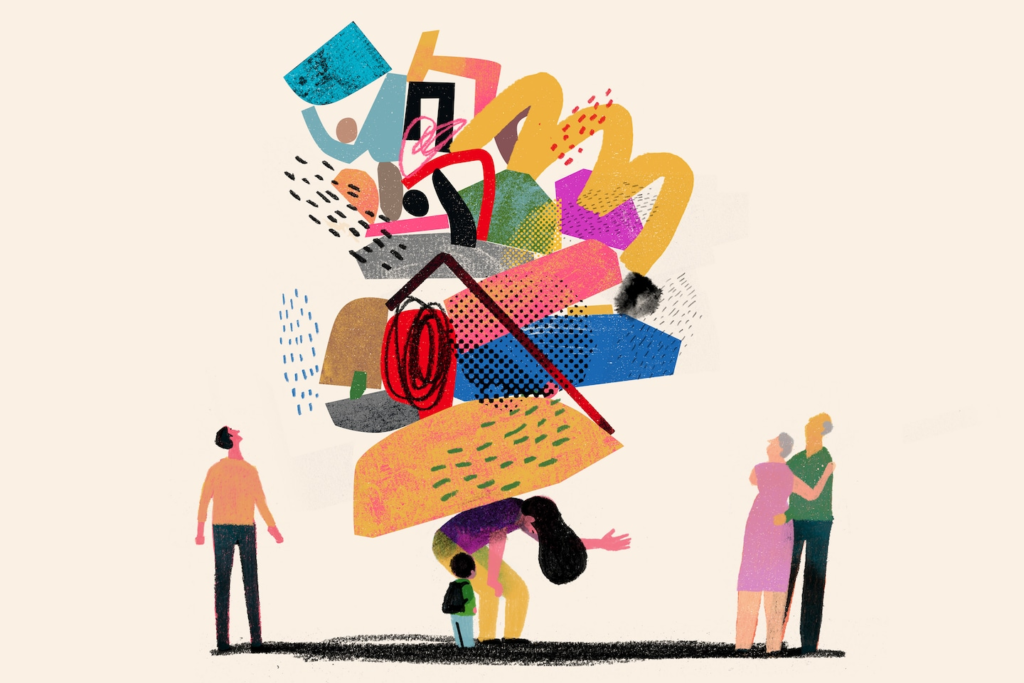
Parents say they want a village, but too often, we only want villagers who parent exactly like we do. When caregivers don’t align with our philosophies, we sometimes opt out, at a cost.
Maternal anxiety and parental loneliness have surged to record highs. A survey by Ohio State University’s Wexner Medical Center found that 66 percent of parents feel isolated and 62 percent experience burnout.
I’ve lived the alternative. When I was writing my book, “Please Yell at My Kids,” I spent years studying how families around the world raise children in community. In places including Brazil, Singapore and Mozambique, I saw how neighbors, aunties and grandparents routinely love, care for and, yes, scold kids. In these cultures, the village is alive — not because everyone agrees on every parenting decision but because they trust each other to show up, even imperfectly.
That trust is eroding in the U.S., where parenting can feel like a tightrope walk.
Modern caregivers are swimming in expert-fed, algorithm-driven advice: gentle parenting, conscious parenting, positive parenting, attachment parenting — each with their own jargon and ever-expanding list of rules.
Many of the principles, like naming emotions, praising effort over outcome and modeling regulation instead of punishing, stem from solid developmental research. But as the guidelines become more rigid and complex, the unintended consequence is often less help for parents who desperately need it.
“There are impossible rules,” said Kimberly Bepler, a “grandmother doula” in Oregon who trains grandparents to support new parents. “You can’t yell. You can’t say no. You can’t discipline harshly.”
Bepler says today’s parents are deeply committed to getting it “right.” But many don’t realize how many other adults it takes to raise a child without burning out. Increasingly, grandparents, teachers, even coaches are stepping back, not out of apathy but fear of saying the wrong thing, crossing a line or being shamed for parenting “incorrectly.”
Sandy Wolfe got a crash course in millennial parenting at a playground when she warned her granddaughter to “be careful.” Her daughter quickly corrected her: “We don’t say that anymore. We ask, ‘What’s your plan here?’”
In a video that’s now been viewed more than 11 million times, Wolfe’s daughter walked her through the new parenting lexicon. “Good job” is now “good choice.” “Stop hitting your sister” is replaced with “gentle hands.” Even “I’m so proud of you” is now “You should be so proud of yourself.”
The internet had opinions. Some applauded the gentle parenting framework. Others rolled their eyes and sided with the bewildered grandmother. But beneath the laughs is a deeper tension: What happens to the village when the parenting rule book gets too thick to follow?
Rebecca Parlakian, senior director of programs at the early childhood development organization Zero to Three, says the goal isn’t to be perfect; it’s to offer kids safe, loving, responsive care. “They can adapt to different caregiving styles, as long as those three things are there,” she said.
There’s no question that today’s parenting ideals reflect progress, including more emotional attunement, greater mental health awareness and a commitment to kinder discipline. But if we want the village back, we have to loosen our grip. That may mean more screen time, sugar or a different kind of discipline than our kids are used to at home.
But the beauty of a village isn’t sameness. It’s the wild, messy, deeply varied ways we show up for each other again and again.
Parenting doesn’t need more rules. It just needs more hands.
https://www.washingtonpost.com/parenting/2025/07/22/no-one-wants-a-village/