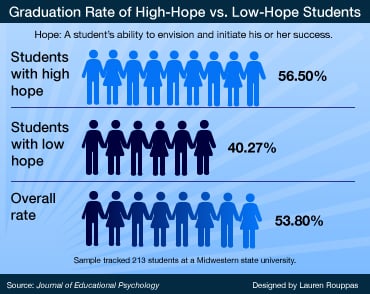
- Research indicating that hope is a leading indicator for students catching up on lost learning primarily stems from the Science of Hope framework, extensively developed by the late Dr. Shane Lopez and supported by Gallup data and longitudinal studies from institutions like Arizona State University. This research posits that hope—defined not as a “wish,” but as a cognitive-motivational set combining goal-directed agency (the willpower) and pathways (the waypower/planning)—is a measurable, actionable, and teachable skill that predicts academic success better than many traditional indicators.
- Here are the key findings and sources of this research:
- 1. Hope as a Predictor of Academic Recovery Research shows that high-hope students are better able to overcome trauma, stress, and, consequently, academic setbacks associated with the pandemic.
- Leading Indicator of Success: Studies have found that hope acts as a leading indicator of student achievement rather than merely a trailing indicator (a result of success).
- The “Why and How”: Hopeful students possess the “will” (motivation) and the “ways” (capacity to find multiple pathways to goals) to navigate obstacles, such as learning loss.
- Mitigating Learning Loss: Research indicates that because hopeful students can adapt to, and find new pathways around, challenges, they are more likely to close learning gaps, even when facing significant, environmental disruptions. <image.png> +42. Longitudinal Evidence (Gallup & Key Studies)Gallup’s extensive research, including the Gallup Student Poll (surveying millions of students), shows a strong link between student hope, engagement, and academic performance. <image.png>
- Academic Performance Correlation: High-hope students are 2.8 times more likely to say they get excellent grades compared to their discouraged peers.
- Predictor of Graduation: Studies by Lopez and others found that high-hope students are more likely to graduate on time and less likely to be dismissed from school.
- Hope vs. ACT/GPA: In some studies, student hope proved to be a better predictor of ongoing enrollment and graduation than standardized entrance exams. <image.png> +23. Key Research Findings
- Hope is Learnable: Research by Crystal Bryce at Arizona State University and others shows that hope is not just a trait, but a skill that can be developed, making it a critical tool for intervention in schools looking to recover learning loss.
- The “Hope into Achievement” Theory: A longitudinal study of 531 ninth-grade students (Dixson, 2019a; Dixson et al., 2025) directly tested the “hope into achievement” theory. The study confirmed that students’ hope scores at the beginning of a school year predicted their academic achievement (GPA) months later, even after controlling for other factors.
- Absenteeism Reducer: High-hope students missed fewer days of school, which is crucial for catching up on lost learning, as chronic absenteeism is a leading indicator of academic struggle.
Summary of Key Researchers
- Shane J. Lopez (Gallup/University of Kansas): Author of Making Hope Happen, pioneering the study of hope in education.
- Matthew W. Gallagher (University of Kansas): Longitudinally studied hope and academic trajectories.
- Susana C. Marques: Studied the link between hope, well-being, and academic success.
- Heather C. Dixson: Developed and tested the “hope into achievement” model (2017–2025).