Loading

Posts by Paul Costello1

Jimmy Carter Energy and the National Goals – A Crisis of Confidence

OTD in History… July 15, 1979, President Jimmy Carter delivers the Malaise  Speech | by Bonnie K. Goodman | Medium
Delivered 15 July, 1979, White House, Washington, D.C.
Audio mp3 of AddressCrisis of Confidence Address. pdf  Official President’s Speaker Outline.pdf

Good Evening,

This a special night for me.

Exactly three years ago, on July 15, 1976, I accepted the nomination of my party to run for President of the United States. I promised you a President who is not isolated from the people, who feels your pain, and who shares your dreams, and who draws his strength and his wisdom from you.

During the past three years I’ve spoken to you on many occasions about national concerns, the energy crisis, reorganizing the government, our nation’s economy, and issues of war and especially peace. But over those years the subjects of the speeches, the talks, and the press conferences have become increasingly narrow, focused more and more on what the isolated world of Washington thinks is important. Gradually, you’ve heard more and more about what the government thinks or what the government should be doing and less and less about our nation’s hopes, our dreams, and our vision of the future.

  Ten days ago, I had planned to speak to you again about a very important subject — energy. For the fifth time I would have described the urgency of the problem and laid out a series of legislative recommendations to the Congress. But as I was preparing to speak, I began to ask myself the same question that I now know has been troubling many of you: Why have we not been able to get together as a nation to resolve our serious energy problem? It’s clear that the true problems of our nation are much deeper — deeper than gasoline lines or energy shortages, deeper even than inflation or recession. And I realize more than ever that as President I need your help.

So, I decided to reach out and to listen to the voices of America. I invited to Camp David people from almost every segment of our society — business and labor, teachers and preachers, governors, mayors, and private citizens. And then I left Camp David to listen to other Americans, men and women like you. It has been an extraordinary ten days, and I want to share with you what I’ve heard.

First of all, I got a lot of personal advice. Let me quote a few of the typical comments that I wrote down. This from a southern governor: “Mr. President, you are not leading this nation — you’re just managing the government.” “You don’t see the people enough anymore.” “Some of your Cabinet members don’t seem loyal. There is not enough discipline among your disciples.” “Don’t talk to us about politics or the mechanics of government, but about an understanding of our common good.” “Mr. President, we’re in trouble. Talk to us about blood and sweat and tears.” “If you lead, Mr. President, we will follow.”

Many people talked about themselves and about the condition of our nation. This from a young woman in Pennsylvania: “I feel so far from government. I feel like ordinary people are excluded from political power.” And this from a young Chicano: “Some of us have suffered from recession all our lives.” “Some people have wasted energy, but others haven’t had anything to waste.” And this from a religious leader: “No material shortage can touch the important things like God’s love for us or our love for one another.” And I like this one particularly from a black woman who happens to be the mayor of a small Mississippi town: “The big shots are not the only ones who are important. Remember, you can’t sell anything on Wall Street unless someone digs it up somewhere else first.” This kind of summarized a lot of other statements: “Mr. President, we are confronted with a moral and a spiritual crisis.”

Several of our discussions were on energy, and I have a notebook full of comments and advice. I’ll read just a few.“ We can’t go on consuming forty percent more energy than we produce. When we import oil we are also importing inflation plus unemployment.” “We’ve got to use what we have. The Middle East has only five percent of the world’s energy, but the United States has twenty-four percent.” And this is one of the most vivid statements: “Our neck is stretched over the fence and OPEC has a knife.” “There will be other cartels and other shortages. American wisdom and courage right now can set a path to follow in the future.” This was a good one: “Be bold, Mr. President. We may make mistakes, but we are ready to experiment.” And this one from a labor leader got to the heart of it: “The real issue is freedom. We must deal with the energy problem on a war footing.” And the last that I’ll read: “When we enter the moral equivalent of war, Mr. President, don’t issue us BB guns.”

These ten days confirmed my belief in the decency and the strength and the wisdom of the American people, but it also bore out some of my longstanding concerns about our nation’s underlying problems. I know, of course, being President, that government actions and legislation can be very important. That’s why I’ve worked hard to put my campaign promises into law, and I have to admit, with just mixed success. But after listening to the American people, I have been reminded again that all the legislation in the world can’t fix what’s wrong with America.

So, I want to speak to you first tonight about a subject even more serious than energy or inflation. I want to talk to you right now about a fundamental threat to American democracy. I do not mean our political and civil liberties. They will endure. And I do not refer to the outward strength of America, a nation that is at peace tonight everywhere in the world, with unmatched economic power and military might. The threat is nearly invisible in ordinary ways. It is a crisis of confidence. It is a crisis that strikes at the very heart and soul and spirit of our national will. We can see this crisis in the growing doubt about the meaning of our own lives and in the loss of a unity of purpose for our nation. The erosion of our confidence in the future is threatening to destroy the social and the political fabric of America. 

The confidence that we have always had as a people is not simply some romantic dream or a proverb in a dusty book that we read just on the Fourth of July. It is the idea which founded our nation and has guided our development as a people. Confidence in the future has supported everything else — public institutions and private enterprise, our own families, and the very Constitution of the United States. Confidence has defined our course and has served as a link between generations. We’ve always believed in something called progress. We’ve always had a faith that the days of our children would be better than our own. Our people are losing that faith, not only in government itself but in the ability as citizens to serve as the ultimate rulers and shapers of our democracy.

As a people we know our past and we are proud of it. Our progress has been part of the living history of America, even the world. We always believed that we were part of a great movement of humanity itself called democracy, involved in the search for freedom; and that belief has always strengthened us in our purpose. But just as we are losing our confidence in the future, we are also beginning to close the door on our past. In a nation that was proud of hard work, strong families, close-knit communities, and our faith in God, too many of us now tend to worship self-indulgence and consumption. Human identity is no longer defined by what one does, but by what one owns. But we’ve discovered that owning things and consuming things does not satisfy our longing for meaning. We’ve learned that piling up material goods cannot fill the emptiness of lives which have no confidence or purpose. The symptoms of this crisis of the American spirit are all around us.

  For the first time in the history of our country a majority of our people believe that the next five years will be worse than the past five years. Two-thirds of our people do not even vote. The productivity of American workers is actually dropping, and the willingness of Americans to save for the future has fallen below that of all other people in the Western world. As you know, there is a growing disrespect for government and for churches and for schools, the news media, and other institutions. This is not a message of happiness or reassurance, but it is the truth and it is a warning.

These changes did not happen overnight. They’ve come upon us gradually over the last generation, years that were filled with shocks and tragedy. We were sure that ours was a nation of the ballot, not the bullet, until the murders of John Kennedy and Robert Kennedy and Martin Luther King, Jr. We were taught that our armies were always invincible and our causes were always just, only to suffer the agony of Vietnam. We respected the Presidency as a place of honor until the shock of Watergate. We remember when the phrase “sound as a dollar” was an expression of absolute dependability, until ten years of inflation began to shrink our dollar and our savings. We believed that our nation’s resources were limitless until 1973 when we had to face a growing dependence on foreign oil. These wounds are still very deep. They have never been healed.

Looking for a way out of this crisis, our people have turned to the Federal Government and found it isolated from the mainstream of our nation’s life. Washington, D.C., has become an island. The gap between our citizens and our government has never been so wide. The people are looking for honest answers, not easy answers; clear leadership, not false claims and evasiveness and politics as usual. What you see too often in Washington and elsewhere around the country is a system of government that seems incapable of action. You see a Congress twisted and pulled in every direction by hundreds of well-financed and powerful special interests. You see every extreme position defended to the last vote, almost to the last breath by one unyielding group or another. You often see a balanced and a fair approach that demands sacrifice, a little sacrifice from everyone, abandoned like an orphan without support and without friends. Often you see paralysis and stagnation and drift. You don’t like it, and neither do I.

What can we do? First of all, we must face the truth, and then we can change our course. We simply must have faith in each other, faith in our ability to govern ourselves, and faith in the future of this nation. Restoring that faith and that confidence to America is now the most important task we face. It is a true challenge of this generation of Americans. One of the visitors to Camp David last week put it this way: “We’ve got to stop crying and start sweating, stop talking and start walking, stop cursing and start praying. The strength we need will not come from the White House, but from every house in America.” We know the strength of America. We are strong. We can regain our unity. We can regain our confidence. We are the heirs of generations who survived threats much more powerful and awesome than those that challenge us now. Our fathers and mothers were strong men and women who shaped a new society during the Great Depression, who fought world wars and who carved out a new charter of peace for the world. We ourselves are the same Americans who just ten years ago put a man on the moon. We are the generation that dedicated our society to the pursuit of human rights and equality. And we are the generation that will win the war on the energy problem and in that process, rebuild the unity and confidence of America.

We are at a turning point in our history. There are two paths to choose. One is a path I’ve warned about tonight, the path that leads to fragmentation and self-interest. Down that road lies a mistaken idea of freedom, the right to grasp for ourselves some advantage over others. That path would be one of constant conflict between narrow interests ending in chaos and immobility. It is a certain route to failure. All the traditions of our past, all the lessons of our heritage, all the promises of our future point to another path — the path of common purpose and the restoration of American values. That path leads to true freedom for our nation and ourselves. We can take the first steps down that path as we begin to solve our energy problem. Energy will be the immediate test of our ability to unite this nation, and it can also be the standard around which we rally. On the battlefield of energy we can win for our nation a new confidence, and we can seize control again of our common destiny. In little more than two decades we’ve gone from a position of energy independence to one in which almost half the oil we use comes from foreign countries, at prices that are going through the roof. Our excessive dependence on OPEC has already taken a tremendous toll on our economy and our people. This is the direct cause of the long lines which have made millions of you spend aggravating hours waiting for gasoline. It’s a cause of the increased inflation and unemployment that we now face. This intolerable dependence on foreign oil threatens our economic independence and the very security of our nation.

The energy crisis is real. It is worldwide. It is a clear and present danger to our nation. These are facts and we simply must face them. What I have to say to you now about energy is simple and vitally important. Point one: I am tonight setting a clear goal for the energy policy of the United States. Beginning this moment, this nation will never use more foreign oil than we did in 1977– never. From now on, every new addition to our demand for energy will be met from our own production and our own conservation. The generation-long growth in our dependence on foreign oil will be stopped dead in its tracks right now and then reversed as we move through the 1980s, for I am tonight setting the further goal of cutting our dependence on foreign oil by one-half by the end of the next decade — a saving of over four and a half million barrels of imported oil per day.

Point two: To ensure that we meet these targets, I will use my presidential authority to set import quotas. I’m announcing tonight that for 1979 and 1980, I will forbid the entry into this country of one drop of foreign oil more than these goals allow. These quotas will ensure a reduction in imports even below the ambitious levels we set at the recent Tokyo summit.

Point three: To give us energy security, I am asking for the most massive peacetime commitment of funds and resources in our nation’s history to develop America’s own alternative sources of fuel — from coal, from oil shale, from plant products for gasohol, from unconventional gas, from the sun. I propose the creation of an energy security corporation to lead this effort to replace two and a half million barrels of imported oil per day by 1990. The corporation will issue up to five billion dollars in energy bonds, and I especially want them to be in small denominations so average Americans can invest directly in America’s energy security. Just as a similar synthetic rubber corporation helped us win World War II, so will we mobilize American determination and ability to win the energy war. Moreover, I will soon submit legislation to Congress calling for the creation of this nation’s first solar bank which will help us achieve the crucial goal of twenty percent of our energy coming from solar power by the year 2000.

These efforts will cost money, a lot of money, and that is why Congress must enact the windfall profits tax without delay. It will be money well spent. Unlike the billions of dollars that we ship to foreign countries to pay for foreign oil, these funds will be paid by Americans, to Americans. These will go to fight, not to increase, inflation and unemployment.

Point four: I’m asking Congress to mandate, to require as a matter of law, that our nation’s utility companies cut their massive use of oil by fifty percent within the next decade and switch to other fuels, especially coal, our most abundant energy source.

Point five: To make absolutely certain that nothing stands in the way of achieving these goals, I will urge Congress to create an energy mobilization board which, like the War Production Board in World War II, will have the responsibility and authority to cut through the red tape, the delays, and the endless roadblocks to completing key energy projects. We will protect our environment. But when this nation critically needs a refinery or a pipeline, we will build it.

Point six: I’m proposing a bold conservation program to involve every state, county, and city and every average American in our energy battle. This effort will permit you to build conservation into your homes and your lives at a cost you can afford. I ask Congress to give me authority for mandatory conservation and for standby gasoline rationing. To further conserve energy, I’m proposing tonight an extra ten billion dollars over the next decade to strengthen our public transportation systems. And I’m asking you for your good and for your nation’s security to take no unnecessary trips, to use carpools or public transportation whenever you can, to park your car one extra day per week, to obey the speed limit, and to set your thermostats to save fuel. Every act of energy conservation like this is more than just common sense, I tell you it is an act of patriotism.

Our nation must be fair to the poorest among us, so we will increase aid to needy Americans to cope with rising energy prices. We often think of conservation only in terms of sacrifice. In fact, it is the most painless and immediate ways of rebuilding our nation’s strength. Every gallon of oil each one of us saves is a new form of production. It gives us more freedom, more confidence, that much more control over our own lives.  So, the solution of our energy crisis can also help us to conquer the crisis of the spirit in our country. It can rekindle our sense of unity, our confidence in the future, and give our nation and all of us individually a new sense of purpose. You know we can do it. We have the natural resources. We have more oil in our shale alone than several Saudi Arabias. We have more coal than any nation on earth. We have the world’s highest level of technology. We have the most skilled work force, with innovative genius, and I firmly believe that we have the national will to win this war.

I do not promise you that this struggle for freedom will be easy. I do not promise a quick way out of our nation’s problems, when the truth is that the only way out is an all-out effort. What I do promise you is that I will lead our fight, and I will enforce fairness in our struggle, and I will ensure honesty. And above all, I will act. We can manage the short-term shortages more effectively, and we will; but there are no short-term solutions to our long-range problems. There is simply no way to avoid sacrifice. Twelve hours from now I will speak again in Kansas City, to expand and to explain further our energy program. Just as the search for solutions to our energy shortages has now led us to a new awareness of our nation’s deeper problems, so our willingness to work for those solutions in energy can strengthen us to attack those deeper problems.

I will continue to travel this country, to hear the people of America. You can help me to develop a national agenda for the 1980s. I will listen; and I will act. We will act together. These were the promises I made three years ago, and I intend to keep them. Little by little we can and we must rebuild our confidence. We can spend until we empty our treasuries, and we may summon all the wonders of science. But we can succeed only if we tap our greatest resources — America’s people, America’s values, and America’s confidence. I have seen the strength of America in the inexhaustible resources of our people. In the days to come, let us renew that strength in the struggle for an energy-secure nation.

In closing, let me say this: I will do my best, but I will not do it alone. Let your voice be heard. Whenever you have a chance, say something good about our country. With God’s help and for the sake of our nation, it is time for us to join hands in America. Let us commit ourselves together to a rebirth of the American spirit. Working together with our common faith we cannot fail.

Thank you and good night.

AmeriCorps Reflects on President Carter’s Life of Service

Jimmy Carter, Bill Clinton, and George Bush.

WASHINGTON, DC—To honor the life and legacy of former President Jimmy Carter, AmeriCorps CEO Michael D. Smith released the following statement:

“Our nation has lost a public servant who symbolizes American integrity and compassion. Former President Jimmy Carter’s life was defined by service. He served honorably as a submariner in the US Navy, as Governor of Georgia, and in the Oval Office; he was a tireless champion for the nation.

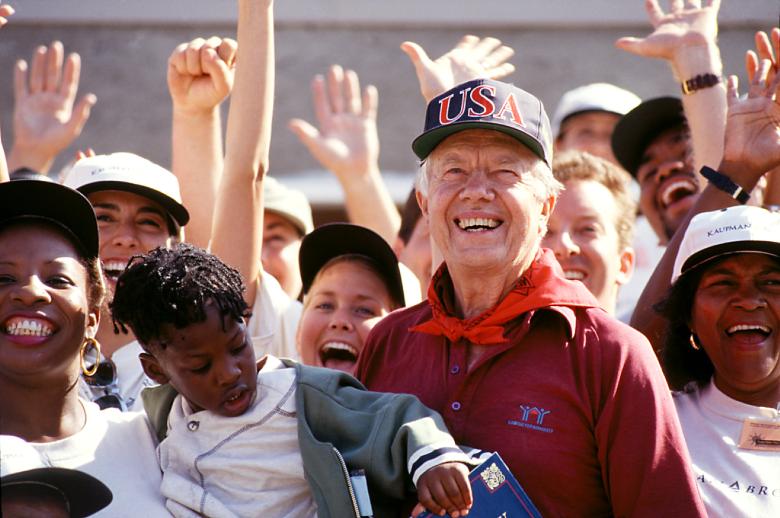
“Even after his presidency, President Carter continued to put our communities first. For decades, he and Mrs. Carter inspired us as faithful volunteers for AmeriCorps’ partner Habitat for Humanity. 

“In September 1984, the Carters led a group of Habitat for Humanity volunteers to New York, building alongside 19 families in need of safe, affordable housing. This event became the inaugural Jimmy and Rosalynn Carter Work Project, which is now a weeklong event taking place in a different location all over the world each year.

“In 2008, the Carter Work Project was hosted in the Gulf Coast as part of the response to Hurricane Katrina. More than 2,000 volunteers, including more than 500 AmeriCorps members, supported 250 families to rebuild after the destruction of the storm. They constructed new homes and participated in a ‘wall blitz’ where walls were assembled for future homes. 

“President Carter said, ‘Habitat for Humanity provides a simple but powerful avenue for people of different backgrounds to come together to achieve those most meaningful things in life. A decent home, yes, but also a genuine bond with our fellow human beings. A bond that comes with the building up of walls and the breaking down of barriers.’

“His quote rings true for national service. AmeriCorps members and AmeriCorps Seniors volunteers continue to follow in President Carter’s footsteps, providing support, breaking down barriers and building bridges in communities nationwide.

“The national service community will deeply miss President Jimmy Carter, but his service lives on in the countless Americans who continue to volunteer for their communities and serve their country. Our heartfelt sympathies are with the Carter family and all of his loved ones. Generations of Americans will continue to be inspired by his patriotism, courage, humanity and exemplary life of service. AmeriCorps is honored to help carry his torch forward in this important work.”

https://www.americorps.gov/newsroom/press-release/americorps-reflects-president-carters-life-service

Montgomery County’s schools chief seeks $300 million more for budget

By Nicole Asbury  Washington Post December 19th 2024 

Montgomery County Public Schools’ superintendent is asking the county to spend roughly $285 million more on the district in its next budget — nearly double the increase in funding it received for the current school year.

Superintendent Thomas Taylor released his recommended $3.6 billion operating budget — his first since joining the district in July — Wednesday in front of school system staff, students and school board members. A majority of the budget covers pay and benefits for the district’s nearly 26,000 employees. But Taylor also is proposing a change in the district’s funding formula to send more money for supplies to schools with a higher population of students who are low-income or are learning English and those with special needs — an increase he dubbed an “equity add-on.”

Taylor is also pitching about 50 new positions in school security and nearly 700 new special-education positions. In return, Taylor said he would cut about 80 positions in the central office — a reduction that is less than 5 percent of the office’s workforce.

Taylor acknowledged that the state’s “financial landscape looks rough” but said he would work with the county council and others to find a way to fully fund the request.

“I would love to come to our funding partners and even to our board of education with a request that is a little bit more in line with community expectations,” Taylor said in an interview. “But I also am compelled to present a needs-based budget, and our needs are severe.”🌸

County Executive Marc Elrich (D), who will recommend his own budget in March, said Taylor’s request was in line with what he anticipated. He said Taylor’s proposal addresses “some of the long-standing problems of the school system,” such as understaffing in special education.

Elrich previously pitched a 10 percent tax increasein 2023 to help the school system cover the costs of teacher salaries and other needs, but the county council instead approved a 4.7 percent hike. In an interview Thursday, he stopped short of saying whether another tax increase could be on the table, adding that he wasn’t sure yet how much of Taylor’s ask exceeds what the county may be able to offer the district for fiscal 2026.

“It exceeds last year by $300 million, but I don’t think it exceeds our planning by $300 million,” he said. “So the jump may not be as big as it appears.”S

State analysts are anticipating a $2 billion budget deficit in the upcoming fiscal year, with the projected gap between revenue and spending expected to widen even more than during the Great Recession. Most of the costs are associated with the Blueprint for Maryland’s Future — a statewide education-reform plan that funnels billions annually toward public schools through a 10-year period, and includes measures to boost teacher pay and expand pre kindergarten.

In Montgomery County, Taylor said the school system expects to allocate nearly $11 million more next year to cover Blueprint-related costs. Most of the allocation will target converting 28 pre kindergarten classrooms into a full day program.

Meanwhile, in nearby Prince George’s County, Superintendent Millard House II cited the projected state deficit while presenting his operating budget proposal this month, warning the next fiscal year would be challenging.

House is requesting a roughly $35 million increase from the county and state above the current budget year, raising its total budget to about $2.9 billion. His budget requests targets mental health supports for students and expands a Chinese, French and Spanish immersion program at Largo High School, among other needs.

Montgomery is home to Maryland’s largest school district, with about 160,000 students and 211 schools.

County officials said this month that it has accumulated more revenue from local income and property taxes than originally projected for the upcoming fiscal year. Still, they cautioned the county’s financial outlook could worsen if cuts made to the federal workforce, as promised by President-elect Donald Trump, materialize.

Montgomery County Council President Kate Stewart (D-District 4) said Wednesday that she was aware of some of the school system’s needs, such as a demand to cover more of the costs’ of employees’ benefits plan. But she said she was surprised by the magnitude of Taylor’s request.

“There’s a lot of issues and needs for members of our community that we’re going to need to be addressing,” Stewart said. “As we look to receiving the budget from the county executive in March, we’re going to need to look at the overall picture and what we’re doing across the county for all of our families and children. Tonight, we got a piece of that.”

In the spring, Montgomery County council members funded 99.2 percent of the school system’s budget request, but there was still a roughly $30 million shortfall. The school board cut a virtual academy and increased class sizes to reconcile the budget gap.

Taylor’s budget recommends anoverall increase of roughly $298 million, but about $11.6 million is anticipated to come from the state. He anticipates that he would be able to keep some employees whose positions are cut, since there are enough vacancies across the school system.

Taylor said his proposed funding model would help schools “better align” their needs with their student population. Previously, schools received a set dollar amount for each student it had enrolled, with some adjustments for inflation for supplies and materials. “Not all schools are created equal, and some schools have more impacted needs than others,” he said.

Taylor also plans to target improving the district’s student performance, which declined after the pandemic. He pitched a “money-back guarantee” that would pledge to reimburse any future graduates who have to take remedial mathematics or literacy courses at Montgomery College starting with the class of 2035. He said ideally the proposal wouldn’t cost the school system any money if the school system does its job effectively, but if any graduate enrolls in those courses, “they could send us the bill.”

Taylor also pledged to improve the district’s performance on the state’s report call, saying he hoped all of the county’s schools would earn four or five stars on the state’s report card by 2035. (The state is currently debating an update of its report cards, including whether to abandon a star rating system.)

Both Taylor’s and House’s recommended budgets head to their respective school boards. After the boards debate and approve a recommended budget, the request is submitted to the county executive — who typically make their own recommendation around March.

https://www.washingtonpost.com/education/2024/12/19/montgomery-county-schools-budget-request/

Why not enlist an army of volunteer retirees?

Opinion | Why not start a national service program for seniors? - The  Washington Post

Opinion  Daniel Pink   Washington Post Dec 2nd 2024

Bad news that happens fast always grabs our attention — earthquakes, plane crashes, cyberattacks. But what shapes our lives more profoundly, yet often eludes our notice, is good news that happens slowly.

Few slow-moving developments are more astonishing, or consequential, than the surge in lifespans over the past century. In 1900, the typical American could expect to live only until their mid-40s. Now, that figure stretches well into the 70s. Today, an American who reaches age 65 can expect to live, on average, nearly 20 more years. Contrast that to 1900, when just 4 percent of Americans even made it to 65.

“We’ve added 30 years to average life expectancy,” Laura Carstensen, a Stanford University professor who directs the school’s Center on Longevity, told me. “That is stunning. It’s never before happened in human history.”

Yet the structure of our lives hasn’t adapted to this transformation. The standard American life story remains a three-act drama: a burst of education, a few decades of work, and then a leisurely retirement. We’ve received an extraordinary multi-decade windfall — and simply tacked it onto the end of the third act.

“We’re squandering it,” Carstensen told me. “What would life look like if we optimized the extra 30 years instead?”

And what if that optimization simultaneously addressed some of America’s most pressing public problems?🎤

In other words, why not establish a robust national service program for people over 65?

Thinking bigger

The contours of such an initiative are already in place. It’s called AmeriCorps Seniors, part of AmeriCorps, the federal agency that promotes service and volunteering. Each year, about 143,000 AmeriCorps Seniors volunteers, all 55 and older, serve local communities in a variety of ways: delivering food to the homebound, tutoring students, even assisting military families with their tax returns.

The program attracts people such as Murphy Smith, a 64-year-old former construction worker in Pensacola, Florida. In retirement, without a job to go to each day, “I was bored,” Smith told me. “I didn’t know what to do. I was going crazy.” A friend connected him to the local Council on Aging, which had received an AmeriCorps grant. And for the past few years, Smith has volunteered nearly 40 hours a week helping an elderly woman with her doctor appointments, medications and groceries. It’s gratifying, Smith says. “We need it as much as they do.”

Talking with Smith is inspiring. Examining AmeriCorps Seniors’ scope, though, can be frustrating. The program’s 143,000 volunteers is a meaningful number, but it represents less than one-fourth of 1 percent of the nearly 80 million Americans over 60. AmeriCorps Seniors’ annual budget is about $235 million — not peanuts, but about what the federal government spends on Social Security every 90 minutes.

Imagine boosting the funding to the equivalent of, say, 90 hours of Social Security payments. That would be enough for AmeriCorps to connect nearly 8.5 million volunteers with local nonprofits meeting local needs.

If scaled wisely, a remade and expanded initiative — call it the Silver Service Corps — would deliver at least three benefits.

Solving problems and helping the helpers

First, this freshly assembled army of seniors could address chronic challenges that, at their core, are problems of human connection. Take loneliness, which Surgeon General Vivek H. Murthy has identified as a public health risk on par with smoking. Smith runs errands and makes appointments for his elderly client. But he says his most important role is “just sitting with Miss Barbara” — keeping her company and talking about what’s going on in her life and in the world.

Or consider the convoluted mess that is America’s child-care “system.” In a country currently short a few million child-care workers, a squadron of 60- and 70-something volunteers isn’t the full solution. But it would help. And the AmeriCorps Seniors Foster Grandparent program could offer the initial infrastructure.

Some volunteers might choose to build relationships through technology. Despite the stereotype that people over 65 can’t connect to Zoom or manage to unmute themselves when they do, the reality is different. Most 70-year-olds, for instance, have been using the internet well over half their adult lives. That creates the opportunity for millions of virtual volunteers to tutor students in math, organize book clubs or mentor small businesses.

A second benefit of a Silver Service Corps: Helping others is good for the helpers. Volunteering and supporting others boosts psychological well-being, improves physical health and even reduces mortality, according to decades of research. A longitudinal study of AmeriCorps Seniors uncovered similar effects. “I saw people go from a wheelchair to just a cane because they were more active [from volunteering],” AmeriCorps Seniors Director Atalaya Sergi told me.

Teresa Amabile, a Harvard Business School professor and co-author of “Retiring: Creating a Life That Works for You,” says a “highly visible, popular program” could also help older Americans find their footing on the longer and trickier terrain of postretirement life. “Many people do feel the need after they retire from their professional careers to give back, to do something that’s useful and meaningful,” she told me. Even if that doesn’t morph into a full-time endeavor, it could help them detach from their working life, adopt a new structure and begin forming an identity for their later years.

A ‘new map of life’

A final virtue of a Silver Service Corps is that it meets our political and cultural moment. The United States remains a stubbornly 50-50 country. In the past nine presidential elections, Republicans have won four and Democrats five — and no candidate from either party has exceeded 53 percent of the popular vote. A program like this appeals to the left by emphasizing care and social services. But it achieves those goals in a way that appeals to the right. AmeriCorps Seniors doesn’t operate its programs; it merely serves as a matchmaker that connects local organizations with volunteers. The federal government is the catalyst, not the boss.

Equally important, the initiative can begin to contend with the happy upheaval of longer lives. This year, a record 4.1 million Americans will turn 65. Next year will match that record. 2026 and 2027 will match it again. By 2040, nearly a quarter of the U.S. population will be over 65.

Is it really wise for them — and, eventually, for all of us — to spend decades unplugged from the needs of the country, collecting a Social Security check and dabbling in leisure? Or is it wiser to enlist them and eventually all of us in fashioning what Stanford’s Carstensen calls the “new map of life”? And might the map’s compass point toward the principle that Americans can be active contributors at every stage of life?

National service shouldn’t be the domain of 18-to-24-year-olds enlisting in the military, the Peace Corps or AmeriCorps. It can be for everyone, including those whose golden years will be longer and more golden than any humans in history.

https://www.washingtonpost.com/opinions/2024/12/02/seniors-service-americorps/

What MCPS Employees Think About Their Schools, Part Five

MCPS-related complaints to county inspector general surged - The Washington  Post

By Adam Pagnucco.
March 12, 2024 Montgomery Perspective

Part One explained the methodology of MCPS’s staff climate survey.  Part Two summarized some stats from FY23.  Part Three looked at five survey questions on which MCPS did well.  Part Four looked at five survey questions on which MCPS did not do well.  Today, we will discuss variation of responses among high schools.

Read More here.

https://montgomeryperspective.com/2024/03/12/what-mcps-employees-think-about-their-schools-part-five/

MoCo’s Economy is Falling Behind: Real Per Capita Personal Income

Kansas economy falling behind by staying in the same place - Kansas Policy  Institute

By Adam Pagnucco. from Montgomery Perspective December 26th 2024

Part One summarized the premise of this series: an examination of key stats from the U.S. Bureau of Economic Analysis (BEA) comparing Montgomery County to its largest neighbors.  Part Two looked at population.  Part Three looked at gross domestic product (GDP).  Part Four looked at per capita GDP.   Part Five looked at personal income.  Now let’s look at per capita personal income, which measures the average amount of money coming into each of our wallets.

Read more here.

https://montgomeryperspective.com/2024/12/26/mocos-economy-is-falling-behind-real-per-capita-personal-income/

MoCo’s Economy is Falling Behind: Real Per Capita GDP

Montgomery Planning: Research & Technology - Jurisdictions in the Montgomery  County, Maryland Region, 1997

By Adam Pagnucco.

Part One summarized the premise of this series: an examination of key stats from the U.S. Bureau of Economic Analysis (BEA) comparing Montgomery County to its largest neighbors.  Part Two looked at population.  Part Three looked at gross domestic product (GDP).  Now let’s look at per capita GDP, which is economic output per person. Read more below.

MCPS’s Troubling Literacy and Math Scores

MCPS's Troubling Literacy and Math Scores - Montgomery Perspective

December 11, 2024 4 Min Read

By Adam Pagnucco.

Last fall, MCPS released its spring 2024 Maryland Comprehensive Assessment Program (MCAP) results by school.  For the first time my sources can remember, MCPS released them in spreadsheet format rather than pdf, a positive step for transparency.  As for the results themselves, well… keep reading.


https://montgomeryperspective.com/2024/12/11/mcpss-troubling-literacy-and-math-scores/

I Tried to Teach My Son Soccer. Here’s What He Taught Me.

A man watches over a group of six year old boys playing soccer.


By Rory Smith

Rory Smith has been watching soccer for 40 years and reporting on it for 20, eight of them at The New York Times.

A few weeks ago, the soccer team that occupies rather more of my thoughts than is healthy had a problem. Well, strictly speaking, it had several. One was that all of the players, including my son, were under the age of 7, which it turns out is something of a tactical limitation. Another was that I had been roped into being one of the coaches.

More urgently, though, we kept conceding goals. Avoidable goals. Silly goals. Goals wrapped up in gift paper and presented to the opposition, accompanied by a heartfelt card.

Technically, when children start playing formal soccer in England — at the age of 6 — the games are not competitive. There is no league table. The results are not even recorded. That arrangement is not quite the same, though, as nobody knowing what the results are. And it was apparent, to anyone who could count, that our results were not good.

It was at this point that I hatched a plan to limit the damage. It seemed to me quite a good plan. We had spent two years encouraging the children to play soccer the way it is meant to be played. They pass out from the back. They take a touch. They rely on their technique to avert danger. They express themselves.

But it had become very clear, very quickly that this approach had not survived contact with reality. We were conceding goals in great bucket loads because we kept creating problems for ourselves: dribbling across our own box, passing aimlessly into the middle of a congested field, turning not into space but into trouble. We kept losing games. And while winning or losing was not supposed to matter, we worried that, sooner or later, the children would start losing enthusiasm.

Rory Smith walking with his father-in-law and two young boys next to soccer fields.
Mr. Smith arriving for practice alongside his son and his father-in-law.Credit…Mary Turner for The New York Times

What we needed, I thought, was just a dash of the ancient wisdom that had been passed down to me, when I was taking my first tentative steps in soccer. Geoff — my first and only youth coach, whose son took all the free kicks and corners — had given us two instructions, and only two: Play the way you are facing and, if in doubt, boot it out.

And so, I took my son aside and suggested, gently, that it would be perfectly fine — if he felt under pressure, if the opposition was swarming him, if there was no other option — just to put the ball somewhere nice and safe. Play it into a channel, upfield, if you can. If that is not an option, then slip it out for a throw in.

This guidance was, in truth, something of a sacrifice for him. My son is a decent player, I think. Quick, tall, hard-working, surprisingly strong for someone I see, quite often, being pinned to the ground by his 2-year-old sister and informed that he is now her “baby.” But he is also more easily instructed than his peers, who do not rely on me for food and shelter, and so it fell to him to act as our troubleshooter.

That was the theory. This was the practice: For a three-week spell, directly after that little parental intervention, there was not a sphere in existence that my son did not efficiently, deliberately and occasionally quite artfully put out of play.

A young boy kicks a soccer ball while being watched by his father, Rory Smith.
Mr. Smith offered his son some ancient soccer wisdom: clear the ball if swarmed by the opposition.Credit…Mary Turner for The New York Times

Often, that involved his chasing down an opponent, winning the ball and immediately thrashing it off the field. And sometimes it meant taking possession, with time and space, deftly bringing the ball under control, looking up at his teammates and then coolly slotting it out for a throw, like that time Renato Sanches passed to an advertising board.

The problem, I suppose, is that a little knowledge is a dangerous thing. There are some soccer journalists out there who have taken the time, and made the effort, to earn actual coaching qualifications. I am not one of them. Coaching, until I had children, was not something that I ever particularly yearned to do.

But I have spent 20 years or so talking to those people whose job it is to develop young soccer players, the ones who go on to grace the world’s most famous fields, the ones who take a game and make it an art. Unfortunately, when I was asked to help out my son’s age group — under the auspices of an actual qualified coach, thankfully — I did so with Ideas.

These were, I think, broadly quite healthy. I knew, for example, that such a tiny proportion of players become professional that there is absolutely no point putting any pressure on your charges whatsoever.

They are not there to win. They are not there to fulfill your dreams. They are there to feel the joy of playing, to love the game, to learn all it can teach about teamwork and endeavor and exercise. In Norway, which produces a lot of soccer players, there is no actual competition until the children hit their teens.

Rory Smith huddles with a group of young soccer players on the field.
Such a tiny proportion of players become professional that there is no point in putting pressure on young players.Credit…Mary Turner for The New York Times

I knew that abusive language and behavior, even violence, is a mounting problem in youth soccer, that referees and coaches and all the other volunteers who provide a service for children each weekend do so in an increasingly poisonous atmosphere, all spittle-flecked rage and threats.

I knew that English soccer in particular had been held back, for years, by the emphasis on the physical and the industrial and the cynical, by the tyranny of booting the ball out of danger when in any doubt. I knew that elite academies now cherish technique above all else, that they teach children to revere the ball, not to surrender it at the first opportunity.

And I knew, a little counterintuitively, that no less an authority than Pablo Aimar — one of soccer’s last great true artists — feels that the emphasis on passing at any cost is debilitating to young players’ technical development. If children are not encouraged to dribble, Aimar believes, then the thrill of seeing a player slalom between opponents will be all but lost.

The problem, of course, is that there is nothing so dangerous as a little knowledge. In my three months or so as an under-7 coach, I have learned many things. I have learned that some people take youth soccer very seriously: One of our opponents had rigged up an iPhone to film the game, presumably so that the coaches could review the tape afterward.

I have learned, too, that on occasions, children can be too obedient. They take things both seriously and literally. If you tell them, say, to put the ball out for a throw, then that is what they will do. Every single time. (This does not work in a domestic setting, with tidying up, for instance. I’ve tried.)

Mostly, though, I have learned things about myself. I would never have thought to describe myself as competitive, not really. If I am playing, of course, I would generally prefer to win than to lose, but the result does not prey on my mind, particularly.

There is something, though, about seeing your child play — knowing their happiness is dependent, to some extent, on the outcome; knowing that you want them only to experience pleasure, and never pain; knowing that you are all but powerless to determine what happens — that sharpens the senses.

Perhaps that stands to reason. Perhaps that is something people have always known, that it is in sports that parents catch their first, unnerving glimpse of what is to come: a son or daughter, out there in the world, no longer under their protection, reliant only on themselves and their friends to overcome the challenges being placed relentlessly in their path.

Rory Smith speaking to his son Ed on the side of a soccer field.
Mr. Smith and his son at the end of practice.Credit…Mary Turner for The New York Times

But it still comes as a shock to know one thing and to feel another, to tell yourself that the outcome does not matter, that it is the taking part that counts, that what they learn today will serve them well tomorrow, and yet to want more than anything for them not to taste disappointment, to fret at the prospect of sadness and dismay.

I had always found reports of referees being verbally abused in youth soccer troubling, of course, but also somehow laughable: The idea of being so worked up over a bunch of children chasing a ball seemed essentially absurd to me.

I know now, though, that at least once I have had to stop myself from offering an instantaneous and unfavorable review of a referee’s performance. And that was after I had refereed my first game, and come off the field to some pretty pointed criticism from both my son and his grandfather. (I knew it was a foul, I just thought my son was being dramatic. It was a teachable moment.)

Mostly, though, I know now quite how much it can mean, to be there with your child as they start to do this thing that you love, that you have loved, for so long, and to see it start to bring them the joy that it has brought you.

We won our first game last week. My son scored twice. I don’t think he was trying to put either of them out for a throw. (He has subsequently described them as “Luis Díaz goals.”) At the final whistle, he and his teammates ripped off their jerseys in the cold November air and wheeled away in celebration, beaming at what they had achieved. I have loved soccer for a long time. But it has never made me happier than it did then.

Rory Smith is a global sports correspondent, based in the north of England. He also writes the “On Soccer With Rory Smith” newsletter. More about Rory Smith

https://www.nytimes.com/2024/11/18/world/europe/rory-smith-soccer-coaching.html