Loading

Posts by Paul Costello1

Curiosity

The Glue of Romantic Relationships: Play & Curiosity - Alicia Muñoz, LPC

The most popular Modern Love article of all time, “The 36 Questions That Lead to Love,” has been read by more than 75 million people. Nothing I have (or will ever) put out into the world will effect more positive change than that short article.

My hope is that most readers absorbed the simple truth that being curious about people you meet is far more seductive than talking about your accomplishments. The most common complaint I hear (by far) about bad first dates is of people droning on about themselves and not asking questions. So skip the self-promotion. Be curious instead. If you need prompts, here are 36 of them.

https://www.nytimes.com/2024/10/11/style/modern-love-7-lessons.html

The 36 Questions That Lead to Love

36 Questions - How to fall in love with anyone

In Mandy Len Catron’s Modern Love essay, “To Fall in Love With Anyone, Do This,” she refers to a study by the psychologist Arthur Aron (and others) that explores whether intimacy between two strangers can be accelerated by having them ask each other a specific series of personal questions. The 36 questions in the study are broken up into three sets, with each set intended to be more probing than the previous one.

The idea is that mutual vulnerability fosters closeness. To quote the study’s authors, “One key pattern associated with the development of a close relationship among peers is sustained, escalating, reciprocal, personal self-disclosure.” Allowing oneself to be vulnerable with another person can be exceedingly difficult, so this exercise forces the issue.

The final task Ms. Catron and her friend try — staring into each other’s eyes for four minutes — is less well documented, with the suggested duration ranging from two minutes to four. But Ms. Catron was unequivocal in her recommendation. “Two minutes is just enough to be terrified,” she told me. “Four really goes somewhere.”

Set I

1. Given the choice of anyone in the world, whom would you want as a dinner guest?

2. Would you like to be famous? In what way?

3. Before making a telephone call, do you ever rehearse what you are going to say? Why?

4. What would constitute a “perfect” day for you?

5. When did you last sing to yourself? To someone else?

6. If you were able to live to the age of 90 and retain either the mind or body of a 30-year-old for the last 60 years of your life, which would you want?

7. Do you have a secret hunch about how you will die?

8. Name three things you and your partner appear to have in common.

9. For what in your life do you feel most grateful?

10. If you could change anything about the way you were raised, what would it be?

11. Take four minutes and tell your partner your life story in as much detail as possible.

12. If you could wake up tomorrow having gained any one quality or ability, what would it be?

Set II

13. If a crystal ball could tell you the truth about yourself, your life, the future or anything else, what would you want to know?

14. Is there something that you’ve dreamed of doing for a long time? Why haven’t you done it?

15. What is the greatest accomplishment of your life?

16. What do you value most in a friendship?

17. What is your most treasured memory?

18. What is your most terrible memory?

19. If you knew that in one year you would die suddenly, would you change anything about the way you are now living? Why?

20. What does friendship mean to you?

21. What roles do love and affection play in your life?

22. Alternate sharing something you consider a positive characteristic of your partner. Share a total of five items.

23. How close and warm is your family? Do you feel your childhood was happier than most other people’s?

24. How do you feel about your relationship with your mother?

Set III

25. Make three true “we” statements each. For instance, “We are both in this room feeling … “

26. Complete this sentence: “I wish I had someone with whom I could share … “

27. If you were going to become a close friend with your partner, please share what would be important for him or her to know.

28. Tell your partner what you like about them; be very honest this time, saying things that you might not say to someone you’ve just met.

29. Share with your partner an embarrassing moment in your life.

30. When did you last cry in front of another person? By yourself?

31. Tell your partner something that you like about them already.

32. What, if anything, is too serious to be joked about?

33. If you were to die this evening with no opportunity to communicate with anyone, what would you most regret not having told someone? Why haven’t you told them yet?

34. Your house, containing everything you own, catches fire. After saving your loved ones and pets, you have time to safely make a final dash to save any one item. What would it be? Why?

35. Of all the people in your family, whose death would you find most disturbing? Why?

36. Share a personal problem and ask your partner’s advice on how he or she might handle it. Also, ask your partner to reflect back to you how you seem to be feeling about the problem you have chosen.

TINY LOVE STORIES Discover our new weekly feature, Tiny Love Stories, which is essentially Modern Love in miniature — reader-submitted stories of no more than 100 words.

https://www.nytimes.com/2015/01/09/style/no-37-big-wedding-or-small.html

The need we are meeting

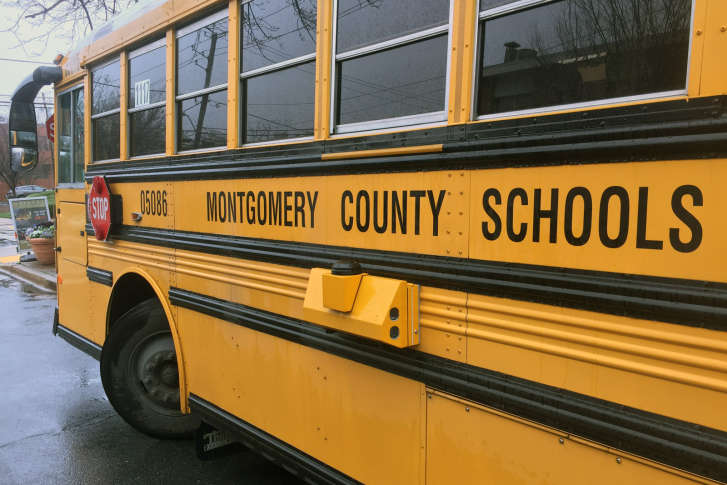
MCPS school buses need to install seat belts - The Observer

COVID exposed the cracks in the health care and education systems, showing that closing schools to protect the physical health of students exposed them to higher risks to their mental health and overall social-emotional wellbeing. Those local communities already lacking resources fell further behind, with rates of depression, suicide, absenteeism and even online disengagement rising to record levels. Since school in person has returned, the recovery from learning loss has been the focus of MCPS and most school districts, but the legacy of a year of lost socialization is still taking its toll among the neediest students.

Project CHANGE’s data from service of 3000 + MCPS students each year over the last 3 years show that up to 70% of young people are not excited about learning, and upwards of 40% give up when things get hard. These scores are validated by their low sense of confidence to learn.  


This image has an empty alt attribute; its file name is Screenshot-9-1024x819.png


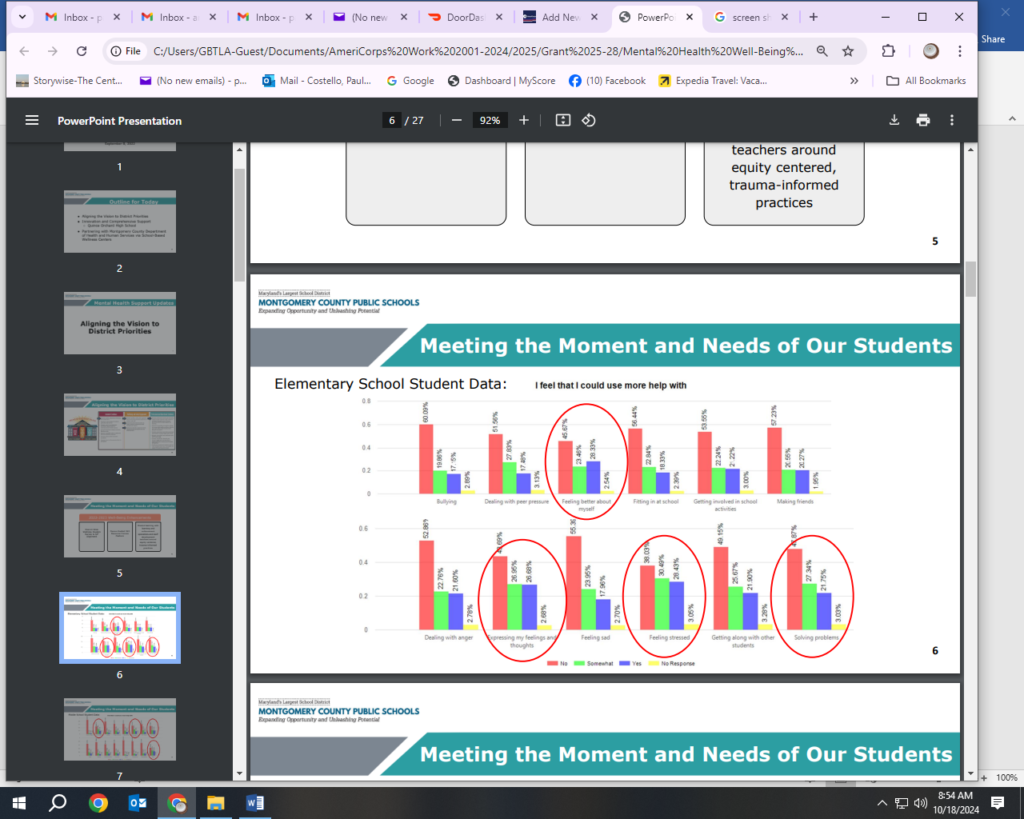
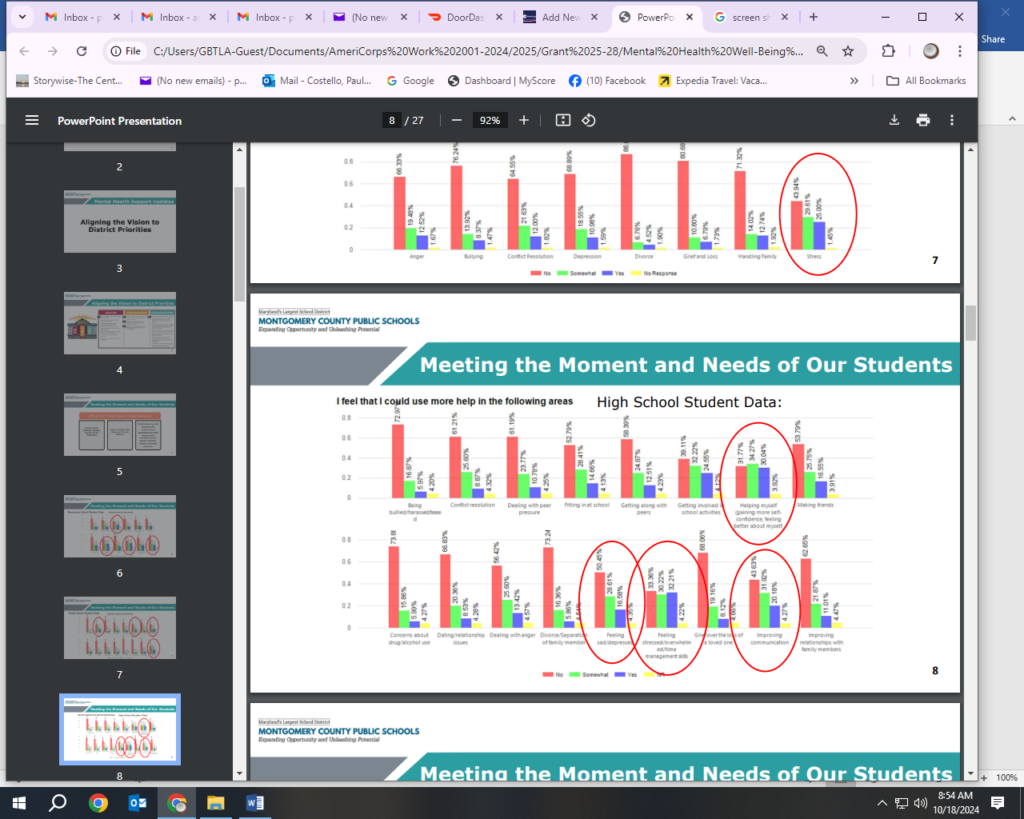
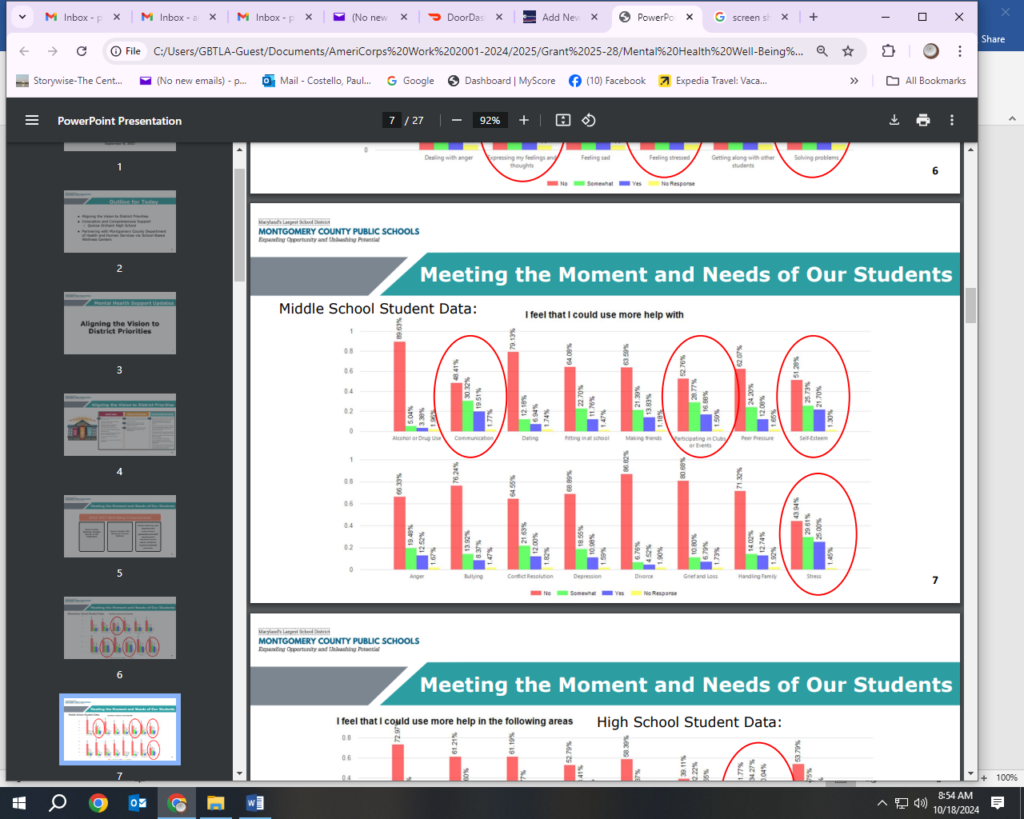
In 2021-2, MCPS conducted their own Student Wellness Survey for 61,000 MCPS students and found that across all grades, 28% of students said they struggled dealing with stress, 26% felt lacking in self-esteem, and 22% needed help with expressing their emotions.  In 2023, the recovery from COVID learning loss was uneven and absenteeism was at 32%, 6 points above the national average, and reflecting over 5 million lost hours of learning.  When the system is obsessed with testing and with closing the achievement gap through improving test scores, the most disadvantaged students struggle even more in a culture that defines their deficiency as a deviancy. The very system committed to help them learn is teaching them they are losers. School is a race they are forced to compete in and run last.

Project CHANGE is committed to counter this destructive lesson and support students to become successful life learners, even if that sometimes means unlearning the lessons of school. The MyScore instrument which Project CHANGE uses to map the culture of learning through the 5C’s has proven success in first of all, diagnosing the problem by taking the student’s self-assessment seriously and validating it with classroom behavior, and from these data points, plan and implement a low-level intervention through mentoring and accompaniment.

This image has an empty alt attribute; its file name is Screenshot-10-1024x819.png

Freedom Is Not What We Think It Is

A photo illustration of a bird in a nest that is surrounded by barbed wire.

By Timothy Snyder New York Times Sept. 21, 2024

Dr. Snyder is a professor of history at Yale University and the author of “On Freedom.”

I know a town in southern Ukraine where every single house has been destroyed by shelling or bombing. Even the ruins are riddled by bullet holes. Posad-Pokrovske, in the Kherson region, was occupied by Russians for most of 2022, before they were driven out by the Ukrainian army.

I visited there a year ago and met Mariia. She was living in a corrugated-metal hut behind the rubble of her house, her possessions arranged neatly, water bottles in a line, extension cords from the generator well hidden. She was proud of her Ukrainian government and cried in sympathy with her president, Volodymyr Zelensky. He seemed so young to her. Mariia is 86.

When we spoke, in Ukrainian, she used the word “de-occupation” rather than the expected “liberation.” I had a draft of a book about freedom in my backpack. I got it out and made a note.

We like to think that people are free when the correct army arrives: a liberation. But removing evil is not enough. Mariia would be less free without her temporary dwelling, provided by an international organization. She will be more free when the lane through the rubble is wide enough for her walker, and when the buses are running again.

The Ukrainians don’t expect us to bring them freedom. One soldier told me to remind Americans that they don’t need our troops. They do need our weapons, as one tool of many to keep their futures open. No one can bring anyone else freedom. But freedom can arise from cooperation.

Ukrainians have to keep fighting because they know what Russian occupation means. They have every reason to think of freedom as negative, as just the removal of what is wrong. But in the hundreds of conversations I have now had with Ukrainians about freedom, including soldiers on the front this month, I have never heard anyone say that. Freedom is about moral commitments and multiple possibilities. The Ukrainians driving vans to the front and rebuilding houses also speak of their actions in terms of freedom.

In the ruins of the Kharkiv suburbs recently, and in the rubble of the Kherson region last year, I was reminded of a nurse who arrived at a Nazi concentration camp in 1945 after “liberation.” She wrote in her diary that this was not the correct word. Inmates could not be regarded as free, she thought, until they had been restored to health and their trauma was addressed.

To be sure, it matters when Russian power is removed from Ukraine. And of course it mattered when the SS fled the camps. No one is free behind barbed wire or under bombing, whether we are talking about the past or the present, about Xinjiang or Gaza or anywhere else.

But freedom is not just an absence of evil. Freedom is a presence of good. It is the value of values, the condition in which we choose and combine the good things, bringing them into the world, leaving our own unique trace. It is positive.

So long as Americans imagine freedom as negative, as a matter of getting rid of power, we will have no land of the free. We will have to listen to one another about how power can create the conditions of freedom. As conservatives say, virtue is real. As liberals believe, there are many virtues, which we have to consider and combine. And as social democrats maintain, we need to work together to create structures that allow us to do that work.

Freedom helps us know how to govern. Freedom, in my view, takes five forms, connecting philosophy to politics. The first, sovereignty, means the capacity of children to understand themselves and the world. We think of states as sovereign, but a politics that begins with freedom requires a government that helps make people so. The second, unpredictability, makes us unruly and lively. The third, mobility, is the multiplicity of paths across space and time that opens before us. The fourth, factuality, is the grip on the world that allows us to change it. And the fifth, solidarity, is the recognition that freedom must be for us all.

And the home of the brave? It is cowardly to believe that freedom is just negative, just an absence. When we think of freedom that way, we leave all the hard questions open: Who are we? What do we care about? For what will we take a risk? What we are really saying is that someone or something else will fill the void and do the work for us. A leader will tell us what to think. Or a market or a machine will do the thinking for us. Or it will be the founders who somehow did all the thinking long ago.

We need government to solve certain problems so that we can be free. Only a government will stop an invader or break up a monopoly. But that is just the beginning. When people have health care, they are less worried about the future and free to change jobs. When children have access to school, adults are more free to organize life. Children who learn can defend themselves against the lies of aspiring tyrants.

Freedom is national work. It takes a cooperative nation to create free individuals. That cooperation is called government. And freedom is generational work. For children to grow up free, the necessary institutions and policies must already be in place. Infants cannot create the conditions of their own upbringing. No young person can build the roads and the universities needed for the American dream. We have to always be looking ahead. It is this prospect, this sense of a better future enabled by present decisions, that makes a land of the free.

When we believe freedom is negative, we believe that we are always right. We separate ourselves from the outside world, believing that this is liberation. We end up in a safe space with other Americans who think the same way. Some outside force is supposed to make us free, and when it does not, we call our condition freedom anyway. We have an answer for everything: Whatever happens, the government is to blame. And so we live inside a story.

A free person knows that there is no one answer to everything and no single story for everybody. As I finished my book about freedom, I tried to listen to people whose predicaments were different from mine. Mariia was one of them. She got me thinking about de-occupation, about how we get from the negative to the positive. She smiled when she spoke to me, and offered me the one beautiful object she had rescued from her ruined house as a gift. I looked at her walker and thought about what more she needed to be free.

To be free, we have to see other people, not least to be able to see ourselves. If we understand freedom correctly, if we draw the right lessons from extreme situations, we can connect freedom to government. Then that better future awaits us: a beautiful range of possibilities for unpredictable, unruly people.More on Ukraine.

Timothy Snyder is a professor of history at Yale University. His most recent book is “On Freedom.”

Source photographs by aguadeluna, Claudiad and banabana-san/Getty Images.

https://www.nytimes.com/2024/09/21/opinion/ukraine-america-russia-freedom.html?searchResultPosition=4

How America Turned Stories Into Weapons of War

This is a cover of a comic book called Sensation Comics. The comic’s title is in bold blue letters on a stripe of red over a yellow circle in which we see an image of Wonder Woman in her iconic tiara and strapless dress. She uses her wristbands to block bullets fired by three tough-looking armed men on the ground below her.

Jennifer Szalai New York Times June 5, 2024
In a new book, the journalist and science fiction writer Annalee Newitz shows how we have used narrative to manipulate and coerce.

A story can entertain and inform; it can also deceive and manipulate. Perhaps few stories are as seductive as the ones we tell ourselves about ourselves — those reasonable, principled creatures so many of us presume ourselves to be.

As Annalee Newitz writes in “Stories Are Weapons,” propaganda is premised on exploiting the discrepancy between surface beliefs and unconscious motives. A clever propagandist can get any number of people who see themselves as invariably kindhearted to betray their ideals. Newitz gives the example of anti-immigration campaigns: Make humans so fearful that even pious, churchgoing grandmothers will countenance rounding up their fellow humans in detention camps.

Not that Newitz, a journalist and science fiction author who uses they/them pronouns, depicts all propaganda as necessarily evil. “Stories Are Weapons,” an exploration of our culture wars’ roots in psychological warfare, contains a chapter on comic book artists like William Moulton Marston, the psychologist and creator of Wonder Woman, who “wanted to empower women” and believed that “propaganda was a progressive force.” But much of the book is about stories that have been used to undermine, to exclude and to wound: myths about the frontier and the “last Indian”; pseudo-intellectual treatises expounding junk-science racism; conspiracy theories about “pizza-eating pedophiles”; and moral panics about rainbow stickers.

And then there are the stories that sow confusion. Newitz explains that they began researching this book in the middle of 2020, while the pandemic was raging and the president was promoting the healing powers of sunlight and bleach. The gutting of reproductive rights and the introduction of anti-trans bills, Newitz says, made them feel as if they were under siege.

“For anyone who has been told that they should not be alive,” Newitz writes on the dedication page. “Together we will survive this war.” Stories are weapons — but Newitz argues that they can also open up pathways to peace. “As a fiction writer, I knew there were other ways to get at the truth, to make sense of a world gripped by absurdity and chaos. I had to tell a story.”

That story is introduced through the exploits of two central figures. The first is Freud’s nephew Edward Bernays, a pioneer in the field that became known as “public relations.” To sell Lucky Strike cigarettes to women, Bernays devised a publicity campaign that linked the product to women’s desires for freedom. “Bernays had successfully turned his uncle’s project to promote mental health into a system for manipulating people into behaving irrationally,” Newitz writes, recounting how he later worked with the C.I.A. to drum up antipathy toward Guatemala’s democratically elected government. A prime beneficiary of the eventual coup was Bernays’s client, United Fruit, which owned huge swaths of Guatemalan land.

The cover of “Stories Are Weapons,” by Annalee Newitz, is blue, with the title in white letters designed to look 3D, as though they are carved from red blocks.

Newitz contrasts Bernays’s cynicism with the idealism of Paul Linebarger, who wrote a handbook for the U.S. Army in 1948 called “Psychological Warfare” — offering “the opportunity of strategic advantage without the cataclysmic danger of a worldwide showdown” — and published novels under various pen names. As Cordwainer Smith, he wrote science fiction; he had formidable “worldbuilding” skills that he was able to carry over into the military’s psychological operations, or psyops, designed to influence adversaries’ opinions and behaviors. Given that he believed the alternative to words was the bomb, Linebarger was prone to think about his work in optimistic terms. “Psychological warfare is good for everybody,” he declared, deeming it “the affirmation of the human community against the national divisions which are otherwise accepted in war.”

The book goes on to narrate numerous instances of weaponized storytelling at work. Newitz is so skillful at elucidating such a tangled, morally contentious history that I never felt lost, though I sometimes thought that the word “psyop” was doing a lot of heavy lifting. Is Charles Murray and Richard Herrnstein’s “The Bell Curve,” which claimed that racial disparities in economic success were due mainly to genetics, more usefully characterized as a “psyop” or a terrible, odious book? What kind of analytical purchase is gained by using the phrase “the psyops known as Jim Crow laws” to describe racist legislation whose primary purpose wasn’t just to demoralize Black Americans in the South but to restrict their actual bodies?

Of course, military lingo packs an emotional payload, which is presumably why Newitz uses it. Tell people that they’re being pummeled by propaganda or a psyop, and you put them on guard. After all, nobody likes to think they are easily manipulated. Newitz shows how conservatives are well versed in the tactic of declaring harm, too: Denouncing something as “woke propaganda” can mobilize people to boycott Wonder Woman or ban a book.

There is a tension, then, between the imperative to seek the truth and the imperative to win the war. The vocabulary of war divides the world into stark binaries: Whatever helps the cause is good; whatever hampers the cause is bad. Complexities that don’t fit neatly into the ironclad narratives brandished by either side can get obscured.

“Stories Are Weapons” critiques this dynamic, but sometimes Newitz succumbs to the urge to oversimplify. The Internet Research Agency, the Russian troll farm that interfered in the 2016 election by slipping anti-Democratic propaganda into people’s social media feeds, “unleashed a new kind of psyop on the American people,” Newitz writes, presenting the presidency of Donald Trump as proof of concept: “It’s hard to argue with results like the ones we saw in the 2016 election.”

But people have done just that, maintaining that Russian trolls weren’t the decisive factor in Trump’s victory. Even Newitz recognizes that the metaphor of war is constraining and can take their story only so far. They condemn how online disagreements swiftly degenerate into violent recriminations and death threats — something that appalls Newitz, but is arguably made more likely when stories are equated with violent attacks.

Psychological disarmament, along with a commitment to a shared future, is made harder by the decimation of trust during wartime. Still, Newitz is hopeful. Weapons, whether rhetorical or physical, offer the power to dominate, but there’s so much more they cannot do. “We do not reach consensus by threatening one another with death,” Newitz writes. “Instead, we promise one another a better life.”


STORIES ARE WEAPONSPsychological Warfare and the American Mind | By Annalee Newitz | Norton | 246 pp. | $27.99

https://www.nytimes.com/2024/06/05/books/review/stories-are-weapons-annalee-newitz.html?searchResultPosition=1

This Is Our Chance to Pull Teenagers Out of the Smartphone Trap

By Jonathan Haidt and Jean M. Twenge New York Times
July 31, 2021

The authors are psychologists who have spent years studying the effect of smartphones and social media on our daily lives and mental health.

As students return to school in the coming weeks, there will be close attention to their mental health. Many problems will be attributed to the Covid pandemic, but in fact we need to look back further, to 2012.

That’s when rates of teenage depression, loneliness, self-harm and suicide began to rise sharply. By 2019, just before the pandemic, rates of depression among adolescents had nearly doubled.

When we first started to see these trends in our work as psychologists studying Gen Z (those born after 1996), we were puzzled. The U.S. economy was steadily improving over these years, so economic problems stemming from the 2008 Great Recession were not to blame. It was difficult to think of any other national event from the early 2010s that reverberated through the decade.

We both came to suspect the same culprits: smartphones in general and social media in particular. Jean discovered that 2012 was the first year that a majority of Americans owned a smartphone; by 2015, two-thirds of teens did too. This was also the period when social media use moved from optional to ubiquitous among adolescents.

Jonathan learned, while writing an essay with the technologist Tobias Rose-Stockwell, that the major social media platforms changed profoundly from 2009 to 2012. In 2009, Facebook added the like button, Twitter added the retweet button and, over the next few years, users’ feeds became algorithmicized based on “engagement,” which mostly meant a post’s ability to trigger emotions.

By 2012, as the world now knows, the major platforms had created an outrage machine that made life online far uglier, faster, more polarized and more likely to incite performative shaming. In addition, as Instagram grew in popularity over the next decade, it had particularly strong effects on girls and young women, inviting them to “compare and despair” as they scrolled through posts from friends and strangers showing faces, bodies and lives that had been edited and re-edited until many were closer to perfection than to reality.

For many years now, some experts have been saying that smartphones and social media harm teens while others have dismissed those concerns as just another moral panic, no different from those that accompanied the arrival of video games, television and even comic books. One powerful argument made by skeptics is this: The smartphone was adopted in many countries around the world at approximately the same time, so why aren’t teens in all of these countries experiencing more mental health issues the way Americans have been? Where’s the evidence for that?

This is a difficult question to answer because there is no global survey of adolescent mental health with data before 2012 and continuing to the present. However, there is something close. The Program for International Student Assessment, or PISA, has surveyed 15-year-olds in dozens of countries every three years since 2000. In all but two administrations, the survey included six questions about loneliness at school. Loneliness is certainly not the same as depression, but the two are correlated — lonely teens are often depressed teens, and vice versa. And loneliness is painful even without depression.

So what does the PISA survey show? In a paper we just published in The Journal of Adolescence, we report that in 36 out of 37 countries, loneliness at school has increased since 2012. We grouped the 37 countries into four geographic and cultural regions, and we found the same pattern in all regions: Teenage loneliness was relatively stable between 2000 and 2012, with fewer than 18 percent reporting high levels of loneliness. But in the six years after 2012, rates increased dramatically. They roughly doubled in Europe, Latin America and the English-speaking countries, and rose by about 50 percent in the East Asian countries.

This synchronized global increase in teenage loneliness suggests a global cause, and the timing is right for smartphones and social media to be major contributors. But couldn’t the timing just be coincidental? To test our hypothesis, we sought data on many global trends that might have an impact on teenage loneliness, including declines in family size, changes in G.D.P., rising income inequality and increases in unemployment, as well as more smartphone access and more hours of internet use. The results were clear: Only smartphone access and internet use increased in lock step with teenage loneliness. The other factors were unrelated or inversely correlated.

These analyses don’t prove that smartphones and social media are major causes of the increase in teenage loneliness, but they do show that several other causes are less plausible. If anyone has another explanation for the global increase in loneliness at school, we’d love to hear it.

We have carried out an extensive review of the published research on social media and mental health, and we have found a major limitation: Nearly all of it, including our own, looks for effects of consumption on the individuals doing the consuming. The most common scientific question has been: Do individual teens who consume a lot of social media have worse health outcomes than individual teens who consume little? The answer is yes, particularly for girls.

We believe, however, that this framework is inadequate because smartphones and social media don’t just affect individuals, they affect groups. The smartphone brought about a planetary rewiring of human interaction. As smartphones became common, they transformed peer relationships, family relationships and the texture of daily life for everyone — even those who don’t own a phone or don’t have an Instagram account. It’s harder to strike up a casual conversation in the cafeteria or after class when everyone is staring down at a phone. It’s harder to have a deep conversation when each party is interrupted randomly by buzzing, vibrating “notifications.” As Sherry Turkle wrote in her book “Reclaiming Conversation,” life with smartphones means “we are forever elsewhere.”

A year before the Covid-19 pandemic began, a Canadian college student sent one of us an email that illustrates how smartphones have changed social dynamics in schools. “Gen Z are an incredibly isolated group of people,” he wrote. “We have shallow friendships and superfluous romantic relationships that are mediated and governed to a large degree by social media.” He then reflected on the difficulty of talking to his peers:

There is hardly a sense of community on campus and it’s not hard to see why. Often I’ll arrive early to a lecture to find a room of 30+ students sitting together in complete silence, absorbed in their smartphones, afraid to speak and be heard by their peers. This leads to further isolation and a weakening of self-identity and confidence, something I know because I’ve experienced it.

All young mammals play, especially those that live in groups like dogs, chimpanzees and humans. All such mammals need tens of thousands of social interactions to become socially competent adults. In 2012 it was possible to believe that teens would get those interactions via their smartphones — far more of them, perhaps. But as data accumulates that teenage mental health has changed for the worse since 2012, it now appears that electronically mediated social interactions are like empty calories. Just imagine what teenagers’ health would be like today if we had taken 50 percent of the most nutritious food out of their diets in 2012 and replaced those calories with sugar.

So what can we do? We can’t turn back time to the pre-smartphone era, nor would we want to, given the many benefits of the technology. But we can take some reasonable steps to help teens get more of what they need.

One important step is to give kids a long period each day when they are not distracted by their devices: the school day. Phones may be useful for getting to and from school, but they should be locked up during the school day so students can practice the lost art of paying full attention to the people around them — including their teachers.

A second important step is to delay entry into social media, ideally keeping it entirely out of elementary and middle schools. At present, many 10- and 11-year-olds simply lie about their age to open accounts, and once that happens, other kids don’t want to be excluded, so they feel pressured to do the same.

The platforms should — at a minimum — be held legally responsible for enforcing their stated minimum age of 13. Since social media platforms have failed to do so using post-hoc detection methods, they should be required to implement age and identity verification for all new accounts, as many other industries have done. Verified users could still post under pseudonyms, and the verification could be done by reliable third parties rather than by the platforms themselves.

Even before Covid-19, teens were finding themselves increasingly lonely in school. The rapid transition to smartphone-mediated social lives around 2012 is, as we have shown, the prime suspect. Now, after nearly 18 months of social distancing, contagion fears, anxious parenting, remote schooling and increased reliance on devices, will students spontaneously put away their phones and switch back to old-fashioned in-person socializing, at least for the hours that they are together in school? We have a historic opportunity to help them do so.More on what social media is doing to our minds.

Jonathan Haidt (@JonHaidt) is a social psychologist at New York University’s Stern School of Business and a co-author of “The Coddling of the American Mind.” Jean M. Twenge (@jean_twenge), a professor of psychology at San Diego State University, is the author of “iGen: Why Today’s Super-Connected Kids Are Growing Up Less Rebellious, More Tolerant, Less Happy — and Completely Unprepared for Adulthood.”

https://www.nytimes.com/2021/07/31/opinion/smartphone-iphone-social-media-isolation.html?pgtype=Article&action=click&module=RelatedLinks

The Internet Is a Wasteland, So Give Kids Better Places to Go

A girl with red polish on her nails holds a cellphone and a stuffed animal.


By Michelle Goldberg     Opinion Columnist New York Times March 18, 2024

In January, I had the odd experience of nodding along with Senator Lindsey Graham, who can usually be relied on to be wrong, as he berated the supervillain Mark Zuckerberg, head of Facebook’s parent company, Meta, about the effect its products have on kids. “You have blood on your hands,” said Graham.

That evening, I moderated a panel on social media regulation whose participants included New York’s attorney general, Letitia James, a progressive crusader and perhaps Donald Trump’s single most effective antagonist. Her position wasn’t that different from that of Graham, a South Carolina Republican. There is a correlation, she pointed out, between the proliferation of addictive social media algorithms and the collapse of young people’s mental health, including rising rates of depression, suicidal thoughts and self-harm.

“And I’ve seen that for myself,” she said, describing helping the family of a young girl find a scarce psychiatric bed during the pandemic. “She talked to me a lot about social media.”

Because alarm over what social media is doing to kids is broad and bipartisan, the social psychologist Jonathan Haidt is pushing on an open door with his important new book, “The Anxious Generation: How the Great Rewiring of Childhood Is Causing an Epidemic of Mental Illness.” The shift in kids’ energy and attention from the physical world to the virtual one, Haidt shows, has been catastrophic, especially for girls.

Female adolescence was nightmarish enough before smartphones, but apps like Instagram and TikTok have put popularity contests and unrealistic beauty standards into hyperdrive. (Boys, by contrast, have more problems linked to overuse of video games and porn.) The studies Haidt cites — as well as the ones he debunks — should put to bed the notion that concern over kids and phones is just a modern moral panic akin to previous generations’ hand-wringing over radio, comic books and television.

But I suspect that many readers won’t need convincing. The question in our politics is less whether these ubiquitous new technologies are causing widespread psychological damage than what can be done about it.

So far, the answer has been not much. The federal Kids Online Safety Act, which was recently revised to allay at least some concerns about censorship, has the votes to pass the Senate but hasn’t even been introduced in the House. In the absence of federal action, both red and blue states have tried to enact their own laws to safeguard kids online, but many have been enjoined by courts for running afoul of the First Amendment. Lawmakers in New York are working on a bill that tries to rein in predatory social media apps while respecting free speech; it targets the algorithms that social media companies use to serve kids ever more extreme content, keeping them glued to their phones. But while the law seems likely to pass, no one knows whether courts will uphold it.

There are, however, small but potentially significant steps local governments can take right now to get kids to spend less time online, steps that raise no constitutional issues at all. Phone-free schools are an obvious start, although, in a perverse American twist, some parents object to them because they want to be able to reach their kids if there’s a mass shooting. More than that, we need a lot more places — parks, food courts, movie theaters, even video arcades — where kids can interact in person.

In “The Anxious Generation,” Haidt argues that while kids are underprotected on the internet, they’re overprotected in the real world and that these two trends work in tandem. For a whole host of reasons — parental fear, overzealous child welfare departments, car-centric city planning — kids generally have a lot less freedom and independence than their parents did. Sitting at home in front of screens may keep them safe from certain physical harms, but it leaves them more vulnerable to psychological ones.

Reading Haidt’s book, I kept thinking of a park in Paris’s Les Halles district where adults aren’t allowed and how much easier it would be to keep kids off the internet if there were similar parks scattered around American cities and towns. I would much rather have my children, who are 9 and 11, roaming the neighborhood than spending hours interacting with friends remotely on apps like Roblox.

But it’s hard to make them go outside when there are no other kids around. One of my favorite days of the year is my Brooklyn neighborhood’s block party, when the street is closed to traffic and the kids play in packs, most ignored by their tipsy parents. It demonstrates how the right physical environment can encourage offscreen socializing.

As I was finishing “The Anxious Generation,” a book that partly overlaps with it arrived in the mail: “Family Unfriendly: How Our Culture Made Raising Kids Much Harder Than It Needs to Be.” The author, Timothy P. Carney, is a conservative Catholic father of six who wants to encourage other people to have lots of kids. He and I agree about very little, but we’re in complete accord about the need for communities to be “kid-walkable and kid-bikeable” so that children will have more real-world autonomy. Carney cites a 2023 paper from The Journal of Pediatrics concluding that a “primary cause of the rise in mental disorders is a decline over decades in opportunities for children and teens to play, roam and engage in other activities independent of direct oversight and control by adults.”

If we want to start getting kids off line, we need to give them better places to go instead.

The Times is committed to publishing a diversity of letters to the editor. We’d like to hear what you think about this or any of our articles. Here are some tips. And here’s our email: letters@nytimes.com.

Michelle Goldberg has been an Opinion columnist since 2017. She is the author of several books about politics, religion and women’s rights, and was part of a team that won a Pulitzer Prize for public service in 2018 for reporting on workplace sexual harassment.

https://www.nytimes.com/2024/03/18/opinion/internet-kids-social-media.html?pgtype=Article&action=click&module=RelatedLinks

Gen Z Has Regrets

A girl stands with one hand wrapped around a gigantic stuffed bear and the other holding her phone.

By Jonathan Haidt and Will Johnson  New York Times
Sept. 17, 2024

Dr. Haidt is a social psychologist at New York University’s Stern School of Business; Mr. Johnson is the chief executive of the Harris Poll.

This article has been updated to reflect news developments.

Was social media a good invention? One way to quantify the value of a product is to find out how many of the people who use it wish it had never been invented. Feelings of regret or resentment are common with addictive products (cigarettes, for example) and addictive activities like gambling, even if most users say they enjoy them.

For nonaddictive products — hairbrushes, say, or bicycles, walkie-talkies or ketchup — it’s rare to find people who use the product every day yet wish it could be banished from the world. For most products, those who don’t like the product can simply … not use it.

What about social media platforms? They achieved global market penetration faster than almost any product in history. The category took hold in the early aughts with Friendster, MySpace and the one that rose to dominance: Facebook. By 2020, more than half of all humans were using some form of social media. So if this were any normal product we’d assume that people love it and are grateful to the companies that provide it to them — without charge, no less.

But it turns out that it can be hard for people who don’t like social media to avoid it, because when everyone else is on it, the abstainers begin to miss out on information, trends and gossip. This is especially painful for adolescents, whose social networks have migrated, since the early 2010s, onto a few giant platforms. Nearly all American teenagers use social media regularly, and they spend an average of nearly five hours a day just on these platforms.

So what does Gen Z really think about social media? Is it more like walkie-talkies, where hardly anyone wished they had never been invented? Or is it more like cigarettes, where smokers often say they enjoy smoking, but more than 71 percent of smokers (in one 2014 survey) regret ever starting?

We recently collaborated on a nationally representative survey of 1,006 Gen Z adults (ages 18-27). We asked them online about their own social media use, about their views on the effects of social media on themselves and on society and about what kinds of reforms they’d support. Here’s what we found.

First, the number of hours spent on social media each day is astonishing. Over 60 percent of our respondents said they spend at least four hours a day, with 23 percent saying they spend seven or more hours each day using social media. Second, our respondents recognize the harm that social media causes society, with 60 percent saying it has a negative impact (versus 32 percent who say it has a positive impact).

Turning to their own lives, 52 percent of the total sample say social media has benefited their lives, and 29 percent say it has hurt them personally. Although the percentage citing specific personal benefits was usually higher than those citing harms, this was less true for women and L.G.B.T.Q. respondents. For example, 37 percent of respondents said social media had a negative impact on their emotional health, with significantly more women (44 percent) than men (31 percent), and with more L.G.B.T.Q. (47 percent) than non-L.G.B.T.Q. respondents (35 percent) saying so. We have found this pattern — that social media disproportionately hurts young people from historically disadvantaged groups — in a wide array of surveys.

And even when more respondents cite more benefits than harms, that does not justify the unregulated distribution of a consumer product that is hurting — damaging, really — millions of children and young adults. We’re not just talking about sad feelings from FOMO or social comparison. We’re talking about a range of documented risks that affect heavy users, including sleep deprivation, body image distortion, depressionanxiety, exposure to content promoting suicide and eating disorders, sexual predation and sextortion, and “problematic use,” which is the term psychologists use to describe compulsive overuse that interferes with success in other areas of life. If any other consumer product was causing serious harm to more than one out of every 10 of its young users, there would be a tidal wave of state and federal legislation to ban or regulate it.

Turning to the ultimate test of regret versus gratitude: We asked respondents to tell us, for various platforms and products, if they wished that it “was never invented.” Five items produced relatively low levels of regret: YouTube (15 percent), Netflix (17 percent), the internet itself (17 percent), messaging apps (19 percent) and the smartphone (21 percent). We interpret these low numbers as indicating that Gen Z does not heavily regret the basic communication, storytelling and information-seeking functions of the internet. If smartphones merely let people text each other, watch movies and search for helpful information or interesting videos (without personalized recommendation algorithms intended to hook users), there would be far less regret and resentment.

But responses were different for the main social media platforms that parents and Gen Z itself worry about most. Many more respondents wished these products had never been invented: Instagram (34 percent), Facebook (37 percent), Snapchat (43 percent), and the most regretted platforms of all: TikTok (47 percent) and X/Twitter (50 percent).

Our survey shows that many Gen Z-ers see substantial dangers and costs from social media. A majority of them want better and safer platforms, and many don’t think these platforms are suitable for children. Forty-five percent of Gen Z-ers report that they “would not or will not allow my child to have a smartphone before reaching high school age (i.e. about 14 years old)” and 57 percent support the idea that parents should restrict their child’s access to smartphones before that age. Although only 36 percent support social media bans for those under the age of 16, 69 percent support a law requiring social media companies to develop a child-safe option for users under 18.

This high level of support is true across race, gender, social class and sexual orientation, and it has important implications for the House of Representatives, which is considering just such a bill, the Kids Online Safety Act. The bill would, among other things, disable addictive product features, require tech companies to offer young users the option to use non-personalized algorithmic feeds and mandate that platforms default to the safest settings possible for accounts believed to be held by minors.

On Tuesday, in response to mounting pressure from child-safety groups and the threat of regulation, Meta announced new settings and features on the Instagram accounts of teen users, to address concerns about safety and sleep deprivation. While we welcome this first step, we remain cautious; Meta has long been accused of prioritizing profit over the safety of its youngest users, which, of course, Meta denies.

Social-media platforms serve as communication platforms, which means any reforms must respect First Amendment protections; the House measure seeks to do this by focusing on what content is being recommended to kids through their algorithms, not on what kids are posting or searching for. But even so, imagine if walkie-talkies were harming millions of young people. Imagine if more than a third of young people wished that walkie-talkies didn’t exist, yet still felt compelled to use them for five hours every day.

If that were the case, we would take action. We’d insist that the manufacturers make their products safer and less addictive for kids. Social media companies must be held to the same standard: Either fix their products to ensure the safety of young users or stop providing them to children altogether.More on the pernicious effects of social media.

Graphics by Aileen Clarke.

Jonathan Haidt, a social psychologist at New York University’s Stern School of Business, is the author of “The Anxious Generation.” Will Johnson is the chief executive of the Harris Poll.

The Times is committed to publishing a diversity of letters to the editor. We’d like to hear what you think about this or any of our articles. Here are some tips. And here’s our email: letters@nytimes.com.

Follow the New York Times Opinion section on FacebookInstagramTikTokWhatsAppX and Threads.A version of this article appears in print on Sept. 22, 2024, Section SR, Page 8 of the New York edi

https://www.nytimes.com/2024/09/17/opinion/social-media-smartphones-harm-regret.html?searchResultPosition=1

AmeriCorps Releases Brief Covering 2019-2023 Member Exit Survey Data

AmeriCorps Week | AmeriCorps

WASHINGTON, DC— AmeriCorps, the federal agency for national service and volunteerism, released a brief exploring the data from its Member Exit Survey from 2019-2023. Since the survey started in 2015, more than 400,000 AmeriCorps members across all programs have completed this survey after exiting service. The questions cover civic engagement, life and career skills, satisfaction and post-service plans, among other focus areas. This data demonstrates a trend of consistent satisfaction across all areas, and a notable increase in college aspirations post-service.

“For thirty years, AmeriCorps has prioritized meeting pressing community needs while also building the next generation of diverse, proximate, results oriented leaders across the social sector. From increased living allowances to more robust training and career pathways support, the Biden-Harris administration has taken unprecedented action to create a world class experience for AmeriCorps members from all walks of life,” said Michael D. Smith, CEO, AmeriCorps. “Our member exit data shows that we are succeeding. AmeriCorps alum feel they are more prepared to meet challenges that come their way. They are bridge builders, problem solvers, and visionaries committed to strengthening communities and improving lives for the long haul.”  

The Member Exit Survey brief compares survey responses from 2019, 2021 and 2023. The survey includes questions which explore the four pathways and five domains of the member experience. Nearly 39,000 AmeriCorps members completed the survey in 2023.  

Notable outcomes in the survey’s four pathways (bridging differences, civic engagement, ‘getting things done’, and life and career skills) include:

  • The vast majority of members agreed or strongly agreed with statements about engaging with diversity.  
  • Across all years, 97 percent respect the values of people from different cultures and backgrounds. 
  • Between 85 and 88 percent believe they can express their views in front of a group of people. 
  • Across all years, 94 percent feel they can solve most problems given the necessary effort. 
  • Across all years, more than half identified or leveraged community resources during their service.   

Notable outcomes in the survey’s five domains (describing member experience, training, satisfaction with experience, motivation to join, and post-service plans): 

  • Across all years, more than 90 percent of members felt they made a contribution to the community, and more than 69 percent did things they never thought they could do. 
  • In 2023, 73 percent felt that the training and resources they received from AmeriCorps gave them the preparation and support to have a successful service experience. 
  • In 2023, 86 percent agree that participating in AmeriCorps was a worthwhile experience in furthering their professional goals and endeavors. 
  • For all years, 90 percent joined AmeriCorps to gain general skills or competencies, and 86 percent joined AmeriCorps to gain direct experience for a specific career. 
  • From 2021-2023, members who pursued AmeriCorps service to do something while also enrolled in school increased from 38 percent to 45 percent. 
  • The percentage who plan to go to graduate school after service dropped from 24 percent in 2021 to 19 percent in 2023. 
  • In that same timeframe, those who plan to go to college post-service grew from 24 to 30 percent.  

The Member Exit Survey informs AmeriCorps’ strategic vision and goals. AmeriCorps member satisfaction remains a top priority for the agency and is reflected in recent decisions like raising the living allowance to $13 per hour and launching partnerships which prioritize career development like the AmeriCorps NCCC Forest Corps, Public Health AmeriCorps and the Youth Mental Health Corps.   

Since the first class of AmeriCorps members pledged to “get things done for America” more than 30 years ago, more than 1.3 million Americans have served. Every year, thousands of AmeriCorps members prepare students for success, rebuild communities and revitalize cities, support veterans transitioning from military to civilian life, fight the opioid epidemic, preserve public lands, strengthen the workforce and so much more. Learn more at AmeriCorps.gov/AmeriCorps30.  

AmeriCorps, the federal agency for national service and volunteerism, provides opportunities for Americans to serve their country domestically, address the nation’s most pressing challenges, improve lives and communities and strengthen civic engagement. Each year, the agency places more than 200,000 AmeriCorps members and AmeriCorps Seniors volunteers in intensive service roles; and empowers millions more to serve as long-term, short-term or one-time volunteers. Learn more at AmeriCorps.gov.

AmeriCorps offers opportunities for individuals of all backgrounds to be a part of the national service community, grow personally and professionally and receive benefits for their service.

My Teenage Son Thinks the World Is Falling Apart. I’ve Changed How I Talk to Him About It.

A photo of a hand holding a mirror reflecting a flash of light.

By Jake Halpern New York Times September 8th 2024

Mr. Halpern is a journalist and author. He and Michael Sloan shared the 2018 Pulitzer Prize for editorial cartooning for “Welcome to the New World,” a 20-part series in The New York Times.

Within our marriage, my wife and I have a clash of cultures, which means we talk to our kids quite differently about the state of the world and its future. We play somewhat typecast roles. I’m the upbeat dad from America; she’s the no-nonsense mom from Poland. We’ve created two different schools of child-rearing; it’s pretty much Disney versus the Iron Curtain.

My wife, Kasia, handles hardship better than I do. In general, she is very at ease when discussing the morbid, the poignant and the tragic. You might say this is her native habitat.

Kasia grew up on the other side of the Iron Curtain, in Warsaw. There was no coddling there. When she was in first grade, her teacher took her on a field trip to the site of a recent plane crash, where she stared at the charred sneakers of dead passengers. The lesson seemed to be: Bad things happen, and there is no point in pretending otherwise. Oh, yeah, and build better planes. That plane, by the way, was headed to Warsaw from — where else? — the United States. The symbolism went deep.

When our boys were toddlers, and they asked us about death, I hemmed and hawed, while Kasia explained: I will die, your father will die, and someday you will die. As you can guess, tears were shed, but death was thus accurately explained.

Kasia lost her own dad when she was just 10 years old. At the time, her father — a renowned mathematician — was living in France and fighting a losing battle with cancer. No one ever told Kasia, or her brother, about the cancer. When she learned that her father had died, the news came as a complete shock. Now, as a parent, Kasia favors something close to complete transparency. She once told me, “I just want to protect the kids from feeling unprepared in case something terrible happens.” That still breaks my heart.S

I, by contrast, enjoyed a largely tragedy-free childhood. I grew up in the glow of the 1980s, going to the mall, listening to Men Without Hats on my Walkman and watching “MacGyver” on television. Oh, MacGyver! Is there anything in this world that can’t be fixed with duct tape, a Swiss Army Knife and a roguish smile? You get the idea. I believed, wholesale, in happy endings. As a parent, I offered my boys the same upbeat reassurances that my own parents offered me, when the Cold War was raging and Ronald Reagan was assuring us that it was “morning in America.”

To be sure, I worried about my kids, especially when they were little. In America, there is an entire industry that caters to such worries and offers endless fixes: car seats, covers for electric outlets, baby gates, window guards, corner protectors, toilet locks and anti-scalding devices for faucets. When my kids were young, I bought plenty of this stuff, partly because it made me feel like I was doing my job — like I was in control. The funny thing is, the older my kids got, the more I realized just how little control I had. My kids, of course, knew it, too.

My youngest son, Lucian, who is now 15, has a fatalistic streak. He recently observed to me, “The world is coming apart, isn’t it, Dad?” His proof, which was ample, included climate change, power outages, Ukraine, Gaza and the protests on the college campus near us. And he didn’t seem convinced that any of the world’s “supreme leaders,” as he called them, were doing an especially good job.

“How much faith, in general, do you have in adults?” I asked him recently.

“Not much,” he replied.

“Have you always felt this way?” I asked.

“No, the world was better 10 years ago,” he said wistfully. “But, I never really thought about that kind of stuff when I was 5. Back then I just thought about what I was going to have for lunch.”

Fair enough.

In one conversation, Lucian told me: “Dad, it’s not a matter of ‘if’ there will be nuclear war; it’s a matter of ‘when.’” He had this look in his eyes: a gleam of defiance, as if he were daring me — the resident optimist — to disagree. I was at a loss for words because, truth be told, I had been inching my way toward that same terrifying realization. The only question was whether I was willing to offer him some grand reassurance that we both knew would be a lie.

Kasia, as far as I can tell, feels far less conflicted about discussing the apocalypse. This is perhaps because, as a child, she had her own brush with Armageddon. When she was 11 and still living in Poland, the nuclear power plant in Chernobyl had its meltdown in 1986. Her mother and stepfather managed to glean tidbits of information, over the crackle of their radio, via Radio Free Europe.

Everyone feared the worst and scrambled to get hold of iodine pills, because they can protect the thyroid against the effects of radiation. Initially, Kasia’s parents couldn’t find any. Eventually, they learned that a friend of a friend, who lived across town, had some extra pills. They rushed over, but by the time they arrived, the friends explained that they had only two doses to spare. “My parents gave the pills to me and my brother,” Kasia recalled.

Her mother and stepfather didn’t minimize the gravity of the situation. Their approach was to give the kids as much information as possible. Their goal, they later told me, was to “build trust” with their kids so that they could all respect and depend on one another. This vector of trust was tested, a year or so later, when her parents chose to hide subversive, underground newspapers in their apartment. They initially were vague with their children about what they were hiding, but later came clean. Their unity, it seemed, was predicated on truth.

This is still Kasia’s approach to life. She is all about the facts. Perhaps not surprisingly, she went on to become a scientist — an endocrinologist who, incidentally, knows a fair amount about thyroids.

The truth is, Lucian is right. The world is coming apart. I see it from his perspective now. He has grown up in an age in which Covid closed schools, forest fires darkened the skies, hurricanes intensified and rioters stormed the U.S. Capitol. My instinct to minimize all of this was wrong. On some level, I just didn’t want to admit to my kids — or to myself — that I was powerless to protect them. This was, at heart, a lie that would only undermine their trust in me.

The real problem with my approach, however, is that I was robbing my kids of a sense of urgency, a sense that the situation, in much of the world, is dire and that it demands their attention. So I’ve embraced the Iron Curtain response: Yes the world is broken, which is why you need to fix it. Lucian’s response to this, of course, is: We didn’t break it. You did. Touché. He also reminds us: If you can’t fix things, what makes you think I can? And I can only reply: Maybe you can’t, but you still have to try.

Jake Halpern is a journalist and author. He and Michael Sloan shared the 2018 Pulitzer Prize for editorial cartooning for “Welcome to the New World,” a 20-part series in The New York Times.

Link