Loading

Posts by Paul Costello1

Why Does Everyone Feel So Insecure All the Time?

A photo illustration shows an egg perched atop a pane of glass against a very dark background.

By Astra Taylor

Since 2020, the richest 1 percent has captured nearly two-thirds of all new wealth globally — almost twice as much money as the rest of the world’s population. At the beginning of last year, it was estimated that 10 billionaire men possessed six times as much wealth as the poorest three billion people on Earth. In the United States, the richest 10 percent of households own more than 70 percent of the country’s assets.

Such statistics are appalling. They have also become familiar. Since it was catapulted onto the national stage more than a decade ago by Occupy Wall Street, “inequality” has been a frequent topic of conversation in American political life. It helped animate Bernie Sanders’s influential campaigns, reshaped academic scholarship, shifted public policy, and continues to galvanize protest. And yet, however important focusing on the inequality crisis has been, it has also proven insufficient.

If we want to understand contemporary economic life, we need a more expansive framework. We need to think about insecurity. Where inequality encourages us to look up and down, to note extremes of indigence and opulence, insecurity encourages us to look sideways and recognize potentially powerful commonalities.

If inequality can be captured in statistics, insecurity requires talking about feelings: It is, to borrow a phrase from feminism, personal as well as political. Economic issues, I’ve come to realize, are also emotional ones: the spike of shame when a bill collector calls, the adrenaline when the rent or mortgage is due, the foreboding when you think about retirement.

And unlike inequality, insecurity is more than a binary of haves and have-nots. Its universality reveals the degree to which unnecessary suffering is widespread — even among those who appear to be doing well. We are all, to varying degrees, overwhelmed and apprehensive, fearful of what the future might have in store. We are on guard, anxious, incomplete and exposed to risk. To cope, we scramble and strive, shoring ourselves up against potential threats. We work hard, shop hard, hustle, get credentialed, scrimp and save, invest, diet, self-medicate, meditate, exercise, exfoliate.

And yet security, for the most part, eludes us. That’s because the main mechanisms by which we are told to gain security for ourselves — making money, buying property, earning degrees, saving for retirement — often involve being invested in systems that rarely provide the stability we crave. The stock in our 401(k), if we are lucky enough to have one, all too often supports industries that poison the planet; the tech company we work for undermines democracy; the rising price of the home we own makes it harder for others to stay housed.

Of course, living with uncertainty and risk is nothing new. How should mortal creatures who have spent our long evolution struggling to survive feel but insecure? The precarious and unpredictable nature of life is what helped inspire the ancient Stoics to counsel equanimity and Buddhist thinkers to develop the concept of Zen. A kind of existential insecurity is indelible to being human. It stems from being dependent on others for survival; from being vulnerable to physical and psychological illness and wounding and the looming fact of death. It is a kind of insecurity we can never wholly escape or armor ourselves against, try as we might.

But existential insecurity is not my focus here. The ways we structure our societies could make us more secure; the way we structure it now makes us less so. I call this “manufactured insecurity.” Where existential insecurity is an inherent feature of our being — and something I believe we need to accept and learn from — manufactured insecurity facilitates exploitation and profit by waging a near constant assault on our self-esteem and well-being. In different ways, political philosophers, economists and advertising executives have pointed out how our economic system capitalizes on the insecurities it produces, which it then prods and perpetuates, making us all insecure by design. Only by reckoning with how deep manufactured insecurity runs will it become possible to envision something different.

Manufactured insecurity is far from inevitable, and yet it is intensifying. The same developments that have supercharged inequality in recent decades — including the deregulation of finance and business and the decline of the welfare state — have heightened insecurity and left no one, wealthy or working class, unscathed. While the relatively privileged seek ways to shield themselves from risk — and even turn periodic shocks to their advantage — the fact is they’ve rigged a game that can’t be won, one that keeps them stressed and scrambling, and breathing the same smoke-tinged air as the rest of us. Which means they, too, have much to gain from rewriting its rules, including reimagining what new forms of security might entail.

For most of my life, it had never occurred to me to fret over the fat in my cheeks. I’d hardly heard the words “buccal fat,” much less thought of it as something that I could or should worry about, until I saw buccal fat described in The Guardianas a “fresh source of insecurity to carry into the new year.” Maybe you read the same article — or maybe you discovered that you were supposed to be insecure about something else: the way you part your hair; the fit of your jeans; the make of your car; the size of your home or the way it is decorated.

As the British political theorist Mark Neocleous has noted, the modern word “insecurity”entered the English lexicon in the 17th century, just as our market-driven society was coming into being. Capitalism thrives on bad feelings. Discontented people buy more stuff — an insight the old American trade magazine “Printers’ Ink”stated bluntly in 1930: “Satisfied customers are not as profitable as discontented ones.” It’s hard to imagine any advertising or marketing department telling us that we’re actually OK, and that it is the world, not us, that needs changing. All the while, manufactured insecurity encourages us to amass money and objects as surrogates for the kinds of security that cannot actually be commodified — connection, meaning, purpose, contentment, safety, self-esteem, dignity and respect — but which can only truly be found in community with others.

Part of the insidious and overwhelming power of insecurity is that, unlike inequality, it is subjective. Sentiments, or how real people actually feel, rarely map rationally onto statistics; you do not have to be at rock bottom to feel insecure, because insecurity results as much from expectation as from deprivation. Unlike inequality, which offers a snapshot of the distribution of wealth at a certain moment in time, insecurity spans the present and future, anticipating what may come next.

This is why insecurity affects people on every rung of the economic ladder, even if its harshest edge is predictably reserved for those at the bottom. Recent years have produced an abundance of scholarship demonstrating the negative effects of inequality on health and happiness across the board. Rising inequality, and the insecurity it causes, correlates with higher rates of physical illness, depression, anxiety, drug abuse and addiction. Living in a highly competitive, consumerist society makes everyone more status-conscious, stressed out and sick.

The philosopher Jeremy Bentham wrote about the “fear of losing” and how wealth itself becomes a source of worry. Assets must be guarded and grown, after all, lest fortunes be diminished or lost. “When insecurity reaches a certain point, the fear of losing prevents us from enjoying what we possess already. The care of preserving condemns us to a thousand sad and painful precautions, which yet are always liable to fail of their end,” he wrote in “Theory of Legislation,” published in 1802.

Bentham was referring to money and objects, which can be ported away by thieves, but he could also have been talking about status, which is impossible to steal yet is never secure. In a world of economic extremes, even the most prosperous are afraid of losing rank, of falling in both net worth and self-worth. It is this insecurity that keeps them grasping ever upward.

These people are suffering from what economists call “fractal inequality.” But to those trapped inside the fractal’s vertiginous snare, the overwhelming sensation is one of insecurity. The person who is in debt looks to the person with zero dollars, who looks to the person who has $50,000, who looks to the person who has six figures, who looks to the person who has half a million dollars, who looks to the person who has a million dollars in the bank, who looks to the person with twice as many assets. And on and on.

The dysphoria of feeling you don’t have enough, even when you objectively have a lot, is not simply a spontaneous reaction to seeing others with more, a kind of lizard-brained lust, but rather the consequence of living in an insecure and risk-filled world in which there are no upper or lower limits on wealth and poverty. Left unchecked — or, rather, untaxed — the fractal’s spiral never ends, as Silicon Valley’s parade of billionaires jockeying for fame and dominance makes clear.

Afew years ago, my sister was working at a hip Brooklyn cafe. The place has a vintage and vaguely Parisian aesthetic, retro and low-tech. There were, of course, regulars, including a medievalist who liked to chat. On a slow day, a barista on duty was exchanging pleasantries with the medievalist when her phone rang: The owner was watching the security camera from his laptop and told her to stop being so talkative. When I asked my sister how many cameras were installed in the small space, she identified at least eight, and said there might be more. The charming cafe was, in fact, a panopticon — the boss able to tune in any time from anywhere and see from nearly every angle. Even when all they wanted to do was show a bit of kindness and community to a local eccentric, the workers were perpetually worried about being fired. The security cameras hadn’t been installed to make the staff safer; they were there to make them feel insecure about holding on to their jobs.

It’s not just baristas. From “pickers” at Amazon warehouses to grocery store clerks to radiologists to well-paid software engineers, workers are increasingly surveilled, tracked and ranked — and made to feel like the rug could be pulled out from under them at any moment.

This manufactured insecurity reflects a cynical theory of human motivation, one that says people will work only under the threat of duress, not from an intrinsic desire to create, collaborate and care for one another. What the economist John Kenneth Galbraith called “the nerve-racking problem of insecurity” is, he argued, a feature inherent to our competitive economic system, one that takes the form of “episodic unemployment for the worker” on the one side, and “occasional insolvency for the farmer or businessman” on the other. “Along with the carrot of pecuniary reward,” he wrote, “must go the stick of personal economic disaster.”

The mere fear of job loss causes ill health, and losing your job or experiencing unwanted unemployment, scholars have shown, increases the risk of death. Here the problem is not necessarily poverty in absolute terms, but the insecurity that comes from instability and the threat of downward mobility and loss of status, a threat now omnipresent.

Today, people might have the same blue- or white-collar jobs their parents or grandparents had before them — academic, office clerk, factory worker, janitor, driver, delivery person — but they are so often now adjuncts, gig workers or temps employed by a private contractor, with few prospects for promotion or improvement in their job benefits, should they have any.

But even if you manage to ascend the professional ranks, you cannot afford to rest. In the United States today, all it takes is a devastating enough crisis to reduce the once fortunate to a state of precarity or poverty: Business could suddenly drop; a job could be automated or offshored; the stock in a retirement account could crash; home values could plummet; a family member could be diagnosed with a serious illness (something that, in the United States, can eviscerate the economic security of a middle-class household overnight); a storm could wreak havoc; another, more deadly pandemic could hit. The writer Barbara Ehrenreich, in her 1989 study of the psychology of the middle class, dubbed the condition “fear of falling.” But today, the middle feels more precarious than ever, and everyone is afraid of what lies below.

These stresses don’t excuse behavior like spying on employees, but they can help us understand what propels it. Constant insecurity helps keep us in line, while the conventional methods of achieving security fail us.

History, including recent history, shows that hard times, or even the mere anticipation of them — the feeling of being economically insecure and anticipating the worst, whether or not those fears are objectively justified — can increase the appeal of racism and xenophobia.

Across the world, the far right has gained ground by speaking directly to atomized and isolated people’s anxieties, and by offering scapegoats: immigrants, Muslims, Jews, Black people, trans people, women seeking abortions. Too often, insecurity fuels the embrace of social hierarchy and domination. What more tempting solution to a discomfiting sense of insecurity than donning a mask of superiority and invincibility? Thus some people denounce “snowflakes” who need “safe spaces” while taking shelter behind bigotry, puffing themselves up by mocking fragility and denying their own vulnerability. In these cases, it’s not enough to point out that such individuals are often more privileged or better off than others — to emphasize inequality. Insecurity is about feelings as much as facts.

Instead we need to seek to channel insecurity in constructive ways. Indignation at the way our current system manufactures and exploits our fears and anxieties can help strengthen existing movements and coalesce new ones, uniting powerful — and expanding — coalitions that can fight for collective forms of security based in care and concern rather than desperation and distress.

My own experience as a co-founder of the Debt Collective, a union of debtors, showed me how economic insecurity can inspire people to organize for redistributive policies and an expanded welfare state. Inspired by the feminist consciousness-raising circles of the 1970s, we often host what we call debtors’ assemblies: forums where people share their financial woes. Without fail, some people cry. They also find life-changing strength and camaraderie. In these sessions, insecurity becomes a gateway, how participants understand themselves and the wider world.

Under such conditions, economic insecurity can become a motor for renewing and improving our society. That’s what happened in the wake of the Great Depression, when trade unionists, unemployed people, socialists, liberal reformers and visionary politicians highlighted insecurity as a central component of laissez-faire capitalism and mobilized to remedy it. In 1938, President Franklin D. Roosevelt denounced insecurity as “one of the most fearsome evils of our economic system” and invoked “security” as the justification for the New Deal that would form the foundation of the American welfare state.

For the last 50 years, this web of security-enhancing social policies has been shrinking. Then came Covid-19. As a result of a sudden increase in federal income support, millions of people — my sister among them — were materially secure enough to leave jobs where they had felt disrespected, abused, unhappy, bored, underpaid or unable to advance, leading to a historic “quit rate.” For a time, the insecurity induced by the threat of job loss was greatly diminished. Some central banks stepped in to raise interest rates, which weakened the bargaining position of labor, ostensibly so the banks could target inflation, while politicians shut down the pandemic assistance programs — some cited cost, but it seemed the real reason was that the programs gave workers too much power. The material security they provided was a threat to our insecurity-dependent status quo.

Rather than something to pathologize, I want us to see insecurity as an opportunity. We all need protection from life’s hazards, natural or human-made. The simple acceptance of our mutual vulnerability — of the fact that we all need and deserve care throughout our lives — has potentially transformative implications. When we spur people on with insecurity because we expect the worst from them, we create a vicious cycle that stokes desperation and division while facilitating the kind of cutthroat competition and consumption that has brought our fragile planet to a catastrophic brink. When we extend trust and support to others, we improve everyone’s security — including our own.

Not only would reweaving the social safety net go a long way toward reducing the stress and strain that ails so many of us today, but also, a baseline of material security might enable us to face our existential insecurity with compassion and even curiosity.

Insecurity, after all, is what makes us human, and it is also what allows us to connect and change. “Nothing in Nature ‘becomes itself’ without being vulnerable,” writes the physician Gabor Maté in “The Myth of Normal.” “The mightiest tree’s growth requires soft and supple shoots, just as the hardest-shelled crustacean must first molt and become soft.” There is no growth, he observes, without emotional vulnerability.

The same also applies to societies. Recognizing our shared existential insecurity, and understanding how it is currently used against us, can be a first step toward forging solidarity. Solidarity, in the end, is one of the most important forms of security we can possess — the security of confronting our shared predicament as humans on this planet in crisis, together.

Article

Teachers, students protest suspension of educators who shared pro-Palestinian views

By Nicole Asbury December 20, 2023 at 1:08 a.m. EST Washington Post

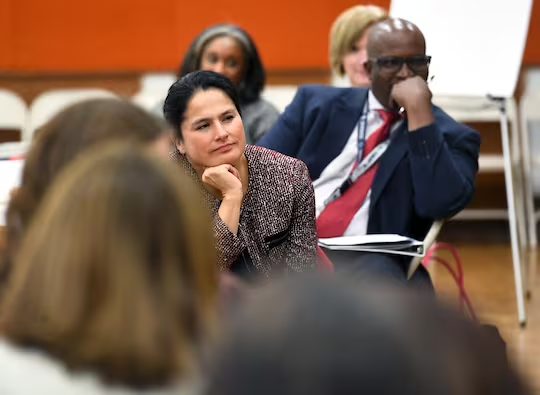
Students and educators in a protest Tuesday evening called on Montgomery County Public Schools to reinstate teachers who were placed on administrative leave for sharing pro-Palestinian sentiments.

About 50 people rallied by the entrance to the Carver Educational Services Center in Rockville, which houses the county board of education, while a meeting was taking place inside. They chanted, “Reinstate our teachers now.”F

After an hour of listening to speakers, organizers walked over to the building’s front doors and chanted, “B-O-E, you can’t hide.” Some of them started booing and blowing whistles as they slammed their fists against the building’s front doors.

Several school systems across the country have struggled to figure out how to respond to teachers and students who want to talk or raise awareness about the Israel-Gaza war as they are also experiencing a rise in hate incidents targeting Jewish and Muslim students. The Montgomery school system — Maryland’s largest, with about 160,000 students — placed one teacher on administrative leave for writing in her work email signature: “From the river to the sea, Palestine will be free.”

The teacher has since filed a complaint with the U.S. Equal Employment Opportunity Commission that alleged discrimination and is receiving legal support from the Council on American-Islamic Relations. At least three others have been suspended for posts made on their personal social media accounts.

Schools shut down some students, teachers who comment on the Gaza war

The posts have varied in nature. In one account, screenshots show a teacher at Tilden Middle School in Bethesda falsely stating that the attack at a music festival on Oct. 7 was a hoax. A different teacher at Takoma Park Middle School who was placed on leave reshared a post that read: “A shout out to bus operators at Dulles who refused to transport Zionists to the pro Israel rally. Their solidarity with the victims of Israeli genocide should be commended.”

Organizers for Tuesday’s demonstration argued that the school system’s disciplinary action violated the teachers’ First Amendment rights. They say the school system didn’t give the teachers a chance to explain themselves.

“It’s definitely unlawful,” said Becca Rothstein, a Jewish teacher in Montgomery County who helped organize Tuesday’s protest. “They just put these teachers on leave without really an explanation of saying why.”

Originally the protest was intended to ask for the reinstatement of Angela Wolf, the Takoma Park Middle School teacher, said Rothstein, who knows Wolf personally. But as organizers saw reports of more teachers on leave, they expanded their call.

Wolf was at the rally but declined to comment.Share this articleNo subscription required to readShare

Montgomery County Public Schools spokeswoman Celia Fischer confirmed that four employees are under investigation and were placed on administrative leave as a part of the process. She referred to the school system’s guidelines on digital communication, which instructs employees not to engage in “any conduct that is rude, disrespectful, uses vulgar language, racial slurs, or includes materials that are inflammatory, libelous, slanderous, or constitute cyberbullying, harassment or intimidation of others.”

School board members and Superintendent Monifa B. McKnight were scheduled to meet inside with student leaders to discuss mental health, school safety, athletics and other topics on Tuesday. Several Montgomery County Police Department vehicles were in the parking lot, and two school security staff monitored the protest from inside the building.

A teacher wrote a Palestinian rallying cry in her email. She’s on leave.

The rally was mostly peaceful. Some of the signs in the crowd said, “Stop criminalizing dissent,” and “MCPS stand by your staff.” A former student of Wolf’s, Khaliah Deya, spoke at the rally and characterized Wolf as “an anti-racist educator.” She added that Wolf was “de facto censored on false charges of antisemitism.”

Deya, 22, said that she drove from Baltimore to show support for Wolf, who was one of her middle school teachers. She said some of the social media posts from Wolf were “taken out of context.”

“Yes, she is a teacher, but she is a human being first,” Deya said. “She has her own personal opinions and expressions. … To judge her so harshly for voicing her own personal opinion on her own personal page, I think, is completely disrespectful.”

Last week, the Jewish Community Relations Council of Greater Washington issued a statement that supported the school system’s decision to place the four teachers on administrative leave.

“While it is true that public officials, including teachers, may express opinions on public issues when speaking in a private capacity, that right is limited to those cases in which the speech does not interfere with official duties,” the organization said. They added that the teachers’ actions were “well-known, insidious anti-Semitic messages” that “cast doubt on their fitness to teach.”

Rothstein said the suspensions send a troubling message to students that is “anti-education.”

“Our students see what’s going on on their phones,” she said. “They’re confused why their teachers are being taken out of the classroom for saying something.”

https://www.washingtonpost.com/education/2023/12/20/montgomery-protest-teacher-suspensions-palestinian-israel-gaza/

The 5 absolute truths I’ve learned in 10 years as a parenting editor

Perspective by Amy Joyce Staff writerDecember 19, 2023 at 6:00 a.m. EST Washington Post

hen I started editing On Parenting about a decade ago, I knew we had to cover parenting in a very real way. Parents felt alone, that they weren’t sure how to do this. Essentially, I felt that caregivers wanted what I wanted: to learn and to be understood.

Thankfully, it seemed to fill a need, and On Parenting took off. What a fun time we’ve had.

This piece marks the end of my tenure not just with On Parenting, but my 28 years at The Washington Post. I was fortunate enough to do many interesting things as a writer, reporter and editor. But by far, my favorite was parenting — the beat I cared about the most.

How lucky I’ve been to learn how to be a parent in a way few people can: by reporting stories, editing essays, talking to amazing minds, experts, academics and, of course, other parents. I wanted to understand it all.

But here’s the thing about parenting: We will never understand it all. Nor will we do everything right, not even close. I know that’s not possible, especially in a country where child care is unaffordable, where there is no universal paid leave for new parents, where health care is impossibly expensive and where people are discriminated against when they are pregnant and when they become mothers.

And yet, we continue to try to understand.

So what have I learned? Here are the five absolute parenting truths I leaned as my sons grew from babies into teens, and as I grew from the new mom and On Parenting editor into, well, me.

Boundaries are good, and your influence matters

“If there’s anything we’ve confirmed over and over in the research literature is that children thrive when they have both warmth and structure,” Lisa Damour, author of “Untangled” and the “Emotional Lives of Teenagers,” told me recently.

People say children will see how far they can go and we must “nip it in the bud.” It’s true that they push the limits — begging for another cookie, staying out past curfew, playing on devices too long. The key, though, is not to “nip” anything, but to have a loving relationship so you can say “You know you can only have one” or “You’re past your time limit, turn it off.”

These boundaries and structure aren’t always clear immediately. But when you take the time to truly know your children, you will better know what they need. (Bedtimes, for instance, have always been pretty defined in my house because we know our boys need their sleep or they don’t function well.)

Not only have boundaries and rules changed as my children have, but so have we as parents. Damour once told me she had to learn not to take anything too personally. “One of the challenges of raising teenagers is it is their job to seek independence, which often means pushing us away,” Damour says. “And it’s the job of the parents to not take this as a personal rejection, to recognize this as a sign of healthy development.” Because a teen who is prickly one minute is often seeking our comfort the next, she says. And if we’re holding a grudge, we’ll miss out on being able to support them when they need it.

As much as children push back, they are comforted to know those rules are there, that “things will not be allowed to spin out of control,” Damour says. Recently, I found myself apologizing for holding strong on some rules I can’t recall now — maybe it was the no phones in bedrooms line we drew. My older son stopped and said, “It’s okay Mom, you’re the parent.” It doesn’t always go that smoothly, but if ever there was a moment where I understood what he needed, it was then. Thanks for that reminder, kid.

Kindness and empathy are learned

One of the most-read stories we’ve had at On Parenting published in July 2014: “Are you raising nice kids? A Harvard psychologist gives 5 ways to raise them to be kind.”

The subject of that piece, Richard Weissbourd, director of the Making Caring Common Project at Harvard, suggests that we forget to (or simply don’t) prioritize caring for others. In his research, 80 percent of youths interviewedsaid their parents were more concerned with their achievement or happiness than whether they cared for others.

Children are not born understanding how to help their community. They need parents to model that for them: being kind to strangers, to bus drivers and to wait staff; asking your small children who they were kind to today and why. Piece by piece, you are helping them build their moral fabric.

“It’s about having the motivation to care about other people,” Weissbourd said to me recently. “But it’s also about having the skills to listen to other people.”

How to help children find awe, our most undervalued emotion

Let them learn for themselves

I remember watching my son grasp a plastic shape with his chubby baby fingers and try to force it into the wrong hole. It was so hard to sit on my hands and not do it for him. And yet when I did just watch and encourage him, he twisted it and pushed it until he found what worked. That shape sorter is a rite of baby passage. That urge to help a little too much is a part of parenthood.Share this articleNo subscription required to readShare

There have been times, of course, where I was impatient and couldn’t keep my hands off, assuming I was showing my sons how to do it better. Or maybe I wanted to swoop in because I hated to see them struggle — with school, with friends, with teachers, with disappointment. But I also have had to learn this is exactly how they learn to live, to cope and to thrive.

As Jessica Lahey, author of “The Gift of Failure,” said to me recently: “Do I want them to be able to do it perfectly today, the way I want it done? Or do I want them to be able to just do it themselves next time?”

That helicopter parent thing is real, and it is detrimental. When we get too involved, “we just obliterate any possible obstacle that stands in a kid’s way and you don’t develop the confidence you can handle hard things,” says Ned Johnson, co-author of “The Self-Driven Child.” “When we go and put on our cape and rescue our kids, we feel relieved and they do. But we deprive them of feeling like superheroes of their own lives.”

I was the parenting editor during the college admissions scandal, when it was discovered that parents had cheated and paid to get their children into colleges. That phrase “helicopter parenting” became synonymous with the scandal. Don’t be the helicopter parents. Be the cheerleader. Be the place for your children to fail safely. After all, if you put that triangle in the right hole for your baby, what is gained? A box with some shapes inside and a bored kid who can’t figure it out.

Connection is the key

I first heard about Meghan Leahy at a moms group I attended when my boys were little. Someone said they had a “parent coach” who changed their family’s life. What did she do that was so magical, we asked. This mother laughed a little and said: “Pretty much showed me why I needed to hug my kids more.”

I went on to hire Meghan as our parenting advice columnist. And that hugging advice is a bedrock of her parenting philosophy. It’s not just about hugs — what she wants us to know is that everything comes down to our connection with our kids. “I don’t know why we’re here on Earth,” she said to me recently, “but we are, and we’re built to connect.”

We parents can spend a lot of time actively not connecting with our kids — I need to get this done, I need to get that done, I have to focus on this other thing, Leahy says. And so when a child looks to be “misbehaving,” we should “shift our focus to ‘My child is trying to connect with me,’” she says.

I recall a time when I was struggling with two small boys, a job, a sick parent, a life. Meghan suggested taking a few minutes to stop what I was doing and look them in the eye, play a game, be silly together. It worked. Whining mostly stopped, we came to love those moments, and I still had time to get all the things done.

When life feels a little off the rails with the teens in my house now, I stop to think about how we’re connecting. Often, I realize we haven’t had a moment in a while. But here’s the thing: I’m not sports obsessed, they’re beyond sporty. I love art, pottery, going on hikes. They … are the opposite. So I have to find a way in. Sometimes that means me sitting near them as they tell me about this crazy video they just watched. We connect in our own ways, and I’ve learned to look for the opportunities to do that, rather than waiting for them to magically appear. And in the meantime, I’ve built this relationship with some really amazing teens.

It goes too fast

I was once told to “love every minute” by an older man while I was wrangling two toddlers in a hardware store. I looked up, after jimmying one of the boys into the shopping cart and begging the other to hold my hand, and, well, you can imagine what I wanted to tell that man at the time. And here I am, years later, remembering every detail of that fuzzy blue hat on my boy, the innocent trust they had in their mother, saying it went too fast.

So here is my advice: Write it down. Take pictures. Notice things in the moment — like when they put their head on your shoulder. When they say something wise. When they do something kind. When they are funny. And when they want to talk to you, try to give them that minute. When they beg you to sit with them at bedtime and you’re exhausted? Give them the time.

Because it does go fast. That’s why you look at photos of them on your phone at night after they are finally asleep. That’s why you already miss them and they still live in your house. That’s why you tear up when you give their outgrown Halloween costume away.

I guess this is what I really learned, while raising two boys: I learned about these two people who live in my house, who grew up with a mother who was a parenting editor, who sometimes hated that I knew “so much,” and who are their very own, self-propelled, amazing individuals. Despite me, despite the very little I know.

https://www.washingtonpost.com/parenting/2023/12/19/five-truths-about-parenting/

Homelessness is at a record high in America. Volunteerism is declining.

Perspective by Petula DvorakColumnist December 21, 2023 at 12:16 p.m. EST Washington Post

A sharp rise in the number of people unhoused for the first time drove the uptick. Meanwhile, fewer Americans are stepping up to help.

He traced the letters of his name with his finger in the night air: “I -B-A-N-E-Z.”

Rafael Ibanez, 54, has been repeating his name, spelling it out, for government bureaucrats for at least two months, since the backpack containing all his identification papers was stolen.F

He’s on his makeshift front porch, a scavenged folding chair next to his shelter, garbage bags hung on crisscrossing ropes. Across the street, little girls in glittery blue dresses were giddy at the Kennedy Center’s Opera House for opening night of the Disney musical “Frozen.”

One city, two worlds in the nation’s capital.

Ibanez is part of one of the fastest-growing populations in America – the homeless.

Last week, the Department of Housing and Urban Development released its Annual Homeless Assessment Report showing that 12 percent more people were experiencing homelessness this year compared to last. And the number — about 650,000 — is the highest ever since they’ve been keeping count.

“Homelessness is solvable and should not exist in the United States,” said HUD Secretary Marcia L. Fudge.

Indeed. And yet here we are, a calamity that is entirely man-made.

Ibanez worked as a landscaper and construction worker in Arizona for decades,he said, then work dried up and he followed a family member north, where he hoped jobs would be easier and more abundant.

His backpack and identity papers were stolen when he was in Manhattan. So he came to D.C., as many do, in the belief that proximity to the federal government will ensure they’ll get assistance and benefits quicker.

A decent number of the folks in D.C.’s tent villages are like him. Veterans who want their benefits, immigrants who want to become citizens and folks whose Social Security benefits were janked up believe their answers lie in the nation’s capital.

The numbers in D.C. are also rising, with an 11.6 percent increase this year over last, according to the D.C. government. There are about 5,000 people without a home in the nation’s capital.

This was the case with one unforgettable woman I met in 2016, Wanda Witter.

After battling Social Security for years, hauling three suitcases stuffed with paperwork to prove her case, the then 80-year-old woman who was homeless until the week we met got one of the biggest I-told-you-so’s that a person can hope for.

‘I wasn’t crazy’: A homeless woman’s long war to prove the feds owed her big bucks

The government admitted the mistake and deposited $99,999.00 in her Sun Trust bank account. She got a cute apartment.

Ibanez has been living outside the Kennedy Center for two months now. He said it’s the first time he’s lived rough,and it’s getting colder. He believes that if he could just get someone in the federal government to believe who he is, he can come inside, too. But the visits to offices haven’t helped.

There are facts of his story I’m missing and I’m sure many are hard.Share this articleNo subscription required to readShare

But there he was this week, among a small tent city of the forgotten, trying to stay warm, eat and get someone to acknowledge his existence so he can file for food stamps and housing benefits.

This is getting more difficult in America – and notably in D.C. – because the nonprofits that step in to help people, which have long been underfunded and understaffed, are running up against a deepening challenge: a nationwide decline in volunteers.

The number of Americans who raised their hands to volunteer in the United States dropped about 7 percentage points between September 2020 and September 2021, to the lowest it’s been since do-gooders work has been tracked in the early 2000s, according to a January report released by the Census Bureau and AmeriCorps, the federal agency for national service and volunteerism.

“There have always been organizations that have struggled to find volunteers, but it’s now it’s a huge problem,” Nathan Dietz, research director at the Do Good Institute in the University of Maryland’s School of Public Policy, who co-wrote a study released last month exploring factors influencing volunteering and charitable giving in the United States, told my colleague Joe Heim.

Plus, these remaining folks who help the homeless are being flooded because of this sad fact in the yearly count — the steep increase in homeless Americans is largely made up of folks who are unhoused for the first time in their lives.

It’s a domino effect — it’s hard to buy a house, so the renter market is flooded and rents are growing.

“Millions of households are now priced out of homeownership, grappling with housing cost burdens, or lacking shelter altogether, including a disproportionate share of people of color,” according to a report by the Joint Center for Housing Studies at Harvard University.

These aren’t just the folks battling mental illness or addictions, as former president and current candidate Donald Trump would like you to believe as he tromps through America with dictatorial declarations of mass roundups and arrests of the homeless and immigrants.

Between fiscal years 2021 and 2022, the number of people who became newly homeless increased by 25 percent, according to HUD data.

“This rise in first-time homelessness is likely attributable to a combination of factors, including but not limited to, the recent changes in the rental housing market and the winding down of pandemic protections and programs focused on preventing evictions and housing loss,” the HUD announcement said.

These are folks thrown to the curb because the rent is simply too darn high.

The eviction protections that helped renters during the pandemic are gone. And the people already on the edge before covid paralyzed the nation are falling off, according to the Harvard report.

Ibanez wishes he could pay rent again.

For now, he gets takeout boxes that diners leaving Georgetown restaurants give him. Some of the folks who rack their rental bikes next to his encampment give him their coats or blankets. He’s seeing more of this now, close to the holidays.

“People are good to me,” he said. “They try.”

Not hard enough.

https://www.washingtonpost.com/dc-md-va/2023/12/21/homelessness-rising-dc-volunteers/

Montgomery and Prince George’s school enrollment lags pre-pandemic total

By Nicole Asbury

Maryland’s two largest school systems both have about 3 percent fewer students this fall than they did before the coronavirus pandemic, according to enrollment data made public this week.

Montgomery County Public Schools counted 160,770 students on Sept. 30. That was almost unchanged from last year’s total and about 4,500 fewer than the enrollment in fall 2019.Fast, informative and written just for locals. Get The 7 DMV newsletter in your inbox every weekday morning.

Prince George’s County Public Schools reported 131,390 students, spokeswoman Meghan Gebreselassie said Wednesday. That, too, was nearly the same as the fall 2022 head count, and it was about 4,600 students fewer than the 2019 enrollment.

The pandemic shuttered schools around the country in early 2020 and forced students to attend classes remotely, causing massive disruptions and enrollment drops. Statewide, Maryland schools lost more than 18,000 students in fall 2020.

This week’s data shows that enrollment in Maryland’s two most populous counties has not yet recovered.

The Maryland Department of Planning had projected in an August report that statewide enrollment would increase through 2024a trend fueled in part by recovery from the pandemic and immigration.

Elsewhere in the Washington region, some schools are already bouncing back. In October, preliminary counts totaled more than 98,000 students in D.C. traditional public and charter schools, which outpaced pre-pandemictotals.Share this articleNo subscription required to readShare

The numbers from Prince George’s and Montgomery aren’t final. The Maryland State Department of Education expects to release a full enrollment report in January.

D.C. releases ‘highest ever’ school enrollment figures

Before the pandemic, Maryland officials expected public schools would expand. A 2019 state planning report projected seven years of enrollment growth, with most gains from 2019 to 2022. At the time, state officials projected Montgomery schools would have about 163,900 students and Prince George’sabout 133,400 by the 2023-24 school year. Neither system has reached those numbers.

Montgomery school officials attribute the decline to “significant impacts from the pandemic,” spokesman Chris Cram said. Some families enrolled children in private schools. Some teach them at home. Others moved out of the county.

During a Montgomery school board session Tuesday, county schools Superintendent Monifa B. McKnight acknowledged the setback the school system experienced during the pandemic after several years of growth. She added that officials expect enrollment to “move and change as the school year goes along.”

“We are a very mobile county,” she said. “Our students don’t fit into this perfect space of coming in and enrolling in MCPS by Sept. 30.”

Seth Adams, associate superintendent of facilities management, said the system projects enrollment to reach 167,000 by 2029. But he said a decline in births will slow kindergarten enrollment over the next few years.

Maryland colleges are trying to shake tepid enrollment. Results are mixed.

Montgomeryschools reported about 56,700 students identified as Hispanic this fall, the largest ethnic group in the system. About 38,400 of the county’s students are non-Hispanic White, about 34,700 are African American, and about 22,000 are Asian American.

Prince George’sschools did not immediately provide demographic breakdowns.

https://www.washingtonpost.com/education/2023/11/02/montgomery-prince-georges-school-enrollment-lags-pre-pandemic-total/

Being 13

Addi and a friend are in the backseat of a car. Addi is holding an iPhone, showing it to her friend, and laughing.

By Jessica Bennett Sept. 20, 2023 New York Times

As eighth grade began, Anna was worried that she wasn’t very popular because her parents wouldn’t let her on Snapchat. London had a tough couple of days; she had been sent to the principal’s office for lashing out at a girl who had been mean to her by sending a text impersonating a boy that girl liked. And when Addi’s school had a lockdown later in the year, she spent the evening decompressing with her sister, reenacting a TikTok sketch — her mind far from the flashing police lights that had reflected in the windows.

Anna, London and Addi — three girls from three states, who, at 13, were legally able to join social media, and whose cellphones were always close at hand.

I started following them a year ago, after they responded to an open call for teenagers who’d let a reporter into their lives and phones. With their parents’ permission, they each wrote weekly diaries and recorded voice memos about their days (except when they were grounded). The girls’ last names have been withheld to protect their privacy, but all of the images and text messages you see here are real.

I wanted to put a face to the alarmingheadlinesabout teensandsocial media — in particular, girls. And to understand one tension: What happens when girls’ self-confidence, which has been shown to drop right around this age, intersects with the thing that seems to be obviously contributing to their struggle?

Read On Below

https://www.nytimes.com/interactive/2023/09/20/well/family/13-year-old-girls-social-media-self-esteem.html

Norman Lear’s secret to longevity? Always being curious about others.

Perspective by Hank Stuever Washington Post December 6, 2023 at 5:25 p.m. EST

The older he got, the more Norman Lear became the symbol of something he never agreed to be, but nevertheless was, up until his death Tuesday at age 101: the infinitely thoughtful, creatively productive, intelligently outspoken, most-elder citizen of the great American ideal, always open to what’s next, what’s happening, what’s now.

“I don’t wake up in the morning to be old,” Lear told me during an October 2017 day I spent with him for a Washington Post profile. “I wake up to do the things that were on my mind when I fell asleep last night.”

At the time, he was 95. He had been out the night before, very late, watching Dave Chappelle and others at a comedy club. He said that once he turned 90, he noticed that people applauded his presence alone, regardless of the occasion or work at hand. He was still learning to be gracious about that — the beloved, good-humored old man in the trademark white boater hat. Walk into any room, and they all stand and smile at you.ADVERTISING

His advanced age had become yet another feature of a person whose influence on television and cultural life was already part of history, and still part of its present: He had finished work on a second season (of an eventual four) of Netflix’s “One Day at a Time,” a funny and remarkably modern reboot of one of his 1970s sitcom classics. That afternoon, he would take a call from a producing partner on a series he was eager to make about getting old, tentatively titled “Guess Who Died?”

Obituary: Norman Lear, who brought social commentary to the sitcom, dies at 101

A couple of years later, ABC and late-night host Jimmy Kimmel dabbled in a completely unnecessary yet engagingly irresistible experiment: live prime-time reenactments of memorable episodes of Lear’s sitcoms (“All in the Family,” “The Jeffersons”), with Lear himself occupying a center seat of honor in the show’s studio audience. Applauded, again, for still being here, still being Norman Lear.

It was fun, yet there was also something subliminally wistful about the whole affair, some mutual acknowledgment that Lear’s style of sitcom — unabashedly topical, emotionally raw, empathetic yet hilarious, filmed with multiple cameras before a studio audience — had become a revered artifact. (The new “One Day at Time” got rave reviews and yet lived its short life entirely under the cancellation ax.) Archie Bunker, Maude Findlay, George Jefferson. The actors who originally played them were by then all dead. It was hard to avoid wondering how Lear truly felt about all this retro reverence.

He was sentimental (about his childhood, about his World War II service, about his country, about his kids), but not overly nostalgic. He loved the present, with all its attendant problems. He spent his life in the moment (the television moments, the political moments, the cultural moments), to such a degree that it’s difficult to think that he’s actually gone. Hardly any of us will get to our old age the way he did, and yet we seem to believe it’s widely possible, in no small part because a fair number of our celebrities, including the pioneers of TV (Lear, Betty White, Carl Reiner, Bob Newhart, Mel Brooks, Dick Van Dyke, et al.), have made it look so effortless.

From 2017: Norman Lear put his foot down — and Trump’s White House flinched

It’s not. The wellness industry, AARP and so many others try to sell us the dream of the optimally fabulous old age — even as TikTok fills up lately with millennials in their late 30s complaining about back pain. (Imagine.) Lear was all the proof anyone needs that a charmed life is both charmed and earned, and when it came to aging, his response to it fit neatly with what his TV shows taught us all along: Life is not easy. Life is not fair. But how people live it is fascinating, and perhaps the secret is to remain deeply curious about how life goes for other people.

In his memoir and interviews, Lear talked about being a boy in New York and wondering, on elevated subway rides, what was going on in each and every apartment and house the train passed: What’s for dinner? What are they talking about? Early television’s attempts to answer this were overly sweet, ordered and White.Share this articleNo subscription required to readShare

Lear and his collaborators came along and suggested that the manners within the American household could be loud and rude and fraught with divides over almost any issue (politics, class, race, gender, religion, sex, money — the biggies), and tangled up in personal biases and the wounds of the human condition. Love could and should exist in there, too, and all of this could also be, in a perfectly placed swerve of comic timing, hilarious. The only way to understand the lives of these fictional other people is to eavesdrop from the fourth wall and accept them as they are, to the point where their responses and behaviors adhere to a formula that fits into 22 minutes of TV.

On this side of the fourth wall, we have the luxury of not having to wrap up our personal crises at the half-hour mark and at least the delusion that our lives do not hew to formula (when they so often do). Watching those sitcoms, America became like Lear on those train rides — desperate to look in and, in so doing by the millions, experience an electronic togetherness.

Another word for it is empathy. And another thing to remember, which was very important to Lear, was that in World War II he had been the one to open the bay doors of a B-17 and watch bombs descend on towns below, also filled with houses filled with families at dinner tables, also having conversations, also filled with stories he longed to know.

Empathy was a constant in Lear’s work and in his public life, as founder for People for the American Way, in which the principles and points of view evident in his television shows (Is it possible to reason with a bigot like Archie Bunker? What’s life like for a self-made Black businessman who moves with his family to a deluxe apartment in the sky? What options are available for Maude during an unplanned pregnancy?) apply to a political and social sphere: What if our decisions were based on acceptance and bridging our differences? What if we could truly and honestly relate, instead of siphoning ourselves off into niche audiences and markets?

By 2017, Lear had experienced the gall of watching Americans cruelly disregard one another’s experiences, backgrounds and beliefs in a tidal shift of populist politics. Television itself was deep into its own fragmentation process of streaming services offering hundreds of new TV comedies and dramas, which had a way of undoing communal experience. (Hence Kimmel’s fond desire to re-create old-fashioned sitcom broadcasts, if only for a night or two.)

Lear talked to me about his nightly habit of getting in bed and watching the entire MSNBC lineup for fresh outrages coming out of Donald Trump’s Washington.

Norman Lear turns 100 and shares the meaning of life

I asked Lear whether it was sometimes all too much for a nonagenarian to bear? Did he envy the many friends and loved ones who had already passed and were therefore spared what, on some nights after too much Rachel Maddow, had begun to look like the end of everything decent, constitutional and free — the things he held dear.

I had absent-mindedly brought my hand to my mouth as I listened to his answer. He laughed. Why would anyone want out?

“I’m much more involved with the wonder or the acceptance as a kind of miracle that you just put your hand up and put your finger near your lip,” he said. “It took you every f—ing split second of your life to get to do that, and several seconds more to hear me say what I’m saying, and it took me every split second of my life, 95 years, months, weeks, hours, days to say what I’m saying now and to shake my head yet again. So, does that say something about the moment and the importance of the moment? We’re living in a world where everyone, all the billions of them, lived so we can sit here and have this conversation.”

That moment faded into my past and his, but the lesson was clear — Norman Lear wasn’t planning to go anywhere soon, and he had left me with what felt like his best advice: Stick around and see how the show ends, for as long as it’s airing, and never stop wondering about the world around you and the feelings and interactions of the human characters in it.

By Hank Stuever is a deputy features editor at The Washington Post, focusing mainly on the Style section’s coverage of culture, politics, media, fashion and entertainment. He joined The Post in 1999 as a Style reporter. He was the TV critic from 2009 to 2020 and a senior Style editor from 2021 to 2023.  Twitter

https://www.washingtonpost.com/entertainment/tv/2023/12/06/norman-lear-longevity-age-tribute/

Why Is It a Surprise That America Is Gloomy After a Devastating Pandemic?

An upside down happy face, magenta with beige facial features is draped by a green cord with blue and white beads scattered.


By David Wallace-Wells
New York Times December 10th 2023

“Why is everyone so grumpy?” my colleagues Peter Coy and Binyamin Appelbaum asked last month, broaching the subject that has preoccupied confused economists and anxious Democrats.

American G.D.P. is booming, unemployment is near historic lows and inflation increasingly appears to be under control, such that even notorious inflation scolds have declared that a once improbable economic “soft landing” is imminent. But if every conventional top-line measure of the health of the economy is strong, why are so many Americans so despondent about the state of the country and its future, with poll after poll showing deep dissatisfaction with the state of the economy?

The outsize effect of inflation has been the most commonly offered hypothesis in debates over the “vibe-cession”: While the inflation rate has slowed considerably, prices are stable only at much higher levels than even three years ago. Other theories: that partisanship is clouding our judgment, that the media is shoving too much bad news down our throats and that the grimmest takes invariably take over TikTok. There are other propositions, too, each weedsier than the next: that wage gains powered by pandemic relief were reversed when that stimulus was withdrawn, that rent and the cost of homeownership are driving generational despair and so on.

But in fishing for causes, an obvious contributor is often overlooked: the pandemic itself. It not only killed more than a million Americans but also threw much of daily life and economic activity and public confidence into profound disarray for several years, scarring a lot of people and their perceptions of the country, its capacities and its future.

When Americans are asked whether the country is on the right track, or whether they themselves are optimistic or pessimistic, they don’t treat the query like a trivia quiz about the last quarter’s G.D.P. growth or the Black unemployment rate or even the size of their own paychecks or stock portfolios. They are effectively responding to the therapist’s query: How are things? They answered that question according to one set of patterns, stretching back decades. And the pattern did not begin to shift only when inflation peaked in late spring 2022, or when pandemic relief was relaxed in fall 2021, or when supply-chain issues first arose earlier that year. They began answering differently in 2020, as the scale and duration of the pandemic came into view.

For decades, surveys about the economy were such an accurate gauge of economic fundamentals that, practically speaking, there was little need to distinguish between the two.

That all changed in early 2020, when a significant gap opened between economic conditions and public perception. Perhaps the most vivid illustration of this gap comes from The Economist, which trained a computer model to use fundamental economic indicators to estimate consumer sentiment. Using those indicators, the model was able to quite closely predict public sentiment, showing a very close correlation between economic fundamentals and public perceptions that stretched back at least to 1980.

Then, in early 2020, the correlation evaporated in the United States. At first, the fundamentals tanked while Americans maintained a rosier view of things, but this relative optimism was pretty short-lived. By the fall, the gap had opened up in the opposite direction, with Americans more pessimistic about the economy than the “fundamentals” model predicted. By the spring of 2021, the gap was about 20 points. By the end of the year, which was both the deadliest in the pandemic and when inflation first arrived, public confidence was 30 points lower than the model suggested. By June 2022, when inflation peaked just after the cessation of the Omicron wave, the gap was about 35 points.

A similar analysis by The Financial Times shows the same pattern: An expectations gap in the United States opened up in 2020, grew in 2021 and held steady through 2022. Other ways of charting the divergence tell slightly different versions of the story: Data from the Conference Board show steep falls in confidence in 2020, followed by messier data since. Last month my colleague Paul Krugman published his own analysis, using a different model built on the University of Michigan data, which more clearly showed the effect of inflation in 2022 but also showed larger gaps at earlier points in recent economic history — and made the current divergence, which measures at about 15 points, seem less anomalous as a result. In fact, the most striking feature of his chart may be the step-change downward in 2020, for both “observed” and “expected” sentiment. The current gap appears no bigger than the negative gap that prevailed in 2009 and 2010 and not much bigger than the positive one that held through the Trump “boom,” when partisanship probably helped contribute to public confidence 10 points higher than the fundamentals suggested.

If all of these analyses suggest that the gap between fundamentals and mood represents a negative vibe, it is probably worth considering, alongside the economic factors, the way that vibes of widespread social dislocation, illness and death have contributed, as well. But it is remarkablehow invisible the pandemic has been in recent debates about American gloom, with only a few economists even considering the role that recent mass death and social disorder may be playing in our moods. America’s worst year for Covid deaths ended just 23 months ago.

There were secondary effects: mass unemployment, G.D.P. contraction and a stock-market collapse, a rapidly expanded social safety net. But each was reversed fairly quickly, leaving behind a discombobulated economy that nevertheless looks, at first glance, pretty healthy. These days, both consumers and businesses are acting as if the economy is booming, spending and investing and mostly reporting good news about their own finances. But when asked to assess the broader state of the world, they invariably get bleak. “The pandemic shattered a lot of illusions of control,” the University of Michigan’s Betsey Stevenson recently told The Times. “In terms of sentiment,” the former Federal Reserve economist Claudia Sahm wrote this fall, “the pandemic caused a sudden increase in pessimism that hasn’t gone away.”

Covid-19 isn’t a total explanation, of course. People do worry about price levels, not just the rate of change, and for much of the past two years, inflation outpaced wage growth. Much of the gains Americans got from pandemic stimulus policies disappeared in 2022, when they were rolled back, driving child poverty back up and leaving millions more disenrolled from Medicaid. Partisanship skews perceptions, and perhaps the media does, too, including by underplaying the way that a Trump presidency would make inflation worse. (Though none of those phenomena were new in 2020 or 2021.)

But let’s not forget that the backdrop for all of this economic dislocation was the pandemic itself — a tough and disorienting few years for almost everyone, whether you spent them anxious about infection or outraged about mitigation overreach or somewhere in between. According to the General Social Survey, the share of Americans describing themselves as “very happy” fell about 40 percent between 2018 and 2021 and has only halfway recovered since. The share of Americans who described themselves as “not too happy” roughly doubled early in the pandemic and has barely declined since.

That alone is a big hole to climb out of, emotionally and politically, and as Jerusalem Demsas noted recently in The Atlantic, it takes a little time for perceptions to catch up with reality. Would it have been reasonable, in 2010 or 2012, to ask about public confidence in the economy or the shape of the future without emphasizing the financial crisis in the rearview mirror? In 1992, 15 months after the end of what was in retrospect a mild U.S. recession and in a much calmer time for partisanship and news polarization, the percentage of Americans who said they were satisfied with the direction of the country hit a new low: 14 percent.

This time around, the top-line recovery was remarkably swift. But while President Biden is being graded harshly — with lower approval ratings at this point in his first term than any other president since Jimmy Carter — only one leader of a Group of 7 nation is more popular than he is. In Britain, Rishi Sunak’s net approval hit negative 45 in September; in Canada, the Justin Trudeau government has a negative 33.

What’s unusual isn’t America’s gloominess, the Financial Timesanalysis illustrates, but that the economic reality in the United States is buoyant compared to those peers. Consumer confidence in the United States is roughly the same as it is in France, Germany or Britain, each of which has had worse experiences of inflation and a worse postpandemic economic performance than ours.

It may be that there are some unusually negative features of the American recovery buried deep in the data, or that there is something unique about the way American partisanship and news polarization shaped the country’s experience of the pandemic and the pandemic recession. But it’s also worth noting that things look and feel pretty bleak everywhere, regardless of the economic data. In the aftermath of what counts these days as a world-historical trauma, the world as a whole remains in a pretty gloomy place. Is that really a surprise?

https://www.nytimes.com/2023/12/06/opinion/bad-economy-vibes.html

People Are Pessimistic About Their Economic Futures. Can You Blame Them?

A colorful, simple drawing of a person lying facedown, their legs on the lawn, their torso on a sidewalk and their head on the street. Scattered on the ground are a small American flag, a “Joe” hat, a “Joe” button and a “Biden Harris” lawn sign.

By Steven Rattner  served as counselor to the Treasury secretary in the Obama administration.

As a part-time commentator on things economic, I’m often asked a seemingly straightforward question: If the economy is so good, why are Americans so grumpy?

By many measures — unemployment, inflation, the stock market — the economy is strong. Yet only 23 percent of Americans believe the country is headed in the right direction, a strong headwind for President Biden’s approval ratings. Meanwhile, Donald Trump’s formidable base of disgruntled voters endures.

As I’ve engaged with my many interlocutors, I’ve concluded that voters have valid reasons for their negativity. In my view, blame two culprits: one immediate and impacting everybody, and another that particularly affects young people and is coming into view like a giant iceberg. Both sit atop the leaderboard of reasons for the sour national mood.

While inflation has provided the proximate trigger for unhappy feelings, an understandable grimness about our broader economic prospects, particularly for younger Americans, is playing a major part.

Start with inflation. Until the chaos of the pandemic, there hadn’t been a year with average annual inflation above 4 percent since 1991. As a result, for more than two-thirds of voting age Americans, 2022 was by far the highest inflation of their adult lifetimes.

To them, higher prices just means less spending power. A recent Blueprint/YouGov poll on the economy found that just 7 percent of respondents were principally concerned about the availability of jobs, while 64 percent were most worried about prices.

The problem for President Biden is that by a margin of 43 percent to 23 percent, voters believe that he is more focused on jobs. By strikingly similar margins, they credit Republicans with mirroring their priorities: 54 percent said prices while 18 percent mentioned jobs.

Even as inflation has receded from its June 2022 peak, sentiment has hardly shifted. Many Americans appear to believe that it’s not enough for costs to rise more slowly and that prices should fall toward prior levels.

To economists, that’s a fantasy. Prices writ-large haven’t declined substantially since the Great Depression, and the price drops that consumers seem to want would most likely indicate the kind of troubled economy they fear.

With each disappointing poll — many of the recent ones show Mr. Trump edging out Mr. Biden — the frenzy among Democrats to revive their 2024 prospects has only grown. Efforts by the White House a few months ago to trumpet “Bidenomics” (a portmanteau of two of the Democrats’ largest liabilities in 2024: Mr. Biden and his economy) as a success have fizzled.

Maybe that shouldn’t be surprising. Voters may have internalized the fact that Mr. Biden’s initial policy agenda included substantial increases in government spending, a potential source of inflationary pressure.

The longer-term issue that bubbles up from polls and other data is deep pessimism about the future. Uncharacteristically, a stunning majority of Americans now believe that the next generation is likely to have a lower standard of living.

A Wall Street Journal-NORC poll from March found that just 21 percent of respondents felt confident that life for their children’s generation will be better, matching the record low since this question was first asked. In 1990, 50 percent of those asked felt life would be better for their kids.

The pessimism is easy to understand.

Consider one marker of generational progress: moving out. Nearly half of all Americans aged 18-29 live at home with their parents, the highest share since the Great Depression. In recent decades, rents in American cities have far outstripped income growth for young Americans, even those with college degrees.

Those seeking to buy their first home and “climb the property ladder” face the double whammy of high house prices and high mortgage rates, creating a massive affordability problem.

Even more fundamentally, voters — admittedly, not economists — may deserve credit for at least subconsciously comprehending two immense longer-term challenges: lagging productivity and a huge and fast-rising national debt.

Increasing productivity — how much output per hour an individual worker generates — is the only lasting mechanism for improving the standard of living. During the halcyon postwar era, between 1947 and 1973, productivity increased at a remarkable 2.8 percent annual rate.

Then its growth — save for the computer revolution boom from 1995 to 2005 — slowed markedly, to just 1.8 percent between 1973 and 2019 and an even worse 1.3 percent in the last decade of that period. Living better becomes more challenging.

The reasons for this slowdown are myriad and much debated. They range from less innovation and less investment to corporate consolidation, land use restrictions and, over the last 15 years, the sluggish recovery from the Great Recession.

Moreover, workers have not shared fully in even these more meager productivity gains, as they did in the past. Since 1990, worker productivity has risen by 91 percent, but compensation (adjusted for inflation) has risen by just 58 percent.

The national debt, which was a (relatively) modest $5.7 trillion when President Bill Clinton left office early in 2001, has reached $33 trillion. This constitutes a form of intergenerational theft; while it will most likely never be repaid, rising interest costs will eventually require higher taxes or cuts in federal programs or both.

Perhaps this is why younger Americans are particularly troubled. Mr. Biden has far lower support among this cohort than he enjoyed in the 2020 election, when 60 percent of those under 30 pulled the lever for him. Today, his share of that group hovers around 50 percent in polls.

And, among 2020 Biden voters in swing states surveyed in another recent poll, just 11 percent of the 18-to-29-year-olds thought positively of the current economy, the smallest share of any age group. (Economics are hardly all that is worrying these Americans; among other things, they are also perturbed by his handling of the Israel-Hamas war, which just 20 percent of young voters approve of.)

What can Mr. Biden do, with the election just 11 months away? Probably not much. While inflation is happily showing signs of ebbing, the deeply structural productivity problem, decades in the making, would require many tough choices and require many years to address, even if our deep political divisions were to end and a national consensus were to form around the need for action.

Regardless, the narrative that we are in a bad economy is clearly deeply embedded in Americans’ consciousness. And there are early signs in softening retail sales that consumers’ propensity to spend is starting to wane, suggesting weakening economic conditions ahead.

But the president is not without hope. Once he has an opponent, he can attack their record and policies. That worked for Barack Obama in 2012 and for George W. Bush in 2004.

When stacked up in polls against a “generic Republican,” Mr. Biden trails by 16 percentage points in swing states. Against the likely nominee, Mr. Trump, he trails by just four.

Given the extreme views of today’s Republicans on issues like abortion and democracy (not to mention Mr. Trump’s obvious character flaws), shifting the focus of the 2024 campaign to his opponent may work well for Mr. Biden — even if the economic mood remains cranky.

https://www.nytimes.com/2023/12/07/opinion/economy-young-voters-inflation-biden.html

This Is Not the Way to Help Depressed Teenagers

An illustration of a headless student sitting at a school desk, holding his head in his hands.

By Darby Saxbe is a clinical psychologist and a professor of psychology at the University of Southern California.

Ever since the pandemic, when rates of teenage suicide, anxiety and depression spiked, policymakers around the world have pushed to make mental health resources more broadly available to young people through programming in schools and on social media platforms.

This strategy is well intentioned. Traditional therapy can be expensive and time-consuming; access can be limited. By contrast, large-scale, “light touch” interventions — TikTok offerings from Harvard’s School of Public Health, grief-coping workshops in junior high — aim to reach young people where they are and at relatively low cost.

But there is now reason to think that this approach is risky. Recent studies have found that several of these programs not only failed to help young people, they also made their mental-health problems worse. Understanding why these efforts backfired can shed light on how society can — and can’t — help teenagers who are suffering from depression and anxiety.

Consider a “social-emotional skills training” school program called WISE Teens. Led by clinical psychologists in training, it consists of eight weekly hourlong classroom sessions in which students learn to manage their emotions with the help of tools and principles drawn from cognitive behavior therapy and Zen Buddhism.

Last month, the journal Behavior Research and Therapy published a study of 1,071 Australian teenagers who were observed from 2017 to 2018: One group participated in WISE Teens; another group participated in a standard health-class curriculum. Compared with the teenagers who got the standard education, the students in WISE Teens reported more depression, more anxiety, more difficulty managing their emotions and worse relationships with their parents. One out of every eight WISE Teens participants appeared clinically depressed after completing the program, compared with one out of every 13 participants who did the regular health classes.

These results are striking but not unique. Last year, an even larger study of a school-based mindfulness program, which looked at more than 8,000 British teenagers in more than 80 schools, found that the program did not improve mental health — and in fact led to worse anxiety and emotional problems, and lower levels of mindfulness skills. Yet another study published last year, which included some 2,500 Australian teenagers, also found that a mental health program made students more distressed.

Why were these programs counterproductive? The WISE Teens researchers suggest, convincingly, that the teenagers weren’t engaged enough in the program and might have felt overwhelmed by having too many tools and skills presented to them without enough time to master them. (The study found that WISE Teens participants who spent more time practicing the skills at home showed some slight mental health benefits — though most of the participants did not engage in home practice.)

But I would venture three additional explanations for the backfiring, all of which dovetail with what other research tells us about youth mental health.

First, by focusing teenagers’ attention on mental health issues, these interventions may have unwittingly exacerbated their problems. Lucy Foulkes, an Oxford psychologist, calls this phenomenon “prevalence inflation” — when greater awareness of mental illness leads people to talk of normal life struggles in terms of “symptoms” and “diagnoses.” These sorts of labels begin to dictate how people view themselves, in ways that can become self-fulfilling.

Teenagers, who are still developing their identities, are especially prone to take psychological labels to heart. Instead of “I am nervous about X,” a teenager might say, “I can’t do X because I have anxiety” — a reframing that research shows undermines resilience by encouraging people to view everyday challenges as insurmountable.

It’s generally a sign of progress when diagnoses that were once whispered in shameful secrecy enter our everyday vocabulary and shed their stigma. But especially online, where therapy “influencers” flood social media feeds with content about trauma, panic attacks and personality disorders, greater awareness of mental health problems risks encouraging self-diagnosis and the pathologizing of commonplace emotions — what Dr. Foulkes calls “problems of living.” When teenagers gravitate toward such content on their social media feeds, algorithms serve them more of it, intensifying the feedback loop.

A second possible explanation for why these programs backfired is that they were provided in the wrong place and to the wrong people. The structure of school, which emphasizes evaluation and achievement, may clash with practicing “slow” contemplative skills like mindfulness. And many of the skills taught in these programs were developed for people coping with severe mental illness, not everyday stresses. These tools might not feel applicable to teenagers who aren’t deeply struggling — and on the flip side, their wide-scale adoption might make them seem too generic and watered-down to teenagers who are truly ill.

A third possible explanation is that these interventions offered enough information to highlight a problem, but not enough to fix it. As research has repeatedly shown, the most effective therapies involve not just learning skills but also developing meaningful relationships. Even the most structured cognitive behavioral approaches recognize the value of a strong working therapeutic alliance between therapist and client. Effective therapies often require clients to do hard things: Exposure therapies for anxiety, for example, ask clients to confront fears they’d prefer to avoid. Such interventions work best with steady, consistent, hands-on support from a dedicated therapist.

To be sure, psychologists have done some important and innovative work making mental health interventions more broadly accessible. To cite just one example, Jessica Schleider, a psychology researcher at Northwestern University, has tested several single-session treatments that can be offered online and show promising results in teenagers. But although such offerings fill gaps in our mental health infrastructure, they cannot take the place of more time- and resource-intensive forms of care.

The hard truth is that soaring rates of teenage depression and anxiety present a structural problem requiring structural solutions, including the training of a much larger work force of therapists. In school settings, creating more opportunities for young people to build relationships with adults through smaller class sizes and greater access to traditional guidance counselors might move the needle more than specialized mental health curriculums can. Other, more prosaic-seeming changes like starting school later to encourage sleep, decreasing the homework burden and creating more opportunities for play, exercise, music, arts and community engagement are all empirically supported strategies for improving mental health.

In the meantime, those serving up mental health guidance, both online and at school, should be cautious. It’s critical to keep pace with the evidence and attend to the first principle of all health care providers: First, do no harm.

https://www.nytimes.com/2023/11/18/opinion/teenagers-mental-health-treatment.html

+++++++++++++++++++++++++++++++++++++++++++++++++++++++++++

Opinion | Jamieson WebsterTeenagers Are Telling Us That Something Is Wrong With AmericaOct. 11, 2022

Opinion | ‘The Ezra Klein Show’Why Are Teens in Crisis? Here’s What the Evidence Says.May 19, 2023

OpinionCan You Punish a Child’s Mental Health Problems Away?Opinion | Henry NichollsLet Teenagers Sleep InSept. 20, 2018