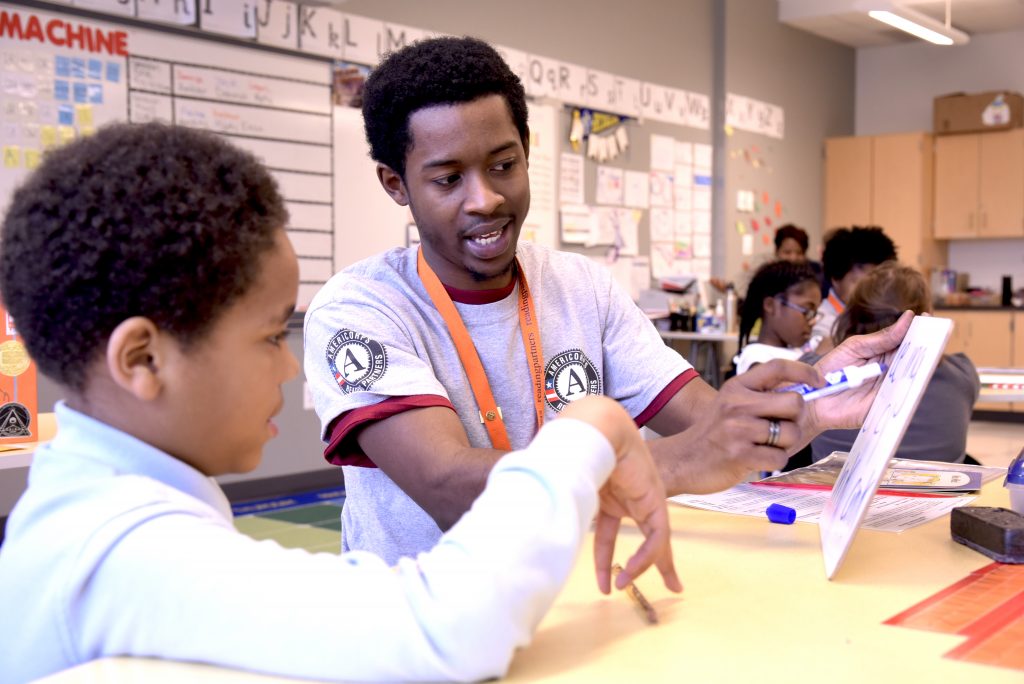
As we approach the end of another year, I wanted to make an offer regarding some of your amazing students who you wish could stay on for an extra year. There are always some student leaders who contribute so much by their presence and example, that you will miss them when they are gone. What we are proposing is a way that you could possibly facilitate the continuing service of these student leaders in your school for 2022-23. Let me explain.
AmeriCorps Project CHANGE is Montgomery County’s original AmeriCorps program, started by former MCPS principal Dr. Bob Anastasi and Superintendent Jerry Weast back in 2001. For 20 years, Project CHANGE has served the community and its students, and come the end of your school year, we begin our recruiting for 16 new members of our team for the coming year.
Candidates have to be 18, have a high school diploma, be American citizens or green card holders, and be able to devote an uninterrupted year to service. Selected to be Members, they will serve in MCPS schools- potentially your school- and in After School programs. A member who serves 35 hours a week, (Fridays are trainings days) receives a living allowance of $21,500 and health insurance, plus 300 hours of personal and professional development. At the completion of their 1700 hours, they receive a $6,450 Segal Education award. They are supported, trained and supervised by our AmeriCorps team of professionals.
Imagine some of your best students applying to AmeriCorps Project CHANGE, serving back in the school from which they just graduated, working as a peer mentor and classroom support to the teachers and staff. Imagine that you help us customize a role for that student that you know so well that will excite them, and bring out the best of their talents.
MCPS John Landesman leads Study Circles for the AmeriCorps team
And here is the good news. Because MCPS is our partner, all the costs are paid by the school system. All you have to do is help us recruit and select, and then provide the supervision and support throughout the year. It is a win-win for you, the student and ourselves, because we both get the best students, and MCPS harvests the gifts it has helped create among its student population. If you are interested in having a chat about this, with no obligation, Mr John Di Tomasso is serving as our High School liaison. He is Project CHANGE Chairman, and a former MCPS principal himself and he is happy to talk you through the options.
Congratulations to the class of 2022 and to you, the school team that got them through. If you wanted a chance to enlist your best for a year of giving back, please do not hesitate to contact us. Yours Sincerely
Paul Costello Executive Director Project CHANGE John Di Tomasso Project CHANGE Chairman Khadija Barkley Head of Saturday School
Graduates, consider a Gap year serving your school
HOW TO MAKE SCHOOLS SAFE AGAIN FOR LEARNING The rising incidence of violence in our schools is turning education into the opposite of what it should be. School is meant to be a place where it is safe to explore and experiment, not a place ruled by fear. Yet, after COVID19, the social safety net is frayed. Schools are struggling just to get back to normal schedules, and the youth who are troubled or feel neglected risk dropping out, or turning to destructive behaviors, just to get attention. Most of the shooters in schools are of high school age which means that peers know them. It also means their peers can help them and probably are the best equipped to see trouble brewing before it becomes lethal. That is where YOU come in.
SERVING WITH AMERICORPS You are 18+, and you have just graduated from High School. You are not quite ready for college or starting a normal job. You see the gaping need in your own school community and you want to give back. You know kids in your own circle who lost hope. You know how much it means to have someone there to listen, to encourage, and to help a fellow student get back on track. You feel that urge to serve the school community that gave you so much, but you don’t know how. You can’t afford to do it for nothing. You need health insurance perhaps, and you need some support and training. You want to do it but don’t know where to start. We have a way.
AmeriCorps Project CHANGE is offering you the unique opportunity for a gap year that will change your life because it will give you the chance to make a difference and change someone else’s life. Project CHANGE doesn’t believe in just talking about change. It believes in getting things done. You will not be acting in any official role, or expected to be a trained counsellor. You are there as peer support in the classroom with the teachers, as all AmeriCorps members do. They are part of the support team for those trained to look after the students. But that informal support role is vital. Because you are a peer, you get it. You can help bridge any generational divide.
PROJECT CHANGE Project CHANGE is the original AmeriCorps program that for 21 years, has been serving Montgomery County students. Every year, we look at the emerging needs and focus on who might be most inspired to respond to them. We believe that motivated and energetic new graduates from our local High Schools are the people best placed to serve in our schools to know who needs support, and to thereby mitigate the violence epidemic threatening education everywhere.
Project CHANGE has a unique Social Emotional Learning Approach based around stories. We focus on the story that a student is telling themselves about their value, their talents, their chances for success and their future. We use a student-friendly tool called MyScore which gets students to focus on growing in the 5Cs of Social Emotional Learning- confidence, curiosity, collaboration, courage and career-future focus. Members who serve their Gap Year in the schools will be trained to use this tool and shape interventions around the student’s own sense of self. Imagine being the difference between a student passing or failing? Imagine being the difference between a student believing in herself and a student acting out their despair and damaging everyone around them?
DO YOU QUALIFY
Requirements for AmeriCorps members in Project Change: 1. 18+ years of age 2. High School Diploma 3. Drivers license/access to a vehicle 4. Able to work in the US 5. Able to devote 35 hours a week 6. Some experience working with children/youth 7. Willing to have a criminal background check 8. Proof of full vaccination status for COVID19 9 Able to serve for a full 12 months 10. Willing to serve in a High School setting
BENEFITS
In return, AmeriCorps members receive: Professional Development through weekly training on Fridays $21,500 living stipend $6,450 educational scholarship upon completion Health benefits Professional mentoring Peer support network and connection to AmeriCorps alumni Preference in hiring for many organizations The positions offer an overall life-changing experience. Most positions are full-time (1700 hours during a 12-month term) and some positions are half-time (900 hours during a 12-month term).
BACKGROUND Montgomery County Public Schools (MCPS) with 160,000 Students shut down for over a year, leaving kids cut off from their peers, depriving them of normal healthy social outlets. School is back but how do we make up for their losses in Social/Emotional learning, the very skills students need most to succeed in life. This is where YOU come in. Your role in the school will be as a mentor and coach to your peers, and to model for them ways to
-Actively engage and problem-solve physical, psychological, social and disciplinary issues that affect themselves and the community. -Take responsibility for their actions. -Set themselves up for success
Project CHANGE Montgomery began in 2001 as the original Montgomery County MD program of AmeriCorps, America’s “Domestic Peace Corps.” Places are available from mid August 2022 to mid-August 2023 and AmeriCorps members serve the county’s most under-served K-12+ students.
From the Washington Post May 20th The Editorial Board
“We remember them.” Following those simple and somber words, President Biden read the names and recounted the lives of the 10 people gunned down May 14 at the Tops Friendly Market grocery store in Buffalo:
Celestine Chaney, 65, cancer survivor, churchgoer, bingo player; Roberta Drury, 32, beloved daughter and sister who moved home to help her brother fighting cancer; Andre Mackniel, 53, who stopped at Tops to buy his 3-year-old son a birthday cake; Katherine “Kat” Massey, 72, a writer and civil rights and education advocate; Margus D. Morrison, 52, school bus aide survived by his wife, three children and a stepdaughter; Heyward Patterson, 67, father and church deacon who fed the homeless and gave rides to neighbors; Aaron Salter Jr., 55, retired police officer who died trying to stop the gunman; Geraldine Talley, 62, expert baker and friend to everybody; Ruth Whitfield, 86, beloved mother, grandmother and great-grandmother who was caretaker of her husband; Pearl Young, 77, who ran the local food pantry and loved singing, dancing and her family.
Seven years ago, we commemorated some of the many lives that have been cut short in mass shootings in the United States. Sadly, the list, which we have updated and republished, was far from comprehensive. Even sadder — no, even more maddening — is that it has grown only longer. When terrible mass shootings have occurred in other nations, governments have responded with sensible gun control measures that have helped to prevent further tragedies. The lives lost in Buffalo — and all those before them — must be a spur to action.Columbine High School students, from left, Darcy Craig, Molly Byrne and Emily Dubin, stop to pay their respects at a memorial set up in a park near the high school in Littleton, Colo., in 1999. (Eric Gay)
April 20, 1999 • At Columbine High School in Littleton, Colo.: Cassie Bernall, 17; Steven Curnow, 14; Corey DePooter, 17; Kelly Fleming, 16; Matthew Kechter, 16; Daniel Mauser, 15; Daniel Rohrbough, 15; William “Dave” Sanders, 47; Rachel Scott, 17; Isaiah Shoels, 18; John Tomlin, 16; Lauren Townsend, 18; Kyle Velasquez, 16.
Dec. 26, 2000 •At Edgewater Technology in Wakefield, Mass.: Jennifer Bragg Capobianco, 29; Janice Hagerty, 46; Louis “Sandy” Javelle, 58; Rose Manfredi, 48; Paul Marceau, 36; Cheryl Troy, 50; Craig Wood, 29.Cody Thunder, right, comforts Lance Crowe before a news conference at North Country Regional Hospital on March 23, 2005, in Bemidji, Minn. (Scott Olson/Getty Images)
March 21, 2005 • At Red Lake High School on the Red Lake Indian Reservation in Red Lake, Minn.: Derrick Brun, 28; Dewayne Lewis, 15; Chase Lussier, 15; Daryl Lussier, 58; Neva Rogers, 62; Chanelle Rosebear, 15; Michelle Sigana, 32; Thurlene Stillday, 15; Alicia White, 15.Amish children ride in the back of a buggy as they travel to a wake at the home of two Amish school shooting victims in Nickel Mines, Pa., in 2006. Officials said a milk truck driver named Charles Carl Roberts IV entered a schoolhouse, let the boys and adults go free, tied up the girls and shot them execution-style before committing suicide. (Getty Images)
Oct. 2, 2006 • At an Amish schoolhouse in Lancaster County, Pa.: Naomi Ebersol, 7; Marian Stoltzfus Fisher, 13; Lena Zook Miller, 7; Mary Liz Miller, 8; Anna Mae Stoltzfus, 12.Thousands attend a candlelight vigil on the campus of Virginia Tech on April 17, 2007, in Blacksburg, Va. (Chip Somodevilla/Getty Images)
April 16, 2007 • At Virginia Tech in Blacksburg, Va.: Ross Abdallah Alameddine, 20; Christopher James “Jamie” Bishop, 35; Brian Bluhm, 25; Ryan Clark, 22; Austin Cloyd, 18; Jocelyne Couture-Nowak, 49; Daniel Perez Cueva, 21; Kevin Granata, 46; Matthew G. Gwaltney, 24; Caitlin Hammaren, 19; Jeremy Herbstritt, 27; Rachael Elizabeth Hill, 18; Emily Hilscher, 19; Jarrett Lane, 22; Matthew J. La Porte, 20; Henry Lee, 20; Liviu Librescu, 76; G.V. Loganathan, 51; Partahi Lumbantoruan, 34; Lauren McCain, 20; Daniel O’Neil, 22; Juan Ramon Ortiz, 26; Minal Panchal, 26; Erin Peterson, 18; Michael Pohle, 23; Julia Pryde, 23; Mary Read, 19; Reema Samaha, 18; Waleed Shaalan, 32; Leslie Sherman, 20; Maxine Turner, 22; Nicole R. White, 20.
Dec. 5, 2007 •At the Westroads Mall in Omaha: Beverly Flynn, 47; Janet Jorgensen, 66; Gary Joy, 56; John McDonald, 65; Gary Scharf, 48; Angie Schuster, 36; Dianne Trent, 53; Maggie Webb, 24.Imam Kasim Kopuz, left, of the Islamic Organization of the Southern Tier in Binghamton, N.Y., leads funeral prayers for Layla Khalil, one of two Muslim victims of a mass shooting, as her husband, center, looks on, on April 5, 2009, in Johnson City, N.Y. (Spencer Platt/Getty Images)
April 3, 2009 • At the American Civic Association immigration services center in Binghamton, N.Y.: Parveen Nln Ali, 26; Almir O. Alves, 43; Marc Henry Bernard, 44; Maria Sonia Bernard, 46; Hai Hong Zhong, 54; Hong Xiu Mao, 35; Jiang Ling, 22; Layla Khalil, 57; Roberta King, 72; Lan Ho, 39; Li Guo, 47; Dolores Yigal, 53; Maria Zobniw, 60.Army soldiers prepare to leave a memorial service in honor of 13 victims of a shooting rampage days before, on Nov. 10, 2009, in Fort Hood, Tex. (Joe Raedle/Getty Images)
Nov. 5, 2009 • At Fort Hood, near Killeen, Tex.: Michael Grant Cahill, 62; Libardo Eduardo Caraveo, 52; Justin Michael DeCrow, 32; John P. Gaffaney, 56; Frederick Greene, 29; Jason Dean Hunt, 22; Amy S. Krueger, 29; Aaron Thomas Nemelka, 19; Michael S. Pearson, 22; Russell Seager, 51; Francheska Velez, 21; Juanita L. Warman, 55; Kham See Xiong, 23.
Jan. 8, 2011 • In the parking lot of a grocery store near Tucson: Christina Taylor Green, 9; Dorothy Morris, 76; John M. Roll, 63; Phyllis Schneck, 79; Dorwan Stoddard, 76; Gabriel Zimmerman, 30.
Feb. 27, 2012 • At Chardon High School in Chardon, Ohio: Demetrius Hewlin, 16; Russell King, Jr., 17; Daniel Parmertor, 16.
April 2, 2012 • At Oikos University in Oakland, Calif.: Tshering Rinzing Bhutia, 38; Doris Chibuko, 40; Sonam Choedon, 33; Grace Eunhea Kim, 23; Katleen Ping, 24; Judith O. Seymour, 53; Lydia Sim, 21.A popcorn box lies outside a movie theater in Aurora, Colo., where a gunman attacked moviegoers during an early-morning screening on July 20, 2012. (Thomas Cooper/Getty Images)
July 20, 2012 • At the Century Aurora 16 movie complex in Aurora, Colo.: Jonathan Blunk, 26; A.J. Boik, 18; Jesse Childress, 29; Gordon W. Cowden, 51; Jessica Ghawi, 24; John Thomas Larimer, 27; Matthew McQuinn, 27; Micayla Medek, 23; Veronica Moser-Sullivan, 6; Alex Matthew Sullivan, 27; Alexander Teves, 24; Rebecca Ann Wingo, 32.Family members of those killed by a gunman at the Sikh Temple of Wisconsin attend a vigil at the temple to mark the one-year anniversary of the shooting on Aug. 5, 2013, in Oak Creek, Wis. (Scott Olson/Getty Images)
Aug. 5, 2012 • At the Sikh Temple of Wisconsin in Oak Creek, Wis.: Satwant Singh Kaleka, 65; Suveg Singh Khattra, 84; Paramjit Kaur, 41; Prakash Singh, 39; Ranjit Singh, 49; Sita Singh, 41.People embrace on Dec. 14, 2012, in the aftermath of the shooting at Sandy Hook Elementary School in Newtown, Conn. Twenty-six people, including 20 first-graders, were killed. (Don Emmert)
Dec. 14, 2012 • At Sandy Hook Elementary School in Newtown, Conn.: Charlotte Bacon, 6; Daniel Barden, 7; Rachel D’Avino, 29; Olivia Engel, 6; Josephine Gay, 7; Dylan Hockley, 6; Dawn Hochsprung, 47; Madeleine F. Hsu, 6; Catherine V. Hubbard, 6; Chase Kowalski, 7; Jesse Lewis, 6; Ana G. Marquez-Greene, 6; James Mattioli, 6; Grace McDonnell, 7; Anne Marie Murphy, 52; Emilie Parker, 6; Jack Pinto, 6; Noah Pozner, 6; Caroline Previdi, 6; Jessica Rekos, 6; Avielle Richman, 6; Lauren Russeau, 30; Mary Sherlach, 56; Victoria Soto, 27; Benjamin Wheeler, 6; Allison N. Wyatt, 6.Priscilla Daniels, wife of Arthur Daniels, one of 12 people killed in a shooting rampage at the Washington Navy Yard on Sept. 16, 2013, is comforted by Lynnell Humphrey, the deputy director of constituent services for D.C.’s Ward 7. (Jonathan Newton/The Washington Post)
Sept. 16, 2013 • At the Washington Navy Yard in D.C.: Michael Arnold, 59; Martin Bodrog, 54; Arthur Daniels, 51; Sylvia Frasier, 53; Kathy Gaarde, 62; John Roger Johnson, 73; Mary Frances DeLorenzo Knight, 51; Frank Kohler, 51; Vishnu Bhalchandra Pandit, 61; Kenneth Bernard Proctor, 46; Gerald Read, 58; Richard Michael Ridgell, 52.Photographs of the nine victims killed at the Emanuel African Methodist Episcopal Church in Charleston, S.C., are held by congregants during a prayer vigil at the the Metropolitan AME Church in Washington on June 19, 2015. (Win McNamee/Getty Images)
June 17, 2015 • At Emanuel African Methodist Episcopal Church in Charleston, S.C.: Sharonda Coleman-Singleton, 45; DePayne V. Middleton Doctor, 49; Cynthia Graham Hurd, 54; Susie Jackson, 87; Ethel Lee Lance, 70; Clementa C. Pinckney, 41; Tywanza Sanders, 26; Daniel Simmons, 74; Myra Thompson, 59.
July 16, 2015 • At an armed services recruiting center and a Navy reserve center in Chattanooga, Tenn.: Carson A. Holmquist, 25; Randall Smith, 26; Thomas J. Sullivan, 40; Squire K. “Skip” Wells, 21; David A. Wyatt, 35.
Oct. 1, 2015 • At a community college in Roseburg, Ore.: Lucero Alcaraz, 19; Treven Taylor Anspach, 20; Rebecka Ann Carnes, 18; Quinn Glen Cooper, 18; Kim Saltmarsh Dietz, 59; Lucas Eibel, 18; Jason Dale Johnson, 33; Lawrence Levine, 67; Sarena Dawn Moore, 44.
Nov. 27, 2015 • At a Planned Parenthood clinic in Colorado Springs: Jennifer Markovsky, 36; Ke’Arre M. Stewart, 29; Garrett Swasey, 44.
Dec. 2, 2015 • At an office park in San Bernardino, Calif.: Robert Adams, 40; Isaac Amanios, 60; Bennetta Betbadal, 46; Harry Bowman, 46; Sierra Clayborn, 27; Juan Espinoza, 50; Aurora Godoy, 26; Shannon Johnson, 45; Larry Daniel Kaufman, 42; Damian Meins, 58; Tin Nguyen, 31; Nicholas Thalasinos, 52; Yvette Velasco, 27; Michael Raymond Wetzel, 37.People take part in a memorial in Orlando for victims of the Pulse nightclub shooting. Forty-nine people were killed in the June 12, 2016, shooting. (Spencer Platt/Getty Images)
June 12, 2016 • At Pulse nightclub in Orlando: Stanley Almodovar III, 23; Amanda L. Alvear, 25; Oscar A. Aracena Montero, 26; Rodolfo Ayala Ayala, 33; Antonio Davon Brown, 29; Darryl Roman Burt II, 29; Angel Candelario-Padro, 28; Juan Chavez Martinez, 25; Luis Daniel Conde, 39; Cory James Connell, 21; Tevin Eugene Crosby, 25; Deonka Deidra Drayton, 32; Simón Adrian Carrillo Fernández, 31; Leroy Valentin Fernandez, 25; Mercedez Marisol Flores, 26; Peter Ommy Gonzalez Cruz, 22; Juan Ramon Guerrero, 22; Paul Terrell Henry, 41; Frank Hernandez, 27; Miguel Angel Honorato, 30; Javier Jorge Reyes, 40; Jason Benjamin Josaphat, 19; Eddie Jamoldroy Justice, 30; Anthony Luis Laureano Disla, 25; Christopher Andrew Leinonen, 32; Alejandro Barrios Martinez, 21; Brenda Marquez McCool, 49; Gilberto R. Silva Menendez, 25; Kimberly Jean Morris, 37; Akyra Monet Murray, 18; Luis Omar Ocasio Capo, 20; Geraldo A. Ortiz Jimenez, 25; Eric Ivan Ortiz-Rivera, 36; Joel Rayon Paniagua, 32; Jean Carlos Mendez Perez, 35; Enrique L. Rios Jr., 25; Jean Carlos Nieves Rodríguez, 27; Xavier Emmanuel Serrano-Rosado, 35; Christopher Joseph Sanfeliz, 24; Yilmary Rodríguez Solivan, 24; Edward Sotomayor Jr., 34; Shane Evan Tomlinson, 33; Martin Benitez Torres, 33; Jonathan A. Camuy Vega, 24; Juan Pablo Rivera Velázquez, 37; Luis Sergio Vielma, 22; Franky Jimmy DeJesus Velázquez, 50; Luis Daniel Wilson-Leon, 37; Jerald Arthur Wright, 31.
Jan. 6, 2017 • At the baggage claim of Fort Lauderdale-Hollywood International Airport in Florida: Mary Louise Amzibel, 69; Terry Andres, 62; Michael Oehme, 57; Shirley Timmons, 70; Olga Woltering, 84.
June 5, 2017 • At an awning company near Orlando: Kevin Clark, 53; Kevin Lawson, 46; Brenda Montanez-Crespo, 44; Jeffrey Roberts, 57; Robert Snyder, 69.Ethan Avanzino grieves beside a white cross for his friend Cameron Robinson, one of 58 victims of the mass shooting on the Las Vegas Strip on Oct. 1, 2017.
Oct. 1, 2017 • On the Las Vegas Strip: Hannah Ahlers, 34; Heather Alvarado, 35; Dorene Anderson, 49; Carrie Barnette, 34; Jack Beaton, 54; Stephen Berger, 44; Candice Bowers, 40; Denise Burditus, 50; Sandy Casey, 35; Andrea Castilla, 28; Denise Cohen, 58; Austin Davis, 29; Thomas Day Jr., 54; Christiana Duarte, 22; Stacee Rodrigues Etcheber, 50; Brian Fraser, 39; Keri Galvan, 31; Dana Gardner, 52; Angela Gomez, 20; Charleston Hartfield, 34; Christopher Hazencomb, 44; Jennifer Topaz Irvine, 42; Teresa Nicol Kimura, 38; Jessica Klymchuk, 34; Carly Kreibaum, 33; Rhonda LeRocque, 42; Victor Link, 55; Jordan McIldoon, 23; Kelsey Breanne Meadows, 28; Calla-Marie Medig, 28; Sonny Melton, 29; Patricia Mestas, 67; Austin Meyer, 24; Adrian Murfitt, 35; Rachael Parker, 33; Jennifer Parks, 36; Carolyn Parsons, 31; Lisa Patterson, 46; John Phippen, 56; Melissa Ramirez, 26; Jordyn Rivera, 21; Quinton Robbins, 20; Cameron Robinson, 28; Rocio Guillen Rocha, 40; Tara Roe, 34; Lisa Romero-Muniz, 48; Christopher Roybal, 28; Brett Schwanbeck, 61; Bailey Schweitzer, 20; Laura Shipp, 50; Erick Silva, 21; Susan Smith, 53; Brennan Stewart, 30; Derrick Taylor, 56; Neysa Tonks, 46; Michelle Vo, 32; Kurt Von Tillow, 55; Bill Wolfe Jr., 42.Derrick Bernaden visits a memorial to the 26 victims of the mass shooting at the First Baptist Church of Sutherland Springs, Tex. A gunman opened fire in the church during a Sunday service on Nov. 5, 2017. (Scott Olson/Getty Images)
Nov. 5, 2017 • At the First Baptist Church in Sutherland Springs, Tex.: Keith Allen Braden, 62; Robert Michael Corrigan, 51; Shani Louise Corrigan, 51; Emily Garcia, 7; Emily Rose Hill, 11; Gregory Lynn Hill, 13; Megan Gail Hill, 9; Crystal Marie Holcombe, 36; John Bryan Holcombe, 60; Karla Plain Holcombe, 58; Marc Daniel Holcombe, 36; Noah Holcombe, 1; Dennis Neil Johnson, 77; Sara Johns Johnson, 68; Haley Krueger, 16; Robert Scott Marshall, 56; Karen Sue Marshall, 56; Tara E. McNulty, 33; Annabelle Renae Pomeroy, 14; Ricardo Cardona Rodriguez, 64; Therese Sagan Rodriguez, 66; Brooke Bryanne Ward, 5; Joann Lookingbill Ward, 30; Peggy Lynn Warden, 56; Lula Woicinski White, 71.Angela Tanner rests against the fence that surrounds Marjory Stoneman Douglas High School in Parkland, Fla., on Feb. 18, 2018, where 17 people were killed in a mass shooting. (Mark Wilson/Getty Images)
Feb. 14, 2018 • At Marjory Stoneman Douglas High School in Parkland, Fla.: Alyssa Alhadeff, 14; Scott Beigel, 35; Martin Duque, 14; Nicholas Dworet, 17; Aaron Feis, 37; Jaime Guttenberg, 14; Chris Hixon, 49; Luke Hoyer, 15; Cara Loughran, 14; Gina Montalto, 14; Joaquin Oliver, 17; Alaina Petty, 14; Meadow Pollack, 18; Helena Ramsay, 17; Alex Schachter, 14; Carmen Schentrup, 16; Peter Wang, 15.
May 18, 2018 • At Santa Fe High School in Santa Fe, Tex.: Jared Black, 17; Shana Fisher, 16; Christian Riley Garcia, 15; Aaron Kyle McLeod, 15; Glenda Ann Perkins, 64; Angelique Ramirez, 15; Sabika Sheikh, 17; Christopher Stone, 17; Cynthia Tisdale, 63; Kimberly Vaughan, 14.
June 28, 2018 • At the Capital Gazette newsroom in Annapolis: Gerald Fischman, 61; Rob Hiaasen, 59; John McNamara, 56; Rebecca Smith, 34; Wendi Winters, 65.A visitor stops at a makeshift memorial outside the Tree of Life synagogue in Pittsburgh following a mass shooting there on Oct. 27, 2018. (Matt Rourke/AP)
Oct. 27, 2018 • At Tree of Life synagogue in Pittsburgh: Joyce Fienberg, 75; Richard Gottfried, 65; Rose Mallinger, 97; Jerry Rabinowitz, 66; Cecil Rosenthal, 59; David Rosenthal, 54; Bernice Simon, 84; Sylvan Simon, 86; Daniel Stein, 71; Melvin Wax, 87; Irving Younger, 69.
Nov. 7, 2018 • At the Borderline Bar and Grill in Thousand Oaks, Calif.: Sean Adler, 48; Cody Coffman, 22; Blake Dingman, 21; Jake Dunham, 21; Ron Helus, 54; Alaina Housley, 18; Dan Manrique, 33; Justin Meek, 23; Mark Meza Jr., 20; Kristina Morisette, 20; Telemachus Orfanos, 27; Noel Sparks, 21.
Jan. 23, 2019 • At the SunTrust Bank in Sebring, Fla.: Debra Cook, 54; Marisol Lopez, 55; Jessica Montague, 31; Ana Piñon-Williams, 38; Cynthia Watson, 65.
Feb. 15, 2019 • At the Henry Pratt Co. in Aurora, Ill.: Russell Beyer, 47; Vicente Juarez, 54; Clayton Parks, 32; Josh Pinkard, 37; Trevor Wehner, 21.On June 2, 2019, people hold hands and pray at a memorial to honor those killed in a mass shooting at the Virginia Beach Municipal Center days earlier, in Virginia Beach. (Sarah Holm/AP)
May 31, 2019 • At the Virginia Beach Municipal Center in Virginia Beach: LaQuita C. Brown, 39; Ryan Keith Cox, 50; Tara Welch Gallagher, 39; Mary Louise Gayle, 65; Alexander Mikhail Gusev, 35; Joshua O. Hardy, 52; Michelle “Missy” Langer, 60; Richard H. Nettleton, 65; Katherine A. Nixon, 42; Christopher Kelly Rapp, 54; Herbert “Bert” Snelling, 57; Robert “Bobby” Williams, 72.
July 28, 2019 • At the Gilroy Garlic Festival in California: Trevor Deon Irby, 25; Stephen Romero, 6; Keyla Salazar, 13.A man cries beside a cross at a makeshift memorial near the scene of a mass shooting at a Walmart Supercenter in El Paso, on Aug. 6, 2019. (John Locher/AP)
Aug. 3, 2019 • At a Walmart Supercenter in El Paso: Andre Anchondo, 24; Jordan Anchondo, 25; Arturo Benavides, 60; Leo Campos, 41; Angelina Englisbee, 86; Maria Flores, 77; Raul Flores, 83; Jorge Calvillo García, 61; Adolfo Cerros Hernández, 68; Maribel Hernández, 56; Alexander Gerhard Hoffman, 66; David Johnson, 63; Luis Juarez, 90; Maria Eugenia Legarreta, 58; Ivan Filiberto Manzano, 45; Gloria Irma Márquez, 61; Elsa Mendoza, 57; Margie Reckard, 63; Sara Esther Regalado, 66; Javier Amir Rodriguez, 15; Teresa Sanchez, 82; Juan de Dios Velázquez, 77.
Aug. 4, 2019 • At the Oregon Historic District in Dayton, Ohio: Megan K. Betts, 22; Monica E. Brickhouse, 39; Nicholas P. Cumer, 25; Derrick R. Fudge, 57; Thomas J. McNichols, 25; Lois L. Oglesby, 27; Saeed Saleh, 38; Logan M. Turner, 30; Beatrice N. Warren-Curtis, 36.
Aug. 31, 2019 • On the streets of Midland and Odessa in West Texas: Rodolfo Julio Arco, 57; Kameron Karltess Brown, 30; Raul Garcia, 35; Mary Granados, 29; Joseph Griffith, 40; Leilah Hernandez, 15; Edwin Peregrino, 25.
Dec. 10, 2019 • At the Jersey City Kosher Supermarket in New Jersey: Mindy Ferencz, 33; Joseph Seals, 40; Douglas Miguel Rodriguez, 49; Moshe Deutsch, 24.
Feb. 26, 2020 • At the Molson Coors Campus in Milwaukee: Dale Hudson, 50; Gennady Levshetz, 61; Jesus Valle Jr., 33; Dana Walk, 57; Trevor Wetselaar, 33.A woman prays during a memorial in Kansas City, Mo., for the victims of the Atlanta-area spa shootings, on March 28, 2021. (Charlie Riedel/AP)
March 16, 2021 • At spas in the Atlanta area: Daoyou Feng, 44; Hyun Jung Grant, 51; Suncha Kim, 69; Paul Andre Michels, 54; Soon Chung Park, 74; Xiaojie Tan, 49; Delaina Ashley Yuan, 33; Yong Ae Yue, 63.
March 22, 2021 • At King Soopers supermarket in Boulder, Colo.: Tralona Bartkowiak, 49; Suzanne Fountain, 59; Teri Leiker, 51; Kevin Mahoney, 61; Lynn Murray, 62; Rikki Olds, 25; Neven Stanisic, 23; Denny Stong, 20; Eric Talley, 51; Jody Waters, 65.Investigators at a FedEx facility where a mass shooting left at least eight people dead and five wounded on April 15, 2021. (Getty Images)
April 15, 2021 • At a FedEx facility in Indianapolis: Matthew Ross Alexander, 32; Samaria Blackwell, 19; Amarjeet Johal, 66; Jasvinder Kaur, 50; Jaswinder Singh, 68; Amarjit Sekhon, 48; Karli Smith, 19; and John “Steve” Weisert, 74.
Nov. 30, 2021 • At Oxford High School in Oxford, Mich.: Madisyn Baldwin, 17; Tate Myre, 16; Hana St. Juliana, 14; Justin Shilling, 17.
Thirteen people, ages 20 to 86, were shot. Eleven were Black and two were White, Buffalo police said. Authorities late Sunday identified the victims:• Roberta A. Drury, 32, of Buffalo• Margus D. Morrison, 52, of Buffalo• Andre Mackniel, 53, of Auburn, New York• Aaron Salter, 55, of Lockport, New York• Geraldine Talley, 62, of Buffalo• Celestine Chaney, 65, of Buffalo• Heyward Patterson, 67, of Buffalo• Katherine Massey, 72, of Buffalo• Pearl Young, 77, of Buffalo• Ruth Whitfield, 86, of Buffalo
May 2022 Where is Next? June 2022 Where is Next? July 2022 Where is Next? August 2022 Where is Next? September 2022 Where is Next? October 2022 Where is Next? November 2022 Where is Next? December 2022 Where is Next?
THE SITUATION Clearly, the world needs changing, but we are stuck. The old methods don’t work. Democracy used to mean people had a say and that say counted. If there was a problem, we could come together to fix it. RIght now, we seem to be going around in circles, or worse, going backwards. What can break this cycle of frustration? AmeriCorps Project CHANGE THE STORY ( APCTS) is ready to offer a new way toward change.
THE RESPONSE APCTS is unique. This innovative AmeriCorps program is the first of its type for combining a year long project of research, service and training under the guidance of some of the world’s leading narrative experts who make up the faculty of Storywise, the Center for Narrative Studies in Washington DC. Project CHANGE was once a good old fashioned AmeriCorps program, but after watching COVID19 devastate our local school system these last 2 years, we decided we had to move to meet the times, and become PROJECT CHANGE THE STORY. We as a local organization decided to change our story before asking anyone else to. But we need to train people how to spread that message and how to implement it at the grassroots.
THE BENEFITS OF THE SCHOLARSHIP
Among the benefits, members for the 2022-23 team will earn a special Certificate of Narrative Practice, be paid $21,500 as a living allowance, offered health insurance, and earn an education scholarship worth $6,500 on completion.
THE SEL TOOL MYSCORE The year will be focused on serving the most under-served students in the MCPS school system, using a special Narrative Change tool known as MyScore and through learning to apply that, facilitate a narrative method of change. Our goal is to create a measurable, positive impact on needy students and the school system overall.
SERVICE SITES Half the members are assigned as SEL coaches working directly in schools, and the other half are assigned to leading non-profits who offer after-school programs. Friday is training days, with world class faculty and Monday to Thursday is the practicum where members are working directly with kids. Each placement is customized to the needs of the particular school or after-school placement, but in each one, the goal is to help change the student story, from struggling to success, from surviving to thriving, from giving up to giving more, from hurt to hope.
RESEARCH Each member will devise and develop their own particular research project that they have determined from the assessment of the local service need and create interventions to be tested and evaluated, to add to the body of practice of narrative change so badly needed in education.
GLOBAL REACH The narrative method has been applied across the world to deal with some of the most intractable problems, ( wiprogram.org, www.newstoryleadership.org) but this is the first time that Storywise.com the Center for Narrative Studies has committed to support a school district and create a new model of change for the nation.
THE INVITATION APCTS is looking for inspired learners to become inspired leaders and after this unique year of training, to become inspired teachers of the narrative method of change for a world so badly in need of a new way to create real change, to inspire a new story.
It is recruiting time again. Anyone who has been on a selection panel from year to year knows that the losses of last year’s team shapes the way we choose next year’s winning team. If your team lacked strong defenders in the vital games, or it had a solid team but no players who could penetrate the defense, you go looking for what you lack.
The same is true for us at Project CHANGE. Year to year, the selection is testimony to where we are and where we have been, and the pool of people who, at any one time, might be open to a year of service. What about 2022-23, the year we are trying to come out of the shadows of COVID? It is not going to be a normal year, so we need a team that rises above the normal.
Stressful times test us all, but they will sorely and surely test any AmeriCorps member choosing to serve this coming year. I can say that because of how much it seemed to test many members last year. We usually can presume people have natural coping skills, but when what they are coping with is not natural or normal, you have to reassess. The needs of the students we meet every day have changed so dramatically that finding the right kind of people to respond is going to call for something more.
Have you got that extra to give? If we are subject to the same constraints as the students are, none of us can be so sure that we are up for the task. That is the clear mandate from last year, that anyone wishing to serve cannot underestimate the toll it will most likely take. That is not to discourage people but to state it bluntly and boldly, that this is not your normal service year. Something more is called for because so much more is missing. Don’t blithely presume it will be easy. You are getting a modest living allowance, not a salary, and you are serving in schools short of teachers, and with battling non-profits who improvised to get through the pandemic. Don’t expect a red carpet and a band.
Second, how emotionally agile are you? While the teachers are intent on scores and reading levels and geared up to deliver the curriculum, AmeriCorps members are there as guardians of the Social and Emotional Learning of all students, but especially the most troubled and troublesome. Let me say that again. Trouble is our friend. Our unique approach, MyScore, invites students to assess themselves, and tell us how they feel they are coping. It is not top down but bottom up. But beware. If the whole system has bent and broken under COVID, and is battered every other day with police beatings and school shootings and classroom fights and student mental meltdowns, then we are not dealing with anything that one exam or extra study is likely to fix. Schools alone cannot fix what a pandemic has wrought.
A year of service will tax our own emotional and social maturity to the max. As we have discovered this past year, MyScore showed how much the students struggled but half way through, we decided that their teachers were struggling even more. We are not going to pick anyone for the role if we fear they are going to end up a casualty. It is like the story that life savers tell their trainees, get close but not too close to the desperate drowning man in case his struggle drags you under too.
Third, will you keep showing up regardless? The intermittent pattern of schooling, where infection rates still threatened shutdowns and teacher absence reflected student absence, the whole stop and start of education has made students suspicious of time, and unable to imagine too far into a future. All during the pandemic, they have lost out and have asked, who is there for us when no one else is, who will show up, rain and snow, hot or cold, bad days and good days? Funa is serving his third year and has coached his 3 new members at Sligo to not just show up on time but to show up early, and the students have noticed. They have said that even more than some teachers, the AmeriCorps members are always there. That in itself is testimony of a human commitment that all healthy SEL growth relies on. If you fear that this kind of commitment is too much given your busy life, or how far away you live, or your own prior obligations to kids or parents, then please, reconsider. For the time you are serving, those kids are number one priority and number two and number three. If they do not see that, they read between the lines. They know we say we care but we show we don’t.
Fourth, Are are committed to open and timely communication? Things happen. Parents get sick. Cars get towed. There is always something that is going to be the challenge of the day or week, but how good are you at letting the right people know, and at the right time? This past year, we have had members who just disappear for days at a time, and we have to send out search parties. As well as feeding our own anxieties, because we want to know, are they OK, did something happen. We hear four days later that a child was sick or a relative died. There is always a good reason, but running a program is hard enough without having to be a mind reader. The program perhaps is old fashioned and relies on emails over phone or text message, but if you are the sort of person with a clogged email inbox with 300 unopened messages, then that will get in the way of being a successful Project CHANGE member.
Who will you take your frustrations out on? It will get frustrating. The students are back but mostly not to learn. They are back to play. They missed out on so much. Or the AmeriCorps rules prohibit certain political activity and its an election year and the nation is falling apart, and you expect us to just sit back and do nothing. AmeriCorps Lives matter too. Yes, be a citizen and act, protest but that is not your job at AmeriCorps. Or those pesky Time Sheets, you are one month behind, then two, then three and the Director is chasing you to get them filled in. Can’t he see how hard I am working?
Unless we know you have healthy ways to deal with anxiety and frustration, and can switch off, take the dog for a walk, play tennis, grow petunias, your stress has to be dissolved and dealt with outside the system, not disposed of with rants or unrealistic demands inside the system. We are on the same side, but tension will get to all of us and wear us all out. I have to be sure I do not take it out on you, and you do not take it out on me. I love what some call Rule Number 6 which is “Never to take yourself too f….g seriously.” There is no Rule 1 or 5, in fact there are no other rules. Just Rule Number 6. How serious is that?
Are you doing this to get somewhere beyond this? This is hardly a year you use to kill time or because you have nothing better to do. This is one year you decide to serve, and at the end of it, we want to be sure it was not wasted. You have given so much, but it must enhance you and move you one chapter forward in your book of life. Expectations are crucial. Some very qualified members begrudge that their true talents are not utilized, but that is not why we signed you on. The essential qualification that defines the work is having a servants heart. Everything else is secondary. That is the core qualification we need you to have.
The final question is- Are you going to ensure you have some fun and enjoy the whole adventure? If you are doing this to be a martyr or a saint, then perhaps its not a good fit. The needs of the students come first and if we get into that victim mind, where we feel no one understands the size of our problems, then we misread the AmeriCorps script of getting things done for others and for America. If we get righteous or holier than thou, we do no one any favors. We are there for students needs, not ours.
But more than that, the successful member commits to an adventure, like trekking the Alps or summiting Everest, to climb and find new vistas and to be exhausted and lost, and all the rest, and see all that as part of the deal. If you are not going to have fun, to savor the chance, then we would ask you why torture yourself. Do this as your gift, not your duty. Someone once said “Joy is the infallible sign of grace.” If this is not the offer of joy, don’t do it. This is not ice cream or roller coaster joy. It is no ordinary feeling. It is the grace that comes from being there for others when no one else is, for believing in the kid who does not believe in herself, for cheering the failing efforts of a student everyone has labeled a loser, or calming a refugee who is beyond frustration with learning a new language in a new country. It is about the joy you only receive from serving. Is that you?
Recruiting Season is upon us. AmeriCorps might be calling you soon.
The recent ASC AmeriCorps training conference in Burlington VT was a grand reunion of program directors, State Commissioners and national AmeriCorps leaders. Our last meeting was in 2019, so meeting in person felt extra special. We could put aside our ZOOM faces and screens. If we chose to wear a green sticker, we gave notice that we were OK to be hugged again. It was sens-ational in the truest sense.
Thinking back to our last conference, one could not help feel how much the world has changed. Last week, the New York Times and the Washington Post featured the deadly milestone of ‘One Million lost to COVID.’ We pointed to that in our session that we delivered first up Wednesday morning entitled “Our Stories Rise Up” based on our newly published book. As the three days unfolded, and we attended great sessions on Mental Health and Wellness and How to Avoid Burnout, the elephant in the room was COVID, clearly the context for everything but sadly, not mentioned or directly addressed at all. We are living through it but not wanting to talk about it. AmeriCorps is not the only one. A national conference of family Therapists met in DC in March on the Theme “Meeting the Moment” and over three days, only one training out of 300 headlined the pandemic. Kubler Ross has stages of grief that begin with denial, and perhaps that is where we are right now.
The desire to get back to normal is irresistible but what we have all been through since March 2020 makes that a bit of a pipe dream. Instead of one great forgetting, these strained times call for us to lament our losses and gently embrace the new normal. We must allow learning to emerge from our lamentation. That is why the book presents a set of 22 tools and shares stories of how our AmeriCorps members have been able to do that.
What also came out of the week long sharing with other AmeriCorps programs was the recognition that, even if we have not been in the same boat, we have all been in the same storm. Some have survived better than others, but many of our usual social systems have been battered into brokenness: Education and Health and Food Delivery, Supply Chains and wages, and the predictable patterns of work and travel. We have not been able to mourn our dead except from a safe distance or behind a screen, and we have not been able to nurse our newborn. What kind of lasting toll does that take, when warm family contact threatens the frail and aged.
We may not all be depressed but the world we live in surely is. The rise in racism, suicides and shootings, the burnout among teachers, doctors, nurses and social workers, the stress on your ordinary AmeriCorps member has been extraordinary. At times, one has felt that we needed to suspend operations of trying to meet the urgent needs of the other, and just declare a time out, to mend and heal our own.
Our determination (or is it stubbornness?) kicks in, and we tell ourselves we can lick this. We will get things done. We will go the extra mile. And when we do, we find we have done ourselves in, and the extra mile has put us into a state of collapse. For all our best energy, the world is not so malleable to our intentions anymore. We are not in a position to help or change as we once thought we were. The world moved out of our reach and we stayed where we are.
We have to recognize where we are, in the Post COVID recovery phase of a global pandemic. If history is our guide, we are already living into some changes without quite understanding their long term implications. After the Black Death, when Europe lost half its population, the feudal system died with it, because now there was more land than people to farm it. And some historians even trace the rise of the British Pub to the aftermath of the disease. Why would this pandemic be any different?
We are in the middle of changes we cannot see, but which will profoundly shape our futures. Isn’t it time we talked about that? Isn’t it urgent that if the shape of the world we serve in has changed, that we do not rush back to a normal that no longer exists? A new world to serve in, demands a new way to serve in it.
The AmeriCorps conference, as great as it was, offered a program that started where we left off. How to recruit, how to balance budgets, how to do background checks etc. All of these are important, but all of them needed the added tag line “in a post-Covid world.” Our service had to change. So AmeriCorps has to change with it. That is what Lincoln realized at the outset of the Civil War, the only national catastrophe comparable to the pandemic, when he said:
‘The dogmas of the quiet past, are inadequate to the stormy present. The occasion is piled high with difficulty, and we must rise — with the occasion. As our case is new, so we must think anew, and act anew. We must disenthrall ourselves, and then we shall save our country.’
We need to change our mindset towards the pandemic. Instead of seeing it only as a disaster, we could see it instead as one grand social experiment. Then we would recognize it as a much needed stress test of our most basic social systems that keep people alive and healthy. Then we would put on the hat of a researcher, eager to find out not just where the systems cracked, but where the cracks opened up space for innovation and new opportunities to serve. Whatever past we lost in the catastrophe, we gained an insight as to where the future could be heading.
What kinds of community did we create using ZOOM that were never even imagined before? What new patterns of home life emerged when home became school, and home became the office, and home became the gym, or when the car sat in the garage for months because we got used to walking, or got used to delivery to the door? Amazon and Door Dash were never more convenient.
Change never comes easy. It grows out of necessity but when we get to the other side of the emergency, we can start to see a new world emerging. That idea is wrapped inside the very word “emergency.” We will come to realize that our best efforts in a failing system are as nothing compared to our failing and faltering efforts to rebuild a more equitable a system from the ground up.
This is our chance. This is our time. This is our post-Covid wake up call. AmeriCorps should lead the way in that. We at Project CHANGE certainly hope to.
Montgomery County school board approves superintendent’s contract
Montgomery County’s new superintendent of schools will be paid an annual base salary of $320,000 — making her one of Maryland’s top-paid school leaders.
The four-year contract approved Tuesday by the school district’s Board of Education was the final step to officially hire Monifa B. McKnight as superintendent. Her appointment was approved by State Superintendent of Schools Mohammed Choudhury before her contract was finalized, pursuant to Maryland law.
She was appointed unanimously by the board in February. She will be the first Black woman to the serve as superintendent over Maryland’s largest school system. Her contract officially begins July 1.
“Dr. McKnight is an exceptionally skilled leader who will build on our district’s legacy of excellence, and help us ensure that we are an innovative and equitable school system that provides a world-class education to all of our students,” Brenda Wolff, the board’s president, said in a statement.
The contract released Tuesday requires McKnight to relocate to Montgomery County as soon as possible but no later than June 30, 2023. The board will pay up to $15,000 in relocation costs. Her family currently resides in Prince George’s County.
McKnight’s contract further stipulates she will receive 30 days of paid annual leave and 25 sick or personal leave days. It also includes perks, such as the use a vehicle paid for by the board. She will also receive $48,000 a year in deferred compensation.
Additionally, McKnight’s salary is set to increase at a percentage equal to any increases given to the Montgomery County Association of Administrators and Principals, the union for administrators.
Each year, McKnight will be evaluated by the board no later than Nov. 1. She is expected to provide a self-evaluation before the board conducts its review, under the contract’s terms.
Her contract is set to expire June 30, 2026. Board members will decide by Dec. 1, 2025, whether they will renew it.
McKnight has been part of the school system’s leadership throughout the pandemic as schools grapple with historic student learning loss and a youth mental health crisis. In her time as interim chief, her administration coronavirus response has drawn criticism, with the omicron variant causing cases to surge around the time of winter break. McKnight apologized for problems in communication about changing coronavirus guidelines and other scheduling challenges.
She pledged in a statement Tuesday to focus on rebuilding trust and support students’ mental health and wellness. She added that she would collaborate with parents and teachers “to expand opportunity so that our students are college, career and community ready.”
McKnight has worked in Montgomery County for two decades. She previously worked as deputy superintendent of education for the district, where she helped oversee the creation of the school system’s anti-racist audit, with a report scheduled for release in June.
She has served as interim superintendent since June. Her predecessor, Jack R. Smith, stepped down less than a year into his second four-year contract, citing medical issues with a grandson that resulted in a move to be with his daughter’s family in Maine. Smith was scheduled to receive $315,000 in base pay during his second contract, which would have made him, at the time, one of the highest-paid Maryland superintendents. He turned down the pay increase at the time while the district struggled with the financial effects of the pandemic, according to media reports, and retired with a salary of $295,000.
Few Maryland superintendents have reached a salary above $300,000. According to data provided to the Maryland State Board of Education for the 2021-2022 academic year, Baltimore City’s superintendent had the highest listed salary, at $333,125. Prince George’s County’s chief executive was the second-highest, at $317,288. Anne Arundel’s superintendent fell just short of the $300,000 threshold for the academic year, with a salary of $299,910.
With 209 schools, Montgomery County is among the nation’s largest school systems, with an operating budget of roughly $2.9 billion. Its student body is 33 percent Hispanic, 25 percent White, 22 percent Black, 14 percent Asian and 5 percent multiracial.
Also on Tuesday, the board approved a set of agreements with union leaders that would boost teacher pay by 3.35 percent, effective Dec. 17. The raise is a cost-of-living increase, and it will be paired with a “salary step increase,” that will combine to a more than 6 percent raise, McKnight said.
It’s the highest compensation increase educators have received in a decade, McKnight told the board.
Wolff, the board’s president, said the increase was well-deserved, as teachers, administrators and staffers “have been true heroes during this time of the pandemic.”
“Over the last two years, we can’t thank them enough for everything they’ve done,” Wolff said.
Jennifer Martin, president of the Montgomery County Education Association, the county’s teachers union, said in a statement Tuesday the agreements were “a step in the right direction,” but more work had to be done to retain instructors. Several have retired or resigned in the past year, she said.
“More must be done to make public education a viable and appealing career choice for both new and veteran educators,” Martin said.
The decline in the mental health of children and adolescents has led to new laws allowing kids to attend to their own self-care. By Christina Caron NYT August 23 2021
By the time Ben Ballman reached his junior year in high school he was busier — and more anxious — than he had ever been.
“I had moments where it felt like the whole world was coming down on me,” he said. “It was definitely a really difficult time.”
Before the pandemic shut everything down, his day started at 6:30 a.m., when he woke up to get ready for school. Next came several Advanced Placement courses; then either soccer practice or his job at a plant nursery; studying for the SAT; and various extracurricular activities. He often didn’t start his homework until 11 p.m., and finally went to bed three hours later. Every day it was the same grueling schedule.
“It’s not even that I was going above and beyond, it was, ‘This is the bare minimum,’” said Ben, now 18 and a recent graduate of Winston Churchill High School in Montgomery County, Md. “It’s like a pressure cooker that’s locked down. There’s nowhere to escape. Eventually you just kind of burst at some point, or, hopefully, you can get through it.”
And in March, Utah decided that a “valid excuse” for a student’s absence will now include “mental or behavioral health,” broadening an earlier definition that referred to mental illness. The legislator who sponsored the bill, Representative Mike Winder, a Republican, told the television station KUTV in February that it was his daughter, then a senior at Southern Utah University, who suggested the idea.
Late last year the advocacy group Mental Health America surveyed teenagers about the top three things that would be most helpful for their mental health. More than half of the respondents cited the ability to take a mental health break or absence from either school or work. And in a Harris Poll of more than 1,500 teenagers conducted in May of last year, 78 percent of those surveyed said schools should support mental health days to allow students to prioritize their health.
Ben, the recent graduate, said that as a high school student he had spoken with classmates who were struggling and needed support but didn’t know where to turn. So he organized a coalition of students to improve mental health services for students in his state. This year he spent months supporting a mental health day bill in Maryland, but it stalled in the State Senate.
There is some debate over what constitutes a mental health day and how best to spend it. Just as there isn’t a precise definition for adults, there isn’t a consensus on what it means for children, either. Typically, it is a day to rest, recalibrate and take a break from your regular routine. Unless a state or a school district outlines specific requirements, families can interpret the term broadly.
Dr. Harold S. Koplewicz, medical director of the Child Mind Institute and a child and adolescentpsychiatrist based in New York City, views mental health days as a joyous occasion: an opportunity to have fun.
Ideally, you can use mental health days as a way to celebrate your child’s efforts in school, he said.
For example, maybe your child just finished a big project, handed it in, and the next day she said: “I’m exhausted. I want a mental health day.” In that case, taking the day off is “perfectly appropriate,” Dr. Koplewicz said.
But don’t use mental health days to help your child avoid situations at school that are making them uncomfortable, he cautioned.
Instead, try to pinpoint where that anxiety is stemming from. “Are they avoiding something because it is too challenging? Are they being hurt in some way?” he asked.
If your child doesn’t want to be in school at all or is showing symptoms of depression, like insomnia, oversleeping or a lack of interest in normal activities, take time to have a deeper conversation about what’s going on. Depending on the problem, you might need a longer-term solution rather than simply a day or two to recharge.
If your child needs time off because they are suffering from crippling anxiety or experiencing a behavioral health crisis, for example, it might not be appropriate for schools or families to label that as a “mental health day” — in fact, doing so might inadvertently minimize mental health disorders, Dr. Koplewicz said.
“Sick days are sick days, whether it’s physical or mental,” he added.
Taking a day to relax and recharge can be useful at any age, including for preschoolers, who are also susceptible to stress and exhaustion, said Jennifer Rothman, the senior manager of youth and young adult initiatives at the National Alliance on Mental Illness.
“Everyone has mental health, everyone,” she said. “Our kids are faced with so many things on a daily basis.”
And that was the case well before Covid-19. The state of children’s mental health has worsened over the last decade. Between 2009 and 2019, an increasing percentage of American youth reported feeling sad or hopeless for at least two weeks “to the degree that they could not engage in their usual activities,” the Centers for Disease Control and Prevention reported; and 70 percent of teenagers surveyed by the Pew Research Center in 2018 said anxiety and depression were major problems among their peers.
The percentage of students who seriously considered suicide or made a suicide plan has also risen in the last decade. And suicide has become the second leading cause of death among adolescents.
The pandemic has further exacerbated some of these problems. Nearly half of the parents surveyed in January by the University of Michigan’s C.S. Mott Children’s Hospital said that their teenagers had shown signs of either a new or worsening mental health condition during the pandemic. And a C.D.C. report found that the proportion of 12- to 17-year-olds visiting emergency rooms for mental health reasons rose 31 percent for most of 2020 compared with 2019.
In New York, California and Florida — homes to some of the nation’s largest school districts — there are no state laws specifying that children can take a mental health day. Legislators in each of these states have tried to change that, but those efforts have fallen flat.
In the New York City school system, which has more than 1 million students, a day off for mental or behavioral health reasons “would be treated like any other sick day,” Nathaniel Styer, a New York City Department of Education spokesman, said.
The phrase “mental health day” might make some kids and parents uncomfortable. With that in mind, the school board in Montgomery County, Md., decided that it will excuse absences taken for “student illness and well-being,” starting in the new school year.
“We didn’t want to call it a mental health day, because we know there is still stigma around that,” Karla Silvestre, the school board vice president, told Education Week in June.
Schools are also experimenting with other methods beyond mental health days to help students cope with their daily stressors. The Jordan School District in South Jordan, Utah, is using “wellness rooms,” where students can decompress for 10 minutes if they are feeling overwhelmed. And some schools in Colorado have created “oasis rooms,” a student lounge staffed with peer counselors and other resources.
Melanie Zhou, 19, who attended high school in Highlands Ranch, Colo., worked alongside other students to create the oasis rooms after a friend died by suicide.
“When my friend passed away, I had no idea how to grieve properly,” she said.
Much like Ben, Melanie felt that academics were the priority at her school, not self-care. And at home, “mental heath was not talked about very clearly or openly,” she added.
One advantage of declaring a “mental health day” and recognizing its importance at the state level is that — ideally — using this kind of language can help families start to have more open conversations about subjects related to mental health, and potentially reduce some of the stigma associated with self-care, Ms. Rothman said.
“It doesn’t necessarily mean that you have a diagnosable illness, it just means that you are taking a break,” she added.
A year of AmeriCorps service offers unexpected benefits and rich opportunities for deepening your understanding of your aspirations and connecting with members of your community. The service experience can certainly propel you forward on your journey to find out who you are and where you’d like to go; at the same time, AmeriCorps comes with a particular set of challenges.
One of the biggest challenges for members is learning how to provide and care for themselves on a modest AmeriCorps stipend. The AmeriCorps VISTA website explains that the stipend “enables you to live very frugally, like the community you are serving. The allowance is based on poverty rates for a single individual in your geographic area.”
A simple lifestyle certainly has its own rewards—a focus on people, not things; a truer understanding of the difference between what you want versus what you need; even the opportunity to try on values that counter the themes of a consumer society. Yet, the limits of the stipend produce real obstacles; having fun, exploring your city, and developing hobbies can be tricky when you’re strapped for cash.
Fortunately, many AmeriCorps members have developed strategies to live well while living on a budget. Thanks to the generous responses of Reading Partners’ current AmeriCorps members and alums, this blog is a collection of clever suggestions and resources for creating a full life without oodles of money.
Top tips for living on the AmeriCorps stipend
Create and stick to a budget.
This may be the biggest takeaway for anyone living on limited means. Having a budget means that you’re planning ahead and developing a safety net for yourself—this way, you won’t be wandering around spending money you don’t have. Reliable online budgeting tools include Mint.com and Goodbudget.com.
In addition to budgeting, be sure to: 1) get your student loans put on forbearance as soon as possible and 2) make an effort to save after each pay period, however small the amount may be.
“Even on such a tight budget, remember to save a little bit of money. Even if it is ten dollars per paycheck or change in a jar, set it aside and it will add up. It can feel difficult to not have spending money on the AmeriCorps stipend, so setting a bit aside for a trip or event later in the year will be a treat to yourself.” -Reading Partners AmeriCorps alum
Find out your SNAP/food stamp eligibility and apply as soon as possible.
The process for applying differs by state, so check the USDA’s website for details. Using SNAP will give you a little more room in your food budget and savings from this category can add up over time.
“I didn’t my first year because I felt like I made enough that it didn’t justify it. But the second year, I just decided to try it out and not only was it extremely easy to apply for, but it made a huge difference in my quality of life. This is one piece of the benefits AmeriCorps offers you and don’t hesitate to make grocery budgeting that much easier.” -Regional site coordinator, Tulsa
Cook for yourself as much as possible and grocery shop for deals.
Cooking your own meals rather than eating out at restaurants is one of the best ways to keep spending in check. Most members say they eat out very rarely and pack their lunch for work nearly every day of the week. Eating out once a week or less is common, as is eating at restaurants with lunch specials or happy hours.
Invest in your culinary chops by asking friends for recipe recommendations and borrowing cookbooks. Becoming more comfortable in the kitchen will open up new worlds of nutritious delights. It will keep you healthy and happy too!
Smart shopping is vital. Look for opportunities to find cheap produce, like at a local farmer’s market—a fan-favorite for AmeriCorps members. Community Supported Agriculture (CSA) programs, such as Imperfect Produce in the Bay Area, are great for money-savers. Get a SAMs or Costco card to buy bulk items if you live with roommates willing to split the costs.
“Look through the ads at your local grocery store; don’t worry about having to go to multiple stores to get items on sale; make a list of priority items; plan meals ahead, see a buy one get one free? Get them now and freeze one if need-be…in the back of many grocery stores there are carts full of day-old bread or pastries; get grocery store cards; some Dollar Trees have a big grocery/freezer section.” -Development coordinator VISTA, Colorado
Pick your grocery store wisely. Choose one that’s known for affordable prices. Meal planning can also help you focus your search for deals based on your actual ingredient needs.
“Premade meals and sandwich shops were draining my wallet, and I hate seeing produce go bad when I don’t have specific plans for it, so I plan it out and buy exactly what I need to make homemade meals for the week.” -Senior volunteer organizer, Colorado
Shop smart—for everything.
Whether you love to shop or just need some new items of clothing, try thrift and bargain stores to find what you need for cheap. Recommended secondhand stores include: Salvation Army, Savers, and Goodwill. Sign up for email lists for your favorite shops or activities and wait to purchase when you get a coupon/promo code.
Prioritize self-care.
Find a balance between exercise, sleep, and healthy habits that make you feel good. You don’t have to give this up just because you’re living on a stipend. Many gyms and YMCAs offer discounts based on income. Some local studios may offer free classes in exchange for your time volunteering at the front desk or providing clean-up services. Or forego a membership cost entirely and exercise outside. Find running trails and paths. If you own a bike, explore parks and nearby towns. Learn yoga at home by checking out YouTube videos.
“If you’re interested in joining a gym, you can apply for financial assistance at the YMCA—I got a 60% discount on my membership.” -Senior volunteer coordinator, SF Bay Area
Search for communal living opportunities.
If you have the option to live at home, it may save you money in the form of reduced or free rent. If not, look for openings in houses and apartments with roommates or investigate cooperative living situations through Craigslist and Facebook groups (search for groups with “affordable housing,” “co-op” or other key terms in their title).
Commute to work using public transportation or by carpooling.
Some cities offer a reduced-price transportation pass for low-income individuals. Check your local transportation website for details.
Take on a small part-time job if you want some extra cash.
Some members recommended taking on part-time side jobs if you’re able, such as babysitting, dogsitting, housesitting, or tutoring.
Having fun on the cheap
Attend free events.
Use sites like events12, which compiles lists of local fairs, theater, and arts events, or ask around about free festivals. Even better, many festivals and events that require a ticket will offer free entrance in exchange for volunteer hours. Go to free community lectures at libraries and colleges. Plan ahead by finding out when museums offer free entry days (usually at least one every month or so).
Make your own fun.
Host game nights or potlucks at your house for other AmeriCorps members and friends in your area. Join a book club or start one with coworkers. If you like the outdoors, find parks, beaches, or other destinations you can reach via bike or public transportation. Hiking and spending time outside is one of the most popular activities among Reading Partners’ AmeriCorps members. Host Netflix screening parties, karaoke, or dance parties at home with friends. Read more and borrow books and movies from the library. Befriend others in your AmeriCorps cohort—they likely want to save money too and will help you stay on track.
If you can’t get it free, find deals.
Go to $5 movie nights at local movie theaters (usually Mondays or Tuesdays) or free popcorn days. Theaters may offer reduced-price tickets on certain nights or have pay-what-you-can shows. Keep your eyes open for free promotions at newly opened cafes, restaurants, and ice cream parlors. Locate the best local happy hour for affordable bites and drinks. Many urban areas have First Friday events with fun window-shopping, art-viewing, socializing, and cheap-eating opportunities.
Find and develop a hobby.
Just make sure it’s the type that doesn’t require a lot of pricey materials. Many members noted that they enjoy hobbies like painting, writing, or making DIY projects. And if you do have an expensive hobby, be sure to seek scholarships or other ways of funding your interest.
“I take a lot of improv classes, which are not cheap. Because of my AmeriCorps status, I was very easily able to apply for scholarships that minimized these costs. Programs typically have scholarships like this—they just don’t advertise them.” -Site coordinator, Twin Cities
Download our guide with additional resources and websites for living on the stipend.
Editor’s Note: This article, originally published in 2019, has been updated to accompany a video story about why AmeriCorps service is right for you.Watch it now.
Spending a year of your life serving in AmeriCorps is an amazing experience. You might be cleaning up damaged forests after a hurricane, helping kids in low-income areas improve reading and math skills, building a home for a family that otherwise has unstable housing or assisting a person who struggled with substance abuse with resources for recovery.
Through AmeriCorps you can make a huge impact on others’ lives. Putting AmeriCorps on your resume will open doors for you in your career and life, and the experience is transforming.
However, the one big hang-up (particularly new graduates from high school and college) that keeps many from joining AmeriCorps is the worry about being broke, not being able to pay bills or going into debt.
It’s a valid concern: AmeriCorps members serving in full‐time positions receive a living allowance that typically ranges from $18,000 to $21,500 during their year of service. The amount is on par with the income of many of the people who AmeriCorps members serve.
No, it isn’t much, but is it doable? Absolutely. Thousands of AmeriCorps members (not to mention the people they serve) do it every day.
Here are some tips on how you can truly live on the AmeriCorps living stipend:
Housing Help: Hello, Parents! Hello, Roommates!
Many AmeriCorps members who are recent high school or college graduates still have a bedroom in their parents’ house and for them, spending another year or two living with them is not a big deal and parents typically understand that it’s for the greater good.
“I live at home, and it isn’t a glamorous life, but that’s not the point,” said Gaochy Yang, an AmeriCorps member in College Possible Minnesota who moved back into her childhood home. “We’re here to help the community and make other people’s lives better.”
Since many do not have this option, there are others: Find roommates to share apartment expenses, and ask whether your AmeriCorps service program offers subsidized housing. Many do. Reading Corps, Math Corps, Opportunity Corps and Recovery Corps offer a housing stipend if you live in the Twin Cities metro area. Twin Cities Habitat for Humanity offers spots in a small apartment building for $200 per month. Patrick Farley of Saint Paul was able to find a free place to live when he signed up to serve in Minnesota Recovery Corps.
“I’m in recovery so I was able to find a sober house that needed a house manager, and generally, sober house managers get compensated with free rent,” he said. “So, after I joined AmeriCorps, I took on a house manger position at a sober home and no longer had that rent payment each month, and that freed up my budget greatly.”
How to Eat: Potlucks and SNAP
Most AmeriCorps members qualify for government assistance program called SNAP to help pay for groceries. SNAP, or Supplemental Nutrition Assistance Program, is a household income-based program that will help subsidize the cost of nutritious food. Members receive an EBT card that looks like a credit card and can be used at most grocery stores. (Apply for SNAP in Minnesota online here.)
Members advise cooking at home and packing lunch as much as possible.
Telia Rattliff-Cross, an AmeriCorps member in College Possible Minnesota, recommends shopping for groceries at Aldi, Dollar Tree and other discount stores. “Potluck parties with friends are great,” she said.
Sydney Bartun, an AmeriCorps member in the Community Technology Empowerment Program (CTEP), agrees that dinner with friends is also a good entertainment option. “Convince your friends to come over and make dinner instead of eating out,” Bartun said. “You can buy ingredients to cook using your EBT card, and split the cost between everyone.”
Don’t Pay Your Student Loans
AmeriCorps members can qualify for forbearance on student loans, meaning they are not required to pay students loans during the service term and are not penalized for doing so. Moreover, the National Trust will repay interest that accrues during your service year. (And bonus: Your AmeriCorps education award can be used to pay student loans.)
Most members agree that AmeriCorps members need to be intentional about spending and budgeting.
“My advice is to do your research, ask current AmeriCorps members and do anything to cut corners. It is such a privilege to serve – and there are definitely many ways to make it doable,” said Christy Ohlrogge, an AmeriCorps member in Twin Cities Habitat for Humanity. She noted that AmeriCorps members qualify for income-based discounts at certain gyms, including the YMCA and YWCA.
If you need assistance with transportation costs, many metro areas offer options. In the Twin Cities area, the program is called the Transit Assistance Program (TAP). Members can enroll and receive $1 rides on every bus or light-rail train. You can check the community where you serve for similar options.
What if you need a new pair of jeans?
“Shop at thrift stores – Plato’s closet, ARC Value Village – and look for sales,” suggested Rattliff-Cross. Plus, ask your fellow AmeriCorps members to join Groupon and find great deals in which you can all partake, from discounted oil changes to veterinary services to yoga classes.
Werk Werk Werk Werk Weeerrrrrrrk — Part-time (All Due Respect to Rhianna)
Since every AmeriCorps service opportunity is different, it is not a foregone conclusion that you will be able to have a side hustle in addition to full-time service. It’s important to leave time to take care of yourself, too, of course. However, if you have the energy and the will, you are allowed to work at a part-time job outside your service hours – even just picking up the occasional babysitting or house sitting job. Consider taking advantage of the gig economy: Deliver groceries for SHIPT or Instacart, post your profile for pet sitting on Rover.com or dog-walking on Wag.
Or make money online at home. Take surveys for market research companies (for example, Swagbucks and American Consumer Opinion). You could even test websites for software bugs.
Find the Free Fun
Everyone — especially those who serve others — deserves a little fun every now and then.
“Spending money in order to see friends, especially those who are not in AmeriCorps, is definitely my biggest challenge in living on a budget,” Bartun acknowledged. But there are ways to get out and have fun on the cheap.
Many cultural institutions offer free admission or at least a “free day” for state residents. In the Twin Cities, Como Zoo is free and the Minnesota Zoo offers free admission to SNAP recipients. Minneapolis Institute of Arts, the Weisman Art Museum, the Minneapolis Sculpture Garden and the Museum of Russian Art are always free. In Duluth, you can go to the Lake Superior Maritime Visitor Center and the Tweed Museum of Art. In Rochester, check out the historic Plummer Building at the Mayo Clinic.
Community libraries are a terrific resource, too. With a library card, you can access digital books, free classes and talks; at the Minneapolis City Branch of the Hennepin County Library, you can even reserve a private time to play a grand piano.
Plus, the entire state is filled with farmers markets (many of which accept EBT cards from SNAP), nature preserves, hiking trails, lakes and beaches and free outdoor sports and recreation galore in all four seasons.
Do you want to learn more about how to join AmeriCorps? Read this.