Loading

Posts by Paul Costello1
A school principal’s blunt warning: We can’t pretend the pandemic is over


January 28, 2022 6:00 AM ET NPR
Kids are carrying the trauma of the pandemic and, even if COVID is eventually defanged, it has already left indelible marks on students’ psyches and education.

That’s the warning of Chicago school principal, Seth Lavin.

As the pandemic has disrupted education across the country, the situation in Chicago has been particularly acute. The city’s public school system shut down for five days earlier this month as the teachers union and city officials were in a standoff over COVID safety rules.

“Our schools are not OK. Children are not OK. Teachers are not OK,” Lavin wrote in a recent commentary for the Chicago Sun-Times. “Yesterday we COVID-tested a line of students 300 children long. But this surreal circus is not the main plot of this year. The surge is ending. The crisis will still be here.”

Lavin, who heads the Brentano Elementary Math & Science Academy (Pre-K – 8th grade), spoke with NPR’s All Things Considered.

The interview has been edited for brevity and clarity.

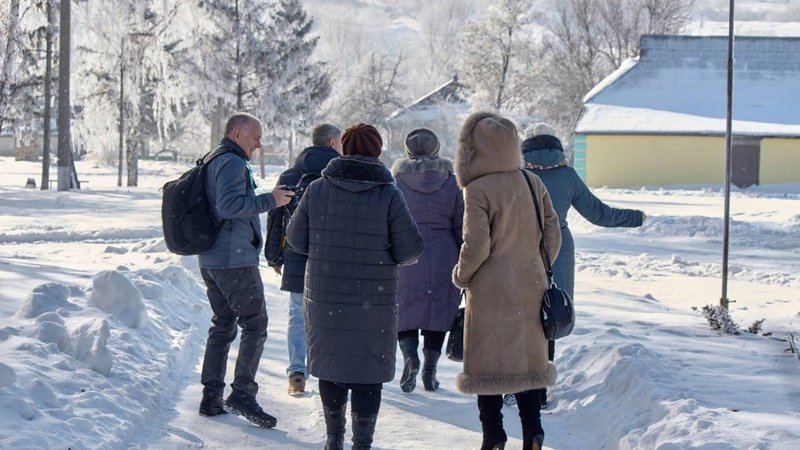
Members of the Chicago Teachers Union and their supporters participate in a car caravan around City Hall to protest against in-person learning in Chicago public schools on January 10, 2022 in Chicago, Illinois.Scott Olson/Getty Images

What’s not OK?

We’ve all been through so much in the past two years. Most of last year we were apart and now we’re together again. Children and all of us are out of practice being a community. We’ve all lost a lot. We’ve all been hurt a lot. So, the children need help. They need love. The adults need help and love too. And so as a community, we’re struggling through it.

How children carry the burdens of COVID

Principal Seth Lavin.Seth Lavin

Kids have experienced loss and kids have lost experiences. They are carrying trauma and, even the ones who aren’t carrying trauma from really terrible things happening during this pandemic, they’ve had experiences that kids shouldn’t have and have lacked experiences that kids should have.

Their friendships are harder. Their emotions are bigger. Their ability to have empathy, and process with those around them, and notice the humans around them is lower. And that just makes everything more challenging in a school because, in a school, we are together and everything we do impacts the people around us directly.

I talk to friends of mine who are teachers, who are principals, and we all share these stories, just examples of things that worry us about our kids – stories that you wouldn’t hear two or three years ago. A friend of mine who’s a principal told me when I asked how she’s doing, she said in the last three years, she had once gone through the process that you go through when a child has suicidal ideation, when they talk a lot about self-harm. She said [she has] done it four times in the last one month.

A student arrives for classes at a Chicago elementary school on January 12, 2022.Scott Olson/Getty Images

Too much focus on learning loss

It is objectively true that over the last two years, kids have not experienced the same lessons they would have, if school had just been in person. But, I really think there’s too much focus on that or on this idea of learning loss, whatever that means.

What school does and what school is isn’t just a sequence of lessons that you’re supposed to get in order at the right time in order to grow up to be the person you’re supposed to grow up to be. That’s not what school is really about. School is about becoming the person you’re meant to be through being in community and having experiences with others, learning who you are, learning how to be a person who shows up in a way that is good for others – and fractions and grammar.

So, yes, our kids missed out on things. They have experiences that they need to have, now, to grow into the people they need to be and to grow in community in the right way. That is all much more important and much more urgent than this idea that we need to somehow make up for the lessons that they didn’t have because they were remote or because school was closed at a certain period of time. That stuff will come. The urgency is we need to help our kids feel safe and good in community at school, so they know how to be with others.

When will things get back to normal?

We can’t pretend that we’re not still in the present tense in the pandemic, and I think it’s important to say that out loud because when we pretend the pandemic is over, when we pretend that these disruptions aren’t still existing in school, when we pretend our kids aren’t still experiencing the hardship that they’re experiencing as a result of this pandemic, we aren’t opening our eyes to what kids and teachers and schools and parents are actually experiencing, and in doing so, we create a disconnect and we make things worse.

I’m an optimist. I think the omicron surge ending is a really good thing and it may mean we have a time of lower cases and normalcy for a while. That’ll give us a longer time of more calm and more stability and school, which is going to help kids and teachers feel more calm and more stable in their bodies and their classrooms to rebuild the community and do the work that we need to do.

But in the long term, this isn’t a blip. I mean, this is now part of our collective experience. It’s been a quarter of my younger son’s life. It’s not just a thing that happened. It’s the world. So, we’re going to be making sense of that forever.

We want to go back to normal, but we also always have to ask what normal even was. This moment, cataclysmic as it is, has to be a time when we rebuild the world in a better way. And I really think that people, schools, teachers and their kids and the parents they work with are doing that work classroom by classroom.

ASMA KHALIDInstagramTwitter

CASEY MORELLTwitter

PATRICK JARENWATTANANONTwitter

AMY ISACKSON

Opinion: Change is a constant, and I’m struggling to keep up

By Brian Broome Contributing columnist February 13, 2022 at 8:00 a.m. EST Washington Post

It’s disheartening to watch the idols from my youth turn into old grumps. Reading Sean Penn’s recent comment that too many men have become “feminized” reminded me that some people struggle with change. But I know that, at 51, I am also out of step, and that many of my ideas are old-fashioned. And I rediscover this on an almost daily basis. How could it be otherwise? I work with predominantly younger people who are more than happy to remind me.Opinions to start the day, in your inbox. Sign up.

Not long ago, Betty White came up in conversation with a 22-year-old colleague. I was speaking reverently about White when I noticed the blank look on my colleague’s face. It was instantly clear to me that she had no idea who White was apart from an elderly actor who recently died. So, I told her about “The Golden Girls,”insisted that she watch it, told her where to find it and then assured her she would find it hilarious.

When I asked her about it a few days later, her face maintained the same blank expression it had before. She said she’d watched a few episodes and was “turned off” by the “slut shaming” and the “fat jokes.” She found them cruel. She didn’t understand how women could claim to be friends with one another and yet criticize each other’s physical appearances repeatedly.

I wanted to argue with her but stopped short because of one unbending reality: The culture changes. As it does, the roles of women and men change. Attitudes about what is funny and what is not also change.

Inspired by my colleague, I took the opportunity to review some of my favorite shows from the ’90s and saw it instantly: Much of the comedy, for lack of a better word, was mean-spirited. What was often considered funny a decade or two ago seems callous today.

I was reminded, too, of those sketches on “Saturday Night Live,” played by the actor Julia Sweeney in the early 1990s, about a person named Pat. The premise of the sketches was that no one could tell whether Pat was male or female; in every “Pat” skit, some outsider would go to great lengths trying to discern Pat’s sex. I didn’t think the gag was particularly funny. But I wasn’t offended by it, either. I just never thought about it.

I know now that there are human beings who endure this sort of mockery every day. It’s not at all comical to them. It can, in fact, be life-threatening.

These changes in our culture can be a test for people like me. Many older Americans can be quick to say how soft and sensitive younger Americans are. How they can’t take a joke and how we fear for the future in their delicate hands. But there is another way to think about this. Perhaps we older folks are mistaking the younger generation’s kindness for weakness. Being inclusive isn’t the same as being gullible. And there are plenty of ways to be funny without being mean.

You can dismiss young people as “too woke” if you want. But culture changes, and you can’t stop it.

Turning this around, it is often hard for younger people to understand how getting older is at times deeply disorienting. It often feels as though the earth is shifting constantly under your feet; things that were once perfectly acceptable can turn harmful. Getting older, I’m learning, can often seem as though much of the world is trying to push you out. You can feel the ground you once knew slipping away.

And, just like that, you find yourself out of step: In the past few years, I have been accused of sizeism, ableism and sexism for things that I’ve said and written that were once part of my daily vocabulary. The criticism angered me. If felt as though I was being called a bad person.

Many of us are experiencing some version of this as we age. We’re finding out that the old standards that we used to go by don’t apply anymore. And that the groups of people we used to make sport of want their full humanity to be respected.

Attitudes change. Language changes. At times, it can be a lot to understand. And it leaves me with two choices. I can try to learn the ways that our culture and our country are changing. And work to accept them with grace. Or I could rail against the sunrise every morning — and turn into an old grump myself.

Image without a caption

Looking for Inspiration

Looking for Inspiration
Alicia Silverstone Quote: “I'm always looking for inspiration.”

Sometimes someone else’s inspired words give us the courage to speak or to claim an insight that we felt was a bit outside the norm, until we find that someone else more famous said the same thing. Read this collection of quotations from speakers as diverse as Albert Einstein and Amelia Earhart, and be inspired.

______________________________________________________________________________________________________________________________________________


“In the long history of the world, only a few generations have been granted the role of defending freedom in its hour of maximum danger. I do not shrink from this responsibility—I welcome it. I do not believe that any of us would exchange places with any other people or any other generation. The energy, the faith, the devotion which we bring to this endeavor will light our country and all who serve it—and the glow from that fire can truly light the world. ” JKF 1961

“Everyone can be great, because everyone can serve.”Martin Luther King, Jr.

Service to others is the rent you pay for your room here on earth. Muhammad Ali

“Promises are the uniquely human way of ordering the future, making it predictable and reliable to the extent that this is humanly possible.” Hannah Arendt

“Activism is my rent for living on the planet.”— Alice Walker, American writer & social activist

I slept and dreamt that life was joy. I awoke and saw that life was service. I acted and behold, service was joy. Rabindranath Tagore

“The biggest problem is not to let people accept new ideas, but to let them forget the old ones. ” .John Maynard Keynes

“You think that because you understand “one” that you must therefore understand “two” because one and one make two. But you forget that you must also understand “and.”—Sufi teaching story

“Everything can be taken from a man, but one thing: the last of the human freedoms — to choose one’s attitude in any given set of circumstances, to choose one’s own way.” Victor Frankl

“I have got to make everything that has happened to me good for me,”  Oscar Wilde


“I am no longer accepting the things I cannot change. I am changing the things I cannot accept.” quote by Angela Davis.

 “Love does not consist in gazing at each other, but in looking outward together in the same direction,” Antoine de Saint Exupery

A Walk

My eyes already touch the sunny hill.
going far beyond the road I have begun,
So we are grasped by what we cannot grasp;
it has an inner light, even from a distance-

and changes us, even if we do not reach it,
into something else, which, hardly sensing it,
we already are; a gesture waves us on
answering our own wave…
but what we feel is the wind in our faces. Rilke

“What we now need to discover in the social realm is the moral equivalent of war; something heroic that will speak to man as universally as war does, and yet will be as compatible with their spiritual selves as war has proved to be incompatible.” William James (1842-1910)

The end of all knowledge should be service to others. Cesar Chavez

 “The first responsibility of a leader is to define reality. The last is to say thank you. In between, the leader is a servant.” –Max DePree

“You become what you think about all day long.”― Ralph Waldo Emerson

“You must be the change you wish to see in the world.” Mahatma Gandhi

“Leadership is meaning making in a community of practice.” Wilfrid Drath


“I don’t intend to revise my view of the world, of course, but rather to find a better way of fulfilling the demands that the world — as I see it — places on me. I don’t want to change myself, but to be myself in a better way… It also seems to me that the only way for someone like me to survive here is to breathe his own meaning into the experience. “ Vaclav Havel =Letters from Prison

“The possible redemption from the predicament of irreversibility — of being unable to undo what one has done though one did not, and could not, have known what he was doing — is the faculty of forgiving. The remedy for unpredictability, for the chaotic uncertainty of the future, is contained in the faculty to make and keep promises. The two faculties belong together in so far as one of them, forgiving, serves to undo the deeds of the past… and the other, binding oneself through promises, serves to set up in the ocean of uncertainty, which the future is by definition, islands of security without which not even continuity, let alone durability of any kind, would be possible in the relationships between [us]. ” Hannah Arendt


“You cannot escape the responsibility of tomorrow by evading it today.” Abraham Lincoln

“You never change things by fighting the existing reality. To change something, build a new model that makes the existing model obsolete.”
R. Buckminster Fuller

“If a factory is torn down but the rationality which produced it is
left standing, then that rationality will simply produce another
factory. If a revolution destroys a government, but the systematic
patterns of thought that produced that government are left intact,
then those patterns will repeat themselves. . . . There’s so much talk
about the system. And so little understanding.”
—Robert Pirsig, Zen and the Art of Motorcycle Maintenance

“Life is short. Break the rules, forgive quickly, kiss slowly, love truly, laugh uncontrollably, and never regret anything that makes you smile.” Steve Tyler (Not Mark Twain)
“The future is already here – it’s just not very evenly distributed.“
William Gibson


“When bad men combine, the good must associate, else they will fall one by one, an unpitied sacrifice in a contemptible struggle.” Edmund Burke

“Anyone who permits another to determine the quality of his inner life gives into the hands of the other the keys to his destiny. If a man knows precisely what he can do to you or what epithet he can hurl against you in order to make you lose your temper, your equilibrium, then he can always keep you under subjection. It is a man’s reaction to things that determines their ability to exercise power over him.” Howard Thurman- Jesus and the Disinherited:

“You don’t grow up. You grow yourself up.” Student at Mazeond College

“Education: the inculcation of the incomprehensible into the indifferent by the incompetent. ” John Maynard Keynes

“The man with the clear head is the man who frees himself from those fantastic ‘ideas’ and looks life in the face, realizes that everything in it is problematic, and feels himself to be lost. As this is the simple truth — that to live is to feel oneself lost — he who accepts it has already begun to find himself to be on firm ground. Instinctively, as do the shipwrecked, he will look round for something to which to cling, and that tragic, ruthless glance, absolutely sincere, because it is a question of his salvation, will cause him to bring order into the chaos of life. These are the only genuine ideas; the ideas of the shipwrecked. All the rest is rhetoric, posturing, farce. He who does not really feel himself lost, is lost without remission; that is to say, he never finds himself, never comes up against his own reality.”  José Ortega y Gasse “Revolt of the Massses”

“Managers are not confronted with problems that are independent
of each other, but with dynamic situations that consist of complex
systems of changing problems that interact with each other. I call
such situations messes. . . . Managers do not solve problems, they
manage messes.”—Russell Ackoff, operations theorist

“The reason people find it so hard to be happy is that they always see the past better than it was, the present worse than it is, and the future less resolved than it will be.” Marcel Pagnol

” Those who carry a new story and who risk speaking it abroad have played a crucial role in times of historic shifts. Before a new era can come into form, there must be a new story. The playwright Arthur Miller noted that we know an era has ended when its basic illusions have been exhausted. I would add that these basic illusions not only are exhausted, but also have become exhausting. As they fail to produce the results we want, we just repeat them with greater desperation, plummeting ourselves into cynicism and despair as we lock into these cycles of failure. ” Margaret Wheatley

“HOPE- Either we have hope within us or we do not. It is a dimension of the soul and is not essentially dependent on some particular observation of the world. HOPE is an orientation of the spirit, an orientation of the heart. It transcends the world that is immediately experienced and is anchored somewhere beyond its horizons. HOPE in this deep and powerful sense is not the same as joy that things are going well or willingness to invest in enterprises that are obviously headed for early success, but rather an ability to work for something because it is good, not because it stands a chance to succeed. HOPE is definitely not the same thing as optimism. It is not the conviction that something will turn out well, but certainty that something makes sense regardless of how it turns out. It is HOPE, above all which gives the strength to live and continually try new things. ” Vaclav Havel

“Pity the leader caught between unloving critics and uncritical lovers” John Gardner

“To see is to experience the world as it is, to remember is to experience the world as it was, but to imagine –ah, to imagine is to experience the world as it isn’t and has never been, but as it might be. The greatest achievement of the human brain is its ability to imagine objects and episodes that do not exist in the realm of the real, and it is this ability that allows us to think about the future. As one philosopher noted, the human brain is an ‘anticipation machine’, and ‘making future’ is the most important thing it does. ” Daniel Dennett

“After all, if you do not resist the apparently inevitable, you will never know how inevitable the inevitable was.”― Terry Eagleton

“We don’t see things as they are, we see them as we are.” Anais Nin


“The worst evil is not to commit crimes, but to fail to do the good one might have done.”― Leon Bloy

“It takes courage to grow up and turn out to be who you really are.” E E Cummings

“The future is not an empty space but like the past it is an active aspect of the present.” – Professor Ivana Milojevic, Futurist

“Practical men who believe themselves to be quite exempt from any intellectual influence, are usually the slaves of some defunct economist. Madmen in authority, who hear voices in the air, are distilling their frenzy from some academic scribbler of a few years back” John Maynard Keynes

“People don’t resist change. They resist being changed.”― Peter Senge

“We never keep to the present. We recall the past; we anticipate the future as if we found it too slow in coming and were trying to hurry it up, or we recall the past as if to stay its too rapid flight. We are so unwise that we wander about in times that do not belong to us, and do not think of the only one that does; so vain that we dream of times that are not and blindly flee the only one that is. The fact is that the present usually hurts. We thrust it out of sight because it distresses us, and if we find it enjoyable, we are sorry to see it slip away. We try to give it the support of the future, and think how we are going to arrange things over which we have no control for a time we can never be sure of reaching.

Let each of us examine his thoughts; he will find them wholly concerned with the past or the future. We almost never think of the present, and if we do think of it, it is only to see what light it throws on our plans for the future. The present is never our end. The past and the present are our means, the future alone our end. Thus we never actually live, but hope to live, and since we are always planning how to be happy, it is inevitable that we should never be so.” Pascal


“Nothing that is worth doing can be achieved in our lifetime; therefore we must be saved by hope. Nothing which is true or beautiful or good makes complete sense in any immediate context of history; therefore we must be saved by faith. Nothing we do, however virtuous, can be accomplished alone; therefore we must be saved by love. No virtuous act is quite as virtuous from the standpoint of our friend or foe as it is from our standpoint. Therefore we must be saved by the final form of love which is forgiveness.”  –Reinhold Niebuhr, The Irony of American History

“The same strength which has extended our power beyond a continent has also interwoven our destiny with the destiny of many peoples and brought us into a vast web of history in which other wills, running in oblique or contrasting directions to our own, inevitably hinder or contradict what we most fervently desire. We cannot simply have our way, not even when we believe our way to have the “happiness of mankind” as its promise.”
― Reinhold Niebuhr, The Irony of American History

“The place God calls you to is the place where your deep gladness and the world’s deep hunger meet.” — Frederick Buechner.

“Metaphors have a way of holding the most truth in the least space.”—  Orson Scott Card

“It is necessary to remember, as we think critically about domination, that we all have the capacity to act in ways that oppress, dominate, wound (whether or not that power is institutionalized). It is necessary to remember that it is first the potential oppressor within that we must resist – the potential victim within that we must rescue – otherwise we cannot hope for an end to domination, for liberation.”― bell hooks, 

“For this was the other thing that Elric knew: that to compromise with Tyranny is always to be destroyed by it. The sanest and most logical choice lay always in resistance.”― Michael Moorcock

“I can think of few important movements for reform in which success was won by any method other than that of an energetic minority presenting the indifferent majority with a fait accompli, which was then accepted.” Vera Brittain

“Never doubt that a small group of thoughtful, committed citizens can change the world; indeed, it’s the only thing that ever has.” Margaret Mead

“Let us temper our criticism with kindness. None of us comes fully equipped.” Carl Sagan


“I write these words to bear witness to the primacy of resistance struggle in any situation of domination (even within family life); to the strength and power that emerges from sustained resistance and the profound conviction that these forces can be healing, can protect us from dehumanization and despair.”― bell hooks,

“An era can be said to end when its basic illusions are exhausted… A retreat began from the old confidence in reason itself; nothing any longer could be what it seemed… A sort of political surrealism came dancing through the ruins of what had nearly been a beautifully moral and rational world… The whole place was becoming inhuman, not only because an unaccustomed fear was spreading so fast, but more because nobody would admit to being afraid.” (Arthur Miller 1974: 30, 32, 36)


“The highest reward for a person’s toil is not what they get for it, but what they become by it.” –John Ruskin

“Persistence wears down resistance.”― William J Federer,


“Every man who begets a free act projects his personality into the infinite. If he gives a poor man a penny grudgingly, that penny pierces the poor man’s hand, falls, pierces the earth, bores holes in suns, crosses the firmament and compromises the universe. If he begets an impure act, he perhaps darkens thousands of hearts whom he does not know, who are mysteriously linked to him, and who need this man to be pure as a traveler dying of thirst needs the Gospel’s draught of water. A charitable act, an impulse of real pity sings for him the divine praises, from the time of Adam to the end of the ages; it cures the sick, consoles those in despair, calms storms, ransoms prisoners, converts the infidel and protects mankind”― Léon Bloy, Pilgrim of the Absolute

“The kind of hope I often think about (especially in hopeless situations like prison or the sewer) is, I believe, a state of mind, not a state of the world. Either we have hope within us or we don’t. Hope is not a prognostication — it’s an orientation of the spirit. Each of us must find real, fundamental hope within himself. You can’t delegate that to anyone else.

Hope in this deep and powerful sense is not the same as joy when things are going well, or willingness to invest in enterprises that are obviously headed for early success, but rather an ability to work for something to succeed. Hope is definitely not the same thing as optimism. It’s not the conviction that something will turn out well, but the certainty that something makes sense, regardless of how it turns out.

 It is this hope, above all, that gives us strength to live and to continually try new things, even in conditions that seem as hopeless as ours do, here and now. In the face of this absurdity, life is too precious a thing to permit its devaluation by living pointlessly, emptily, without meaning, without love, and, finally, without hope.” –Vaclav Havel 


“Let us seek the respite where it is—in the very thick of battle. For in my opinion, and this is where I shall close, it is there. Great ideas, it has been said, come into the world as gently as doves. Perhaps then, if we listen attentively, we shall hear, amid the uproar of empires and nations, a faint flutter of wings, the gentle stirring of life and hope. Some will say that this hope lies in a nation; others, in a man. I believe rather that it is awakened, revived, nourished by millions of solitary individuals whose deeds and works every day negate frontiers and the crudest implications of history. As a result, there shines forth fleetingly the ever threatened truth that each and every man, on the foundation of his own suffering and joys, builds for all.”― Albert Camus

“All grown-ups were once children… but only few of them remember it.” Antoine De Sainte Exupery

“It is the greatest of all mistakes to do nothing because you can only do little – do what you can.” – Sydney Smith

The Origins of That Eisenhower 'Every Gun That Is Made...' Quote

“Every gun that is made, every warship launched, every rocket fired signifies, in the final sense, a theft from those who hunger and are not fed, those who are cold and are not clothed. This world in arms is not spending money alone. It is spending the sweat of its laborers, the genius of its scientists, the hopes of its children. The cost of one modern heavy bomber is this: a modern brick school in more than 30 cities. It is two electric power plants, each serving a town of 60,000 population. It is two fine, fully equipped hospitals. It is some fifty miles of concrete pavement. We pay for a single fighter with a half-million bushels of wheat. We pay for a single destroyer with new homes that could have housed more than 8,000 people. . . . This is not a way of life at all, in any true sense. Under the cloud of threatening war, it is humanity hanging from a cross of iron.[1][5]  
President Eisenhower 1953 “Cross of Iron Speech.”

“In the universe of atoms, friction is the norm, not the exception. It’s this very opposition, this challenge, that ignites the spark of innovation. When the world seems against you, embrace that resistance. It’s the sandpaper to your innovation, the very friction that shapes your destiny. Never stop pushing. Never stop dreaming. Here’s to the crazy ones who use that friction to sculpt their future.”― H.S. Crow, Lunora

“Everybody can be great because everybody can serve. You don’t have to have a college degree to serve. You don’t have to make your subject and your verb agree to serve. You only need a heart full of grace, a soul generated by love.”― Martin Luther King Jr.

“We are now faced with the fact that tomorrow is today. We are confronted with the fierce urgency of now. In this unfolding conundrum of life and history, there ‘is’ such a thing as being too late. This is no time for apathy or complacency. This is a time for vigorous and positive action.”― Martin Luther King Jr.

“We must live together as brothers or perish together as fools.”― Martin Luther King Jr.

“The first people a dictator puts in jail are the writers, the teachers, the librarians – because these people are dangerous. They have enough vocabulary to recognize injustice and to speak out loudly about it. Let us have the courage to go on being dangerous people.”― Madeleine L’Engle

“Not everybody can be famous but everybody can be great, because greatness is determined by service.”― Martin Luther King Jr.

“Some things are best mended by a break.” Edith Wharton

“Please try to remember that what they believe, as well as what they do and cause you to endure does not testify to your inferiority but to their inhumanity.” James Baldwin

“The most dangerous creation of any society is the man who has nothing to lose.” James Baldwin


“As we peer into society’s future, we – you and I, and our government – must avoid the impulse to live only for today, plundering for our own ease and convenience the precious resources of tomorrow. We cannot mortgage the material assets of our grandchildren without risking the loss also of their political and spiritual heritage. We want democracy to survive for all generations to come, not to become the insolvent phantom of tomorrow.” [2]
President Eisenhower Farewell Speech 1960

“What George Washington did right was to realize how much of what he thought was right was wrong.” Nathaniel Philbrick

“A happy person isn’t someone who’s happy all the time. It’s someone who effortlessly interprets events in such a way that they don’t lose their innate peace.”Naval Ravikant

“Play iterated games. All the returns in life, whether in wealth, relationships, or knowledge, come from compound interest.” Naval Ravikant

“To be a Negro in this country and to be relatively conscious is to be in a rage almost all the time.” James Baldwin

“In the councils of government, we must guard against the acquisition of unwarranted influence, whether sought or unsought, by the military-industrial complex. The potential for the disastrous rise of misplaced power exists and will persist. We must never let the weight of this combination endanger our liberties or democratic processes. We should take nothing for granted. Only an alert and knowledgeable citizenry can compel the proper meshing of the huge industrial and military machinery of defense with our peaceful methods and goals, so that security and liberty may prosper together ” President Eisenhower Farewell Speech 1960


“Do it! What are you waiting on? Do it! Stand up for what you believe in. The world needs your voice. Whoever you are, you have something to say. Say it.”— Kerry Washington, American actress, director, and activist 

“It is not the critic who counts: not the man who points out how the strong man stumbles or where the doer of deeds could have done better. The credit belongs to the man who is actually in the arena, whose face is marred by dust and sweat and blood, who strives valiantly, who errs and comes up short again and again, because there is no effort without error or shortcoming, but who knows the great enthusiasms, the great devotions, who spends himself for a worthy cause; who, at the best, knows, in the end, the triumph of high achievement, and who, at the worst, if he fails, at least he fails while daring greatly, so that his place shall never be with those cold and timid souls who knew neither victory nor defeat.” Theodore Roosevelt

“Criticism is necessary and useful; it is often indispensable; but it can never take the place of action, or be even a poor substitute for it. The function of the mere critic is of very subordinate usefulness. It is the doer of deeds who actually counts in the battle for life, and not the man who looks on and says how the fight ought to be fought, without himself sharing the stress and the danger.” Theodore Roosevelt

“People all say that what we’re all seeking is a meaning for life. I don’t think that’s what we’re really seeking. I think that what we’re seeking is an experience of being alive so that our life experiences on the purely physical plane will have resonances within our own innermost being and reality, so that we actually feel the rapture of being alive.” – Joseph Campbell


“People do not care how much you know until they know how much you care.” -John C. Maxwell

“The victim who is able to articulate the situation of the victim has ceased to be a victim: he or she has become a threat.” James Baldwin


 “Volunteers don’t get paid, not because they’re worthless, but because they’re priceless.” – Sherry Anderson

“It is not the story you listen to, it is the story that you listen through.” P Costello

“…the man who really counts in the world is the doer, not the mere critic-the man who actually does the work, even if roughly and imperfectly, not the man who only talks or writes about how it ought to be done.”  Theodore Roosevelt

“Its not what you achieve in a life that matters so much as what you set in motion that carries on beyond your life.” P Andrew Costello

“The reasonable man adapts himself to the world; the unreasonable one persists in trying to adapt the world to himself. Therefore all progress depends on the unreasonable man.” – George Bernard Shaw

“My dear,
In the midst of hate, I found there was, within me, an invincible love.
In the midst of tears, I found there was, within me, an invincible smile.
In the midst of chaos, I found there was, within me, an invincible calm.
I realized, through it all, that…
In the midst of winter, I found there was, within me, an invincible summer.
And that makes me happy. For it says that no matter how hard the world pushes against me, within me, there’s something stronger – something better, pushing right back. Truly yours,
Albert Camus” ( the original quote has been added to here)

“It is impossible for a man to learn what he thinks he already knows.” – Epictetus

“Those who say it can’t be done are usually interrupted by others doing it.” James Balwdin

“I am only one, but I am one.  I cannot do everything, but I can do something.  And I will not let what I cannot do interfere with what I can do.” – Edward Everett Hale

“Our problem is not that we aim too high and miss, but that we aim too low and hit.”— Aristotle

“A great many people think they are thinking when they are really rearranging their prejudices.” – William James

“Don’t ask what the world needs. Ask what makes you come alive, and go do it. Because what the world needs is people who have come alive.” – Howard Thurman

“Hell has three gates: lust, anger, and greed.” The Bhagavad Gita

“If I had asked people what they wanted, they would have said faster horses.” – Henry Ford

“I am no longer accepting the things I cannot change. I am changing the things I cannot accept.”— Angela Davis, American political activist & academic

“The miracle is this–the more we share, the more we have.” –Leonard Nimoy

“I can’t believe what you say, because I see what you do. “ James Baldwin

“The greatest danger for most of us is not that our aim is too high and we miss it, but that it is too low and we reach it.” – Michelangelo

“We have lost the ability to create metaphors for life. We have lost the ability to give shape to things, to recognize the events around us and in us, let alone to interpret them. In this way we have ceased being the likenesses of God, and our existence is unjustified. We are, in fact, dead. . . . We feed on knowledge which has long since decayed.” Friedensreich Hundertwasser 

“You think your pain and your heartbreak are unprecedented in the history of the world, but then you read. ” James Baldwin

When despair for the world grows in me and I wake in the night at the least sound in fear of what my life and my children’s lives may be, I go and lie down where the wood drake rests in his beauty on the water, and the great heron feeds. I come into the peace of wild things who do not tax their lives with forethought of grief. I come into the presence of still water. And I feel above me the day-blind stars waiting with their light. For a time I rest in the grace of the world, and am free.— The Peace of Wild Things by Wendell Barry 

“Birds born in a cage think flying is an illness.” – Alejandro Jodorowsky

“The sun shines not on us but in us. The rivers flow not past, but through us. Thrilling, tingling, vibrating every fiber and cell of the substance of our bodies, making them glide and sing. The trees wave and the flowers bloom in our bodies as well as our souls, and every bird song, wind song, and tremendous storm song of the rocks in the heart of the mountains is our song, our very own, and sings our love.” John Muir

“Anyone who has ever struggled with poverty knows how extremely expensive it is to be poor.” James Baldwin


“Until one is committed, there is hesitancy, the chance to draw back. Concerning all acts of initiative (and creation), there is one elementary truth, the ignorance of which kills countless ideas and splendid plans: that the moment one definitely commits oneself, then Providence moves too. All sorts of things occur to help one that would never otherwise have occurred. A whole stream of events issues from the decision, raising in one’s favor all manner of unforeseen incidents and meetings and material assistance, which no man could have dreamed would have come his way. Whatever you can do, or dream you can do, begin it. Boldness has genius, power, and magic in it. Begin it now.”― William Hutchinson Murray

“We must be silent before we can listen. We must listen before we can learn. We must learn before we can prepare. We must prepare before we can serve. We must serve before we can lead.” ― Mahatma Gandhi


“Thrice happy is the nation that has a glorious history. Far better it is to dare mighty things, to win glorious triumphs, even though checkered by failure, than to take rank with those poor spirits who neither enjoy much nor suffer much, because they live in the gray twilight that knows neither victory nor defeat.” Theodore Roosevelt


“A liberal: someone who thinks he knows more about your experience than you do.” James Baldwin

“It is true of the Nation, as of the individual, that the greatest doer must also be a great dreamer.” Theodore Roosevelt

“This country will not be a permanently good place for any of us to live in unless we make it a reasonably good place for all of us to live in.” Theodore Roosevelt

“Between stimulus and response there is a space. In that space lies our freedom.” – Viktor Frankl

“It is certain, in any case, that ignorance, allied with power, is the most ferocious enemy justice can have.” James Baldwin

“Leaders don’t create more followers, they create more leaders.”― Tom Peters

“I used to think bearing witness was a passive act. I don’t believe that anymore. I think that when we are present, when we bear witness, when we do not divert our gaze, something is revealed — the very marrow of life. We change. A transformation occurs. Our consciousness shifts.”  — Terry Tempest Williams

“Work for a cause, not for applause. Live life to express, not to impress. Don’t strive to make your presence noticed, just make your absence felt.”— Unknown

“The two most important days in your life are the day you are born and the day you find out why.”— Mark Twain

“What we want is to see the child in pursuit of knowledge, and not knowledge in pursuit of the child.” (George Bernard Shaw)

If this work can contribute in any way toward proving this, and at the same time arouse the conscience of the American people to a demand for justice to every citizen, and punishment by law for the lawless, I shall feel I have done my race a service. Ida B. Wells

“No one has a right to sit down and feel hopeless. There is too much work to do.”— Dorothy Day, Catholic social activist & journalist

“Precisely at the point when you begin to develop a conscience, you must find yourself at war with your society. ” James Baldwin

“From time to time in the years to come, I hope you will be treated unfairly so that you will come to know the value of justice. I hope you will suffer betrayal because that will teach you the importance of loyalty. Sorry to say, but I hope you will be lonely from time to time so that you don’t take friends for granted. I wish you bad luck, again, from time to time so that you will be conscious of the role of chance in life and understand that your success is not completely deserved and that the failure of others is not completely deserved either. And when you lose, as you will from time to time, I hope every now and then, your opponent will gloat over your failure. It is a way for you to understand the importance of sportsmanship. I hope you’ll be ignored, so you know the importance of listening to others, and I hope you will have just enough pain to learn compassion. Whether I wish these things or not, they’re going to happen. And whether you benefit from them or not will depend upon your ability to see the message in your misfortunes.”  The Coddling of the American Mind: by Jonathan Haidt and Gregory Lukianoff

“There is a time in every man’s education when he arrives at the conviction that envy is ignorance; that imitation is suicide; that he must take himself for better, for worse, as his portion; that though the wide universe is full of good, no kernel of nourishing corn can come to him but through his toil bestowed on that plot of ground which is given to him to till. The power which resides in him is new in nature, and none but he knows what that is which he can do, nor does he know until he has tried.”― Ralph Waldo Emerson, Self Reliance

“Your vocation in life is where your greatest joy meets the world’s greatest need.” —Frederick Buechner

“The art of teaching is the art of assisting discovery.” (Mark Van Doren)


“When you see something that is not just, not fair, or not right, you have to do something. You have to say something. Make a little noise. It’s time for us to get into good trouble, necessary trouble.”— John Lewis, leader within American civil rights movements & former congressman

” My mentor taught me when an opportunity is presented to you, you look at it, and you FEEL it, and ask yourself Does this opportunity light me up? Does it fill me with a sense of curiosity? Does it excite me? If it does, hell yeah, I’m involved. –Layne Beachley


“The problem with being a leader is that you’re never sure if you’re being followed or chased.” – Claire A. Murray

“The dogmas of the quiet past are inadequate to the stormy present. The occasion is piled high with difficulty and we must rise with the occasion. As our case is new, we must think anew and act anew. We must disenthrall ourselves, and then we shall save our country.” Abraham Lincoln 1862

“Let me give you a word of the philosophy of reform. The whole history of the progress of human liberty shows that all concessions yet made to her august claims have been born of earnest struggle. The conflict has been exciting, agitating, all-absorbing, and for the time being, putting all other tumults to silence. It must do this or it does nothing. If there is no struggle, there is no progress. Those who profess to favor freedom and yet deprecate agitation are men who want crops without plowing up the ground; they want rain without thunder and lightning. They want the ocean without the awful roar of its many waters.” Frederick Douglas 1857


“Two things are infinite: the universe and human stupidity; and I’m not sure about the universe.” Albert Einstein

“Where justice is denied, where poverty is enforced, where ignorance prevails, and where any one class is made to feel that society is an organized conspiracy to oppress, rob and degrade them, neither persons nor property will be safe.” Frederick Douglas

Frederick Douglass | National Portrait Gallery

“Power concedes nothing without a demand. It never did and it never will.” Frederick Douglas

“It is easier to build strong children than to repair broken men.” Frederick Douglas

“The limits of tyrants are prescribed by the endurance of those whom they oppress.” Frederick Douglas

Those who make peaceful revolution impossible will make violent revolution inevitable.”  President John F Kennedy 1962

 “Injustice anywhere is a threat to justice everywhere. We are caught in an inescapable network of mutuality, tied in a single garment of destiny. Whatever affects one directly, affects all indirectly.”  Martin Luther King 1963

“It could be that your purpose in life is to serve as a warning to others.”
Ashleigh Brilliant

“Enthusiasm is one of the most powerful engines of success. When you do a thing, do it with all your might. Put your whole soul into it. Stamp it with your own personality. Be active, be energetic, be enthusiastic and faithful, and you will accomplish your object. Nothing great was ever achieved without enthusiasm.”― Ralph Waldo Emerson

“The great majority of us cannot listen; we find ourselves compelled to evaluate, because listening is too dangerous. The first requirement is courage, and we do not always have it.”— Carl Rogers

“Action is the antidote to despair.”— Joan Baez, American singer-songwriter & activist

“One does not discover new lands without consenting to lose sight of the shore for a very long time.” – Andre Gide

“Treat a man as he is, and he will remain as he is. Treat a man as he could be, and he will become what he should be.”― Ralph Waldo Emerson


“Most of us are just about as happy as we make up our minds to be.” – Abraham Lincoln

if you cannot understand why someone did something, look at the consequences — and infer the motivation.”

Carl Jung


“There is no better than adversity. Every defeat, every heartbreak, every loss, contains its own seed, its own lesson on how to improve your performance next time.
Malcolm X

“Sometimes we are blessed with being able to choose the time, and the arena, and the manner of our revolution, but more usually we must do battle where we are standing.”— Audre Lorde, American writer, feminist, and civil rights activist

“Concerning nonviolence: it is criminal to teach a man not to defend himself when he is the constant victim of brutal attacks.” Malcolm X

You can’t separate peace from freedom, because no one can be at peace unless he has his freedom.” Malcolm X 1965

. “You don’t fight racism with racism, the best way to fight racism is with solidarity.” – Bobby Seale

“Your actions speak so loudly, I can not hear what you are saying.”― Ralph Waldo Emerson

“Trust thyself: every heart vibrates to that iron string. Nothing is at last sacred but the integrity of your own mind. A man should learn to detect and watch that gleam of light which flashes across his mind from within, more than the luster of the firmament of bards and sages… In every work of genius we recognize our own rejected thoughts: they come back to us with a certain alienated majesty. The power which resides in him is new in nature, and none but he knows what that is which he can do, nor does he know until he has tried”― Ralph Waldo Emerson

 “Protesting is never a disturbance of the peace. Corruption, injustice, war and intimidation are disturbances of the peace.” – Bryant McGill

“Not everything that is faced can be changed. But nothing can be changed until it has been faced. History is not the past. It is the present. We carry our history with us. We are our history. If we pretend otherwise we literally are criminals.”  James Baldwin

“Precisely at the point when you begin to develop a conscience, you must find yourself at war with your society.” James Baldwin

“We can disagree and still love each other, unless your disagreement is rooted in my oppression and denial of my humanity and right to exist.” James Baldwin

“When I dare to be powerful—to use my strength in the service of my vision—then it becomes less and less important whether I am afraid,” Audre Lorde

“Your silence will not protect you,” Audre Lorde

“It is necessary that the weakness of the powerless is transformed into a force capable of announcing justice. For this to happen, a total denouncement of fatalism is necessary. We are transformative beings and not beings for accommodation.”  Paulo Freire

“The good we secure for ourselves is precarious and uncertain until it is secured for all of us and incorporated into our common life.” – Jane Addams

“ He who has a why to live can bear almost any how. “Friedrich Nietzsche

Emma Goldman, One of History's Best-Known Anarchists, Left an Outsized  Legacy | Teen Vogue

“If I can’t dance to it, it’s not my revolution.”― Emma Goldman

“His Majesty’s Government view with favour the establishment in Palestine of a national home for the Jewish people, and will use their best endeavours to facilitate the achievement of this object, it being clearly understood that nothing shall be done which may prejudice the civil and religious rights of existing non-Jewish communities in Palestine, or the rights and political status enjoyed by Jews in any other country.” The Balfour declaration 1917

“There is a spirit and a need and a man at the beginning of every great human advance. Every one of these must be right for that particular moment in history, or nothing happens.” – Coretta Scott King

“Our strategy should be not only to confront empire, but to lay siege to it. To deprive it of oxygen. To shame it. To mock it. With our art, our music, our literature, our stubbornness, our joy, our brilliance, our sheer relentlessness – and our ability to tell our own stories. Stories that are different from the ones we’re being brainwashed to believe.” Arundhati Roy

“No one will do for you what you need to do for yourself. We cannot afford to be separate. We have to see that all of us are in the same boat.” – Dorothy Height

“Wherever women gather together, failure is impossible.” – Susan B. Anthony

“We build the path as we can, rock by rock.” – Hosea Williams

 “And what country can preserve its liberties if their rulers are not warned from time to time that their people preserve the spirit of resistance? Let them take arms. The remedy is to set them right as to facts, pardon and pacify them.” Thomas Jefferson

“When an individual is protesting society’s refusal to acknowledge his dignity as a human being, his very act of protest confers dignity on him.” – Bayard Rustin

“You said, ‘They’re harmless dreamers and they’re loved by the people.’ ‘What,’ I asked you, ‘is harmless about a dreamer, and what,’ I asked you, ‘is harmless about the love of the people? Revolution only needs good dreamers who remember their dreams.” Tennessee Williams

“THE STATE OF ISRAEL…will foster the development of the country for the benefit of all its inhabitants; it will be based on freedom, justice and peace as envisaged by the prophets of Israel; it will ensure complete equality of social and political rights to all its inhabitants irrespective of religion, race or sex; it will guarantee freedom of religion, conscience, language, education and culture; it will safeguard the Holy Places of all religions; and it will be faithful to the principles of the Charter of the United Nations.” The Israeli Declaration of Independence 1947


“The Lord has shown you what is good. He has told you what he requires of you. You must act with justice. You must love to show mercy. And you must be humble as you live in the sight of your God.” Micah 6-8

“Let justice roll down like waters.” Amos 5:24

“A revolution is coming – a revolution which will be peaceful if we are wise enough; compassionate if we care enough; successful if we are fortunate enough – but a revolution which is coming whether we will it or not. We can affect its character; we cannot alter its inevitability.” Robert F Kennedy

“Here’s to the crazy ones. The misfits. The rebels. The troublemakers. The round pegs in the square holes. The ones who see things differently. They’re not fond of rules, and they have no respect for the status quo. You can quote them; disagree with them; glorify or vilify them. About the only thing you can’t do is ignore them. Because they change things. They push the human race forward. And while some may see them as the crazy ones, we see genius. Because the people who are crazy enough to think they can change the world are the ones who do.“ —  Rob SiltanemApple Campaign


“Revolution does have to be violent precisely because the Pharaoh won’t let you go. If the Pharaoh would let you go, the revolution won’t have to be violent.” Michael Hardt

“I have always thought that in revolutions, especially democratic revolutions, madmen, not those so called by courtesy, but genuine madmen, have played a very considerable political part. One thing is certain, and that is that a condition of semi-madness is not unbecoming at such times, and often even leads to success.” Alexis de Tocqueville,

“Revolutions are the only political events which confront us directly and inevitably with the problem of beginning. ”Hannah Arendt  

“The only people for me are the mad ones, the ones who are mad to live, mad to talk, mad to be saved, desirous of everything at the same time, the ones who never yawn or say a commonplace thing, but burn, burn, burn, like fabulous yellow roman candles exploding like spiders across the stars and in the middle you see the blue center light pop and everybody goes ‘Awww!'” Jack Kerouac

“Everyone must come out of his Exile in his own way.” Martin Buber 

“There are three principles in a man’s being and life: The principle of thought, the principle of speech, and the principle of action. The origin of all conflict between me and my fellow-men is that I do not say what I mean and I don’t do what I say.” Martin Buber

“Inscrutably involved, we live in the currents of universal reciprocity.” ”Martin Buber  

BBC Radio 4 - In Our Time - What Hannah Arendt can teach us about  totalitarianism

“The new always happens against the overwhelming odds of statistical laws and their probability, which for all practical, everyday purposes amounts to certainty; the new therefore always appears in the guise of a miracle.” Hannah Arendt 

“’The philosophers have only interpreted the world, in various ways. The point, however, is to change it.” Karl Marx 

“The most potent weapon of the oppressor is the mind of the oppressed.” Steve Biko

“It is better to die for an idea that will live, than to live for an idea that will die” Steve Bantu Biko

“Pessimism of the intellect, optimism of the will.”― Antonio Gramsci

 “In essentials, unity; in doubtful matters, liberty; in all things, charity.”  Pope John XXIII

“Let your life be a counter-friction to stop the machine. What I have to do is to see, at any rate, that I do not lend myself to the wrong which I condemn.” Thoreau

“I ask no favor for my sex. All I ask of our brethren is that they take their feet off our necks.” Ruth Bader Ginsburg

“There is no power for change greater than a community discovering what it cares about.” – Margaret J. Wheatley

“If you want to go quickly, go alone. If you want to go far, go together.” – African Proverb

Alice Walker | Official Publisher Page | Simon & Schuster

“The most common way people give up their power is by thinking they don’t have any.” Alice Walker

“Justice and power must be brought together, so that whatever is just may be powerful, and whatever is powerful may be just.”  Blaise Pascal

“Hide nothing from the masses of our people. Tell no lies. Expose lies whenever they are told. Mask no difficulties, mistakes, failures. Claim no easy victories…”
Amilcar Cabral

“International solidarity is not an act of charity: It is an act of unity between allies fighting on different terrains toward the same objective. The foremost of these objectives is to aid the development of humanity to the highest level possible.”—Samora Machel.

Service which is rendered without joy helps neither the servant nor the served.—Mohandas Karamchand Gandhi

“It is a beautiful thing to be on fire for justice… there is no greater joy than inspiring and empowering others––especially the least of these, the precious and priceless wretched of the earth!”― Cornel West,

“Everybody can be great…because anybody can serve. You don’t have to have a college degree to serve. You don’t have to make your subject and verb agree to serve. You only need a heart full of grace. A soul generated by love.” –Martin Luther King, Jr.

“The world changes according to the way people see it, and if you can alter, even by a millimeter, the way people look at reality, then you can change the world.” –James Baldwin

“Never doubt that a small group of thoughtful, committed citizens can change the world; indeed, it’s the only thing that ever has.” –Margaret Mead

Habit is the enormous flywheel of society, its most precious conservative agent. There is no more miserable human being than one in whom nothing is habitual but indecision. Full half the time of such a man goes to the deciding, or regretting, of matters which ought to be so ingrained in him as practically not to exist for his consciousness at all. William James

“One person with passion is better than forty people merely interested.” –E.M. Forster

“No act of kindness, however small, is ever wasted.” –Aesop

“I wish to do something Great and Wonderful, but I must start by doing the little things like they were Great and Wonderful.” –“People say, ‘What is the sense of our small effort?’ They cannot see that we must lay one brick at a time, take one step at a time.” –Dorothy Day

“Start by doing what’s necessary; then do what’s possible; and suddenly you are doing the impossible.” –St. Francis of Assisi ( ?)

“Act as if what you do makes a difference. It does.” –William James

“It means a great deal to those who are oppressed to know that they are not alone. Never let anyone tell you that what you are doing is insignificant.” – Desmond Tutu

There will be no equity without solidarity. There will be no justice without a social movement.–Joia Mukherjee

“The highest reward for a man’s toil is not what he gets for it but what he becomes by it.” —John Ruskin

What counts in life is not the mere fact that we lived. It is the difference we have made to the lives of others that will determine the significance of the life we lead.–Nelson Mandela

“Men who want to support women in our struggle for freedom and justice should understand that it is not terrifically important to us that they learn to cry; it is important to us that they stop the crimes of violence against us. “Andrea Dworkin

“I would like to be remembered as a person who wanted to be free… so other people would be also free.” Rosa Parks

“No man is good enough to govern another man without his consent. ” Abraham Lincoln

“Those who deny freedom to others deserve it not for themselves.” Abraham Lincoln

“With malice toward none with charity for all with firmness in the right as God gives us to see the right let us strive on to finish the work we are in to bind up the nation’s wounds, to care for him who shall have borne the battle and for his widow and his orphan ~ to do all which may achieve and cherish a just and lasting peace among ourselves and with all nations.” Abraham Lincoln

“When a man is denied the right to live the life he believes in, he has no choice but to become an outlaw. ” Nelson Mandela

“I prefer dangerous freedom over peaceful slavery.” Thomas Jefferson

I have walked that long road to freedom. I have tried not to falter; I have made missteps along the way. But I have discovered the secret that after climbing a great hill, one only finds that there are many more hills to climb. I have taken a moment here to rest, to steal a view of the glorious vista that surrounds me, to look back on the distance I have come. But I can only rest for a moment, for with freedom come responsibilities, and I dare not linger, for my long walk is not ended. Nelson Mandela

The function of freedom is to free someone else. Toni Morrison

You get your freedom by letting your enemy know that you’ll do anything to get it. Then you’ll get it. It’s the only way you’ll get it. Malcolm X

Everyone has oceans to fly, if they have the heart to do it. Is it reckless? Maybe. But what do dreams know of boundaries? Amelia Earhart

“We all have limits. Almost no one reaches theirs. You definitely haven’t.”

No man can put a chain about the ankle of his fellow man without at last finding the other end fastened about his own neck. Frederick Douglass

Find out just what any people will quietly submit to and you have the exact measure of the injustice and wrong which will be imposed on them. Frederick Douglass

 “What another would have done as well as you, do not do it. What another would have said as well as you, do not say it; what another would have written as well, do not write it. Be faithful to that which exists nowhere but in yourself — and thus make yourself indispensable.”Andre Gide

“If you have come to help me, you are wasting your time. But, if you have come because your liberation is bound up with mine, then let us work together.” Lilla Watson

“Unless you’re the lead dog of the sled, the view never changes.” ( Author Unknown)

If you want to make enemies, try to change something.– Woodrow Wilson

When we are no longer able to change a situation, we are challenged to change ourselves.– Victor Frankl

If you always do what you’ve always done, you’ll always get what you’ve always got.– Henry Ford

The ordinary focus on what they’re getting. The extraordinary think about who they’re becoming.  Robin Scharma

“Resentment is like drinking poison and expecting the other guy to die.” Carrie Fisher

“Today’s pain is tomorrow’s power. The more you suffer today, the stronger you are tomorrow.” Unknown

You can judge your age by the amount of pain you feel when you come in contact with a new idea.– Pearl S. Buck

In any given moment we have two options: to step forward into growth or step back into safety.– Abraham Maslow

 “Do it or don’t do it. There is no try.” Yoda

The most important thing to remember is this: To be ready at any moment to give up what you are for what you might become.– W.E.B. Du Bois

Who Was Howard Thurman? | BU Today | Boston University

“Don’t ask yourself what the world needs; ask yourself what makes you come alive, and then go do that. Because what the world needs are people who are alive.” Howard Thurman

“One of the great liabilities of history is that all too many people fail to remain awake through great periods of social change. Every society has its protectors of status quo and its fraternities of the indifferent who are notorious for sleeping through revolutions. Today, our very survival depends on our ability to stay awake, to adjust to new ideas, to remain vigilant and to face the challenge of change.” – Martin Luther King Jr.

 “When the power of love overcomes the love of power the world will know peace.” Jimi Hendrix

“If your actions inspire others to dream more, learn more, do more and become more, you are a leader.” John Quincy Adams

“And I said to the man who stood at the gate of the year: “Give me a light that I may tread safely into the unknown.”
And he replied:
“Go out into the darkness and put your hand into the Hand of God. That shall be to you better than light and safer than a known way.”
So I went forth, and finding the Hand of God, trod gladly into the night. And He led me towards the hills and the breaking of day in the lone East. ” Christmas Message 1939 King George VI quoting poet Minnie Louise Haskins (My Mother’s favorite quote)

Peace is not merely a vacuum left by the ending of wars. It is the creation of two eternal principles, justice and freedom. – Author: James T. Shotwell

I will never forget that the only reason I’m standing here today is because somebody, somewhere stood up for me when it was risky. Stood up when it was hard. Stood up when it wasn’t popular. And because that somebody stood up, a few more stood up. And then a few thousand stood up. And then a few million stood up. And standing up, with courage and clear purpose, they somehow managed to change the world. Barack Obama

Change is the process by which the future invades our lives. ALVIN TOFFLER

The price of doing the same old thing is far higher than the price of change. BILL CLINTON

 “I never heard of anyone ever stumbling on something sitting down.”  – Charles F. Kettering

Be sincere; be brief; be seated. Franklin D. Roosevelt

Change comes from power, and power comes from organization. In order to act, people must get together.  SAUL ALINSKY

Change demands new learning. ROSABETH MOSS KANTER

Amazon.com: Eric Hoffer: Books, Biography, Blog, Audiobooks, Kindle

In times of profound change, the learners inherit the earth, while the learned find themselves beautifully equipped to deal with a world that no longer exists. ERIC HOFFER

Societies as well as people become afraid of change as they grow older. It’s human nature. The young have adventures while the old sit at home and nurture their memories. PAUL MCAULEY

The sad thing is that, even though we know our lives aren’t working in certain areas, we are still afraid to change. We are locked into our comfort zone, no matter how self-destructive it may be. Yet, the only way to get out of our comfort zone and to be free of our problems and limitations is to get uncomfortable. ROBERT ANTHONY

“The need for change bulldozed a road down the center of my mind. “MAYA ANGELOU

Always remember that the crowd that applauds your coronation is the same crowd that will applaud your beheading. People like a show. -Terry Pratchet, Discworld (Going Postal)

“There is nothing more difficult to take in hand, more perilous to conduct, or more uncertain in its success, than to take the lead in the introduction of a new order of things.” Niccolo Machiavelli The Prince (1532)

“Every generation needs a new revolution.”— Thomas Jefferson

 “when at long last I will happily go to meet my maker, he will say to me: ‘show me your wounds.’ And if I have no wounds, I will say to him: ‘I have no wounds.’ And he will say to me: ‘was there nothing worth fighting for?’”  Speaker Pelosi’s quoted this story

You are braver than you believe, stronger than you seem, and smarter than you think. -Christopher Robin, Winnie The Pooh

 No one in history has ever been insulted into agreement.— Arthur Brooks

 You can’t talk your way out of something you behaved your way into. You have to behave your way out of it.— Doug Conant (CEO of Campbell Soup, as quoted in Harvard Business Review)

Design Icon: 8 Works by Buckminster Fuller - Dwell

You can never change things by fighting the existing reality. To change something, build a new model that makes the old model obsolete.— Buckminister Fuller

“How, then, does one become an activist?
The easy answer would be to say that we do not become activists; we simply forget that we are. We are all born with compassion, generosity, and love for others inside us. We are all moved by injustice and discrimination. We are all, inside, concerned human beings. We all want to give more than to receive. We all want to live in a world where solidarity and companionship are more important values than individualism and selfishness. We all want to share beautiful things; experience joy, laughter, love; and experiment together.”― Noam Chomsky, On Palestine

“I watched the speech backstage on the teleprompter. Obama paused for a moment, and I saw the text freeze. “I’m going off script here for a second,” he said, “but before I came here I met with a group of young Palestinians from the age of fifteen to twenty-two. And talking to them, they weren’t that different from my daughters. They weren’t that different from your daughters or sons. I honestly believe that if any Israeli parent sat down with those kids, they’d say, I want these kids to succeed; I want them to prosper. I want them to have opportunities just like my kids do. I believe that’s what Israeli parents would want for these kids if they had a chance to listen to them and talk to them. I believe that.” His comments were met with rolling applause, and when he dived back into the prepared text it occurred to me that this tribute—this imploring of Israelis to see Palestinians as human beings no different from themselves—might be the most he would be able to do to keep a promise to those Palestinian kids.”― Ben Rhodes, The World As It Is: Inside the Obama White House

“MOST OF THE NATIONS OF the Middle East can be divided into those with long histories and no oil, and those that have lots of oil and very little history. With a few notable exceptions, both groups share a common feature: they were cobbled together by outsiders. The borders of the modern Middle East were drawn by Europeans after the First World War with no regard for the interests or backgrounds of the people who inhabited it.”― Richard Engel, And Then All Hell Broke Loose: Two Decades in the Middle East

“Art is not a mirror held up to reality
but a hammer with which to shape it.”― Bertolt Brecht

“A bird doesn’t sing because it has an answer. It sings because it has a song.” Moya Angelou

“The best way to find out whether you’re on the right path? Stop looking at the path.” –Marcus Buckingham


Live for your dreams, not your memories.

“The first time it was reported that our friends were being butchered there was a cry of horror. Then a hundred were butchered. But when a thousand were butchered and there was no end to the butchery, a blanket of silence spread. When evil-doing comes like falling rain, nobody calls out “stop!” Bertolt Brecht

Bertolt Brecht: Poet and Communist - The New York Times

When crimes begin to pile up they become invisible. When sufferings become unendurable the cries are no longer heard. The cries, too, fall like rain in summer.” ― Bertolt Brecht, Selected Poems

— “The compassion of the oppressed for the oppressed is indispensable. It is the world’s one hope.”― Bertolt Brecht

 “Philosophy is a battle against the bewitchment of our intelligence by means of our language.” Wittgenstein 

“Or, in the intriguing words of existential philosopher Gabriel Marcel, hope is “a piercing through time … a kind of memory of the future.”
― C.R. Snyder, Psychology of Hope: You Can Get Here from There

“Whereof one cannot speak, thereof one must be silent”. Wittenstein

“I am not young enough to know everything.” Oscar Wilde

‘Political language – and with variations this is true of all political parties, from Conservatives to Anarchists – is designed to make lies sound truthful and murder respectable, and to give an appearance of solidity to pure wind.’ Orwell

Category:George Orwell - Wikimedia Commons

‘Who controls the past,’ ran the Party slogan, ‘controls the future: who controls the present controls the past.’ Orwell

“The great enemy of clear language is insincerity. When there is a gap between one’s real and one’s declared aims, one turns as it were instinctively to long words and exhausted idioms, like a cuttlefish spurting out ink. In our age there is no such thing as “keeping out of politics.” All issues are political issues, and politics itself is a mass of lies, evasions, folly, hatred, and schizophrenia. (…) ? One need not swallow such absurdities as this, but one ought to recognize that the present political chaos is connected with the decay of language, and that one can probably bring about some improvement by starting at the verbal end.”― George Orwell, Orwell on Truth

______________________________________________________________________________

Transcript of Martin Luther King's 'I Have a Dream' speech : NPR

A MLK SELECTION

We must all learn to live together as brothers or we will all perish together as fools. We are tied together in the single garment of destiny, caught in an inescapable network of mutuality. And whatever affects one directly affects all indirectly. For some strange reason I can never be what I ought to be until you are what you ought to be. And you can never be what you ought to be until I am what I ought to be. This is the way God’s universe is made; this is the way it is structured.

 I must say this morning that racial injustice is still the black man’s burden and the white man’s shame.

It is an unhappy truth that racism is a way of life for the vast majority of white Americans, spoken and unspoken, acknowledged and denied, subtle and sometimes not so subtle—the disease of racism permeates and poisons a whole body politic. And I can see nothing more urgent than for America to work passionately and unrelentingly—to get rid of the disease of racism.

 And it may well be that we will have to repent in this generation. Not merely for the vitriolic words and the violent actions of the bad people, but for the appalling silence and indifference of the good people who sit around and say, “Wait on time.”

So we must help time and realize that the time is always ripe to do right.

 And maybe we spend far too much of our national budget establishing military bases around the world rather than bases of genuine concern and understanding.

We are not coming to engage in any histrionic gesture. We are not coming to tear up Washington. We are coming to demand that the government address itself to the problem of poverty. We read one day, “We hold these truths to be self-evident, that all men are created equal, that they are endowed by their Creator with certain inalienable Rights, that among these are Life, Liberty, and the pursuit of Happiness.” But if a man doesn’t have a job or an income, he has neither life nor liberty nor the possibility for the pursuit of happiness. He merely exists.

We are coming to ask America to be true to the huge promissory note that it signed years ago. And we are coming to engage in dramatic nonviolent action, to call attention to the gulf between promise and fulfillment; to make the invisible visible.

And I submit that nothing will be done until people of goodwill put their bodies and their souls in motion. And it will be the kind of soul force brought into being as a result of this confrontation that I believe will make the difference.

It seems that I can hear the God of history saying, “That was not enough! But I was hungry, and ye fed me not. I was naked, and ye clothed me not. I was devoid of a decent sanitary house to live in, and ye provided no shelter for me. And consequently, you cannot enter the kingdom of greatness. If ye do it unto the least of these, my brethren, ye do it unto me.” That’s the question facing America today.

The judgment of God is upon us today. And we could go right down the line and see that something must be done—and something must be done quickly. We have alienated ourselves from other nations so we end up morally and politically isolated in the world. There is not a single major ally of the United States of America that would dare send a troop to Vietnam, and so the only friends that we have now are a few client-nations like Taiwan, Thailand, South Korea, and a few others.

On some positions, cowardice asks the question, is it expedient? And then expedience comes along and asks the question, is it politic? Vanity asks the question, is it popular? Conscience asks the question, is it right?

There comes a time when one must take the position that is neither safe nor politic nor popular, but he must do it because conscience tells him it is right. I believe today that there is a need for all people of goodwill to come with a massive act of conscience and say in the words of the old Negro spiritual, “We ain’t goin’ study war no more.” This is the challenge facing modern man.

Let me close by saying that we have difficult days ahead in the struggle for justice and peace, but I will not yield to a politic of despair. I’m going to maintain hope as we come to Washington in this campaign. The cards are stacked against us. This time we will really confront a Goliath. God grant that we will be that David of truth set out against the Goliath of injustice, the Goliath of neglect, the Goliath of refusing to deal with the problems, and go on with the determination to make America the truly great America that it is called to be.

I say to you that our goal is freedom, and I believe we are going to get there because however much she strays away from it, the goal of America is freedom. Abused and scorned though we may be as a people, our destiny is tied up in the destiny of America.

Before the Pilgrim fathers landed at Plymouth, we were here. Before Jefferson etched across the pages of history the majestic words of the Declaration of Independence, we were here. Before the beautiful words of the “Star Spangled Banner” were written, we were here.

For more than two centuries our forebearers labored here without wages. They made cotton king, and they built the homes of their masters in the midst of the most humiliating and oppressive conditions. And yet out of a bottomless vitality they continued to grow and develop. If the inexpressible cruelties of slavery couldn’t stop us, the opposition that we now face will surely fail.

We’re going to win our freedom because both the sacred heritage of our nation and the eternal will of the almighty God are embodied in our echoing demands. And so, however dark it is, however deep the angry feelings are, and however violent explosions are, I can still sing “We Shall Overcome.”

We shall overcome because the arc of the moral universe is long, but it bends toward justice. MLK

_____________________________________________________________________________

“You must realize that I am far from feeling beaten…it seems to me that… a man ought to be deeply convinced that the source of his own moral force is in himself — his very energy and will, the iron coherence of ends and means — that he never falls into those vulgar, banal moods, pessimism and optimism. My own state of mind synthesises these two feelings and transcends them: my mind is pessimistic, but my will is optimistic. Whatever the situation, I imagine the worst that could happen in order to summon up all my reserves and will power to overcome every obstacle.”
Antonio Gramsci

“The time has come for us to reimagine everything. We have to reimagine work and go away from labor. We have to reimagine revolution and get beyond protest. We have to think not only about change in our institutions, but changes in ourselves. We are at the stage where the people in charge of the government and industry are running around like chickens with their heads cut off. It’s up to us to reimagine the alternatives and not just protest against them and expect them to do better” — Grace Lee Boggs

“I am so clever that sometimes I don’t understand a single word of what I am saying.” Oscar Wilde

“Be yourself; everyone else is already taken.” Oscar Wilde

“Hope is the sum of the mental willpower and waypower that you have for your goals.”
― C.R. Snyder, Psychology of Hope: You Can Get Here from There

“How far you go in life depends on your being tender with the young, compassionate with the aged, sympathetic with the striving, and tolerant of the weak and strong. Because someday in your life you will have been all of these. – George Washington Carver

“When I was younger I made it a rule never to take strong drink before lunch. It is now my rule never to do so before breakfast.” Reply to King George VI, on a cold morning at the airport. As cited in Man of the Century (2002) Churchill

“Injustice anywhere is a threat to justice everywhere.” MLK

 It’s not the load that breaks you down, it’s the way you carry it. – Lena Horne

“In the third space of the basement of Ebenezer Baptist Church, for example, Martin Luther King, Jr. rallied what became the core of a great movement following the arrest of Rosa Parks. In the third space of the Magic Lantern Theater an ex-convict named Vaclav Havel met with his peers to design a peaceful revolution that led him within several months to the Presidential Castle. In the third space of an organization called PEN, fellow writers stood bravely to share the hit placed by an Iranian ruler on Salman Rushdie. In the third space fronting Upper Darby (Pennsylvania’s) 69th Street Terminal, citizens of Delaware County have nightly, over the past five years, offered meals cooked in their own kitchens to their hungry and homeless neighbors.

As we seek to build social capital by means of community-based and nonprofit organizations, we work to assure that our social economy thrives, and that fewer of our fellow citizens either bowl or suffer alone. Such are the rewards of acting in the many and often surprising corners of society’s third space.” Van Till

A luta continua; victoria ascerta–A rallying cry of the FRELIMO movement during Mozambique’s war for independence.

“Hide nothing from the masses of our people. Tell no lies. Expose lies whenever they are told. Mask no difficulties, mistakes, failures. Claim no easy victories…Amilcar Cabral

“International solidarity is not an act of charity: It is an act of unity between allies fighting on different terrains toward the same objective. The foremost of these objectives is to aid the development of humanity to the highest level possible.”—Samora Machel.

Always hear the ‘Yes’ in the ‘No’. Marshall Rosenberg

“Simply put, hope reflects a mental set in which we have the perceived willpower and the waypower to get to our destination.”
― C.R. Snyder, Psychology of Hope: You Can Get Here from There

Content by PuddleDancer Press. Use of content okay with attribution. Please visit www.nonviolentcommunication.com to learn more about Nonviolent Communication.

“Do not go where the path may lead; go instead where there is no path and leave a trail.” Scott Peck


“Life becomes easier when you learn to accept the apology you never got.”
R. Brault

Service which is rendered without joy helps neither the servant nor the served.—Mohandas Karamchand Gandhi

“It is a beautiful thing to be on fire for justice… there is no greater joy than inspiring and empowering others––especially the least of these, the precious and priceless wretched of the earth!”― Cornel West, Black Prophetic Fire


“If I had more time, I would have written a shorter letter.”
Mark Twain

“Everybody can be great…because anybody can serve. You don’t have to have a college degree to serve. You don’t have to make your subject and verb agree to serve. You only need a heart full of grace. A soul generated by love.” –Martin Luther King, Jr.

“The world changes according to the way people see it, and if you can alter, even by a millimeter, the way people look at reality, then you can change the world.” –James Baldwin

Forgiveness means giving up all hope of a better past. – Lily Tomlin possibly???

“Never doubt that a small group of thoughtful, committed citizens can change the world; indeed, it’s the only thing that ever has.” –Margaret Mead

“One person with passion is better than forty people merely interested.” –E.M. Forster

What’s another word for Thesaurus? Steven Wright

“Resistance is the protest of those who hope, and hope is the feast of the people who resist.”― Jürgen Moltmann, The power of the powerless

“No act of kindness, however small, is ever wasted.” –Aesop

“I wish to do something Great and Wonderful, but I must start by doing the little things like they were Great and Wonderful.” –Albert Einstein

“People say, ‘What is the sense of our small effort?’ They cannot see that we must lay one brick at a time, take one step at a time.” –Dorothy Day

“Start by doing what’s necessary; then do what’s possible; and suddenly you are doing the impossible.” –St. Francis of Assisi

“It means a great deal to those who are oppressed to know that they are not alone. Never let anyone tell you that what you are doing is insignificant.” – Desmond Tutu

There will be no equity without solidarity. There will be no justice without a social movement.–Joia Mukherjee

What counts in life is not the mere fact that we lived. It is the difference we have made to the lives of others that will determine the significance of the life we lead.–Nelson Mandela

“The opposite of poverty is justice.”  Bryan Stevenson

When I was young, I admired clever people. Now that I am old, I admire kind people. Abraham Joshua Heschel

I always wanted to be somebody, but now I realize I should have been more specific. Lily Tomlin

“When I am speaking, I always try to evolve the audience.” “You mean involve the audience?” “Oh yes, That too.” Kit Turen

“Talent hits a target no one else can hit. Genius hits a target no one else can see.” Arthur Schopenhauer

“You miss 100% of the shots you don’t take.” Wayne Gretzky


“Do the difficult things while they are easy and do the great things while they are small. A journey of a thousand miles must begin with a single step.” Lao Tzu

“Be yourself; everyone else is already taken.” Anonymous


“Be who you are and say what you feel, because those who mind don’t matter, and those who matter don’t mind.” Anonymous

“Supreme excellence consists in breaking the enemy’s resistance without fighting Sun Tzu

“We suffer more often in imagination than in reality.” Seneca

“I am so clever that sometimes I don’t understand a single word of what I am saying.” – Oscar Wilde

“Wonder rather than doubt is the root of all knowledge. ” Abraham Joshua Heschel

I have not failed. I’ve just found 10,000 ways that won’t work.” Thomas Edison

 “The first principle is that you must not fool yourself — and you are the easiest person to fool.”Richard Feynman

“I am always doing what I can’t do yet in order to learn how to do it.”Vincent van Gogh

“People say nothing is impossible, but I do nothing every day.” – A.A. Milne

“Winnie the Pooh”“In three words I can sum up everything I’ve learned about life: it goes on.” — Robert Frost

“To be nobody-but-yourself-in a world which is doing its best, night and day, to make you everybody else-means to fight the hardest battle which any human being can fight; and never stop fighting.” E.E. Cummings

“I may not have gone where I intended to go, but I think I have ended up where I needed to be.” Douglas Adams, The Long Dark Tea-Time of the Soul

“Our goal should be to live life in radical amazement… get up in the morning and look at the world in a way that takes nothing for granted. Everything is phenomenal; everything is incredible; never treat life casually. To be spiritual is to be amazed.”—Abraham Joshua Heschel

 “Twenty years from now you will be more disappointed by the things that you didn’t do than by the ones you did do. So throw off the bowlines. Sail away from the safe harbor. Catch the trade winds in your sails. Explore. Dream. Discover.”H. Jackson Brown Jr., P.S. I Love You

 “Perhaps one did not want to be loved so much as to be understood.” George Orwell, 1984

“The world breaks everyone, and afterward, many are strong at the broken places.” Ernest Hemingway, A Farewell to Arms

“To go wrong in one’s own way is better than to go right in someone else’s.”Fyodor Dostoevsky, Crime and Punishment

 “Most people do not listen with the intent to understand; they listen with the intent to reply.” Stephen R. Covey, The 7 Habits of Highly Effective People

. “Would you tell me, please, which way I ought to go from here?”
“That depends a good deal on where you want to get to.”
“I don’t much care where — ”
“Then it doesn’t matter which way you go.” — Alice and the Cheshire Cat (Alice’s Adventures in Wonderland, Lewis Carroll)

“Preventive war is like committing suicide for fear of death.” Otto von Bismarck

“Whether you believe you can do a thing or not, you are right.” Henry Ford

“The difference between genius and stupidity is; genius has its limits.” – Albert Einstein

“Someone’s sitting in the shade today because someone planted a tree a long time ago.”Warren Buffett


“Never once in my life did I ask God for success or wisdom or power or fame. I asked for wonder, and he gave it to me.”—Abraham Joshua Heschel

“Success is going from failure to failure without losing your enthusiasm.” — Anonymous

“I’m in shape. Round is a shape.” – George Carlin


“The man who does not read has no advantage over the man who cannot read.” Anonymous

 “There are only two ways to live your life. One is as though nothing is a miracle. The other is as though everything is.” Anonymous

“If you want to go fast, go alone. If you want to go far, go together.”Anonymous

“To succeed in life, you need three things: a wishbone, a backbone, and a funny bone.” – Reba McEntire

“Everyone is a genius. But if you judge a fish by its ability to climb a tree, it will live its whole life believing that it is stupid.” Anonymous

“Do what you can, with what you’ve got, where you are.” Squire Bill Widener

Not everything that can be counted counts, and not everything that counts can be counted.”William Bruce Cameron


I ask you to judge me by the enemies I have made. Franklin D. Roosevelt


“Victorious warriers win first and then go to war, while defeated warriors go to war first and then seek to win.” Zhang Yu

“As you get older, three things happen. The first is your memory goes, and I can’t remember the other two.” – Norman Wisdom

 “There is no agony like bearing an untold story inside you.” Zora Neale Hurston

“Never underestimate a man who overestimates himself.”― Franklin D. Roosevelt


Frederick Douglas Speaks

Narrative of the Life of Frederick Douglass, an American Slave (Barnes &  Noble Classics): Frederick Douglass, George Stade, Robert O'Meally:  9781593080419: Amazon.com: Books

In his 1845 memoir, A Narrative of the Life of Frederick Douglass, an American Slave, the famed abolitionist wrote that, “I have no accurate knowledge of my age, never having seen any authentic record containing it.” Later in life, Douglass—who was born into slavery in Maryland—chose February 14 as his official birthdate, with some historians speculating that he was born in 1818.

Douglass would, of course, go on to become one of the most powerful leaders of the anti-slavery movement, working as an advisor to Abraham Lincoln during the Civil War and later becoming the first African American citizen to hold a government position. In 1872, he was Victoria Woodhull’s running mate in her bid for the presidency (even though he never officially accepted or acknowledged the nomination). He was also a dazzling orator, as these 20 quotes prove.

1. ON THE RELATIONSHIP BETWEEN PROGRESS AND STRUGGLE

“If there is no struggle, there is no progress. Those who profess to favor freedom, and yet depreciate agitation, are men who want crops without plowing up the ground. They want rain without thunder and lightning. They want the ocean without the awful roar of its many waters. This struggle may be a moral one; or it may be a physical one; or it may be both moral and physical; but it must be a struggle. Power concedes nothing without a demand. It never did and it never will.”

2. ON THE UNIVERSALITY OF SORROW

“A smile or a tear has not nationality; joy and sorrow speak alike to all nations, and they, above all the confusion of tongues, proclaim the brotherhood of man.”

3. ON THE VALUE OF EDUCATION

“Some know the value of education by having it. I know its value by not having it.”

4. ON THE DENIAL OF JUSTICE

“The American people have this to learn: that where justice is denied, where poverty is enforced, where ignorance prevails, and where any one class is made to feel that society is an organized conspiracy to oppress, rob, and degrade them, neither person nor property is safe.”

5. ON MEASURING INJUSTICE

“Find out just what any people will quietly submit to and you have the exact measure of the injustice and wrong which will be imposed on them.”

6. ON EMPOWERING YOUTH

“It is easier to build strong children than to repair broken men.”

7. ON MORAL GROWTH

“A battle lost or won is easily described, understood, and appreciated, but the moral growth of a great nation requires reflection, as well as observation, to appreciate it.”

8. ON THE SECURITY OF A NATION

“The life of a nation is secure only while the nation is honest, truthful, and virtuous.”

9. ON THE NEED FOR POWER

“It is not light that we need, but fire; it is not the gentle shower, but thunder. We need the storm, the whirlwind, and the earthquake.”

10. ON FREE SPEECH

“To suppress free speech is a double wrong. It violates the rights of the hearer as well as those of the speaker.”

11. ON REBELLION

“The thing worse than rebellion is the thing that causes rebellion.”

12. ON THE CONSEQUENCE OF SLAVERY

“No man can put a chain about the ankle of his fellow man without at last finding the other end fastened about his own neck.”

13. ON RIGHT VERSUS WRONG

“I would unite with anybody to do right and with nobody to do wrong.”

14. ON WORKING FOR WHAT YOU GET

“People might not get all they work for in this world, but they must certainly work for all they get.”

15. ON THE POWER OF KNOWLEDGE

“Knowledge makes a man unfit to be a slave.”

16. ON THE NECESSITY OF IRONY

“At a time like this, scorching irony, not convincing argument, is needed.”

17. ON REMAINING TRUE TO ONESELF

“I prefer to be true to myself, even at the hazard of incurring the ridicule of others, rather than to be false, and to incur my own abhorrence.”

18. ON THE IMPENETRABILITY OF ONE’S SOUL

“The soul that is within me no man can degrade.”

19. ON THE COLOR OF ONE’S CHARACTER

“A man’s character always takes its hue, more or less, from the form and color of things about him.”

20. ON USING THE PAST TO MAKE A BETTER FUTURE

“We have to do with the past only as we can make it useful to the present and the future.”

Happy Valentines, Happy Birthday Frederick Douglas

Frederick Douglass' 200th Birthday Invites Remembrance and Reflection | At  the Smithsonian | Smithsonian Magazine

The story behind the Frederick Douglass birthday celebration (National Constitution Center)

On February 14, 2022, America will observe the birthday of the iconic Frederick Douglass. While the year of his birth has been narrowed down to two possible candidates, the actual month and day Douglass was born are still unknown.

In his autobiographical writings, Douglass believed he was born in the month of February, and he thought the year was 1818.

Douglass wrote about speaking in 1877 with Captain Thomas Auld, one of his former owners, on Auld’s death bed. “I told him I had always been curious to know how old I was and that it had been a serious trouble to me, to not know when was my birthday. He said he could not tell me that, but he thought I was born in February 1818.” Douglass had been told by Auld’s former wife, Lucretia, that he had been born in 1817.

In 1980, historian Dickson Preston published evidence from the Maryland Archives that showed a ledger from Aaron Anthony, Douglass’ first owner. The birth ledger listed “Frederick Augustus son of Harriott, Feby 1818.” Frederick was born as Frederick Augustus Washington Bailey and his mother was Harriet Bailey. But Preston also believed the notation in the ledger was added at a later date.

In My Bondage and My Freedom, Douglass recalled his last meeting with his mother, where she presented him with a cake. “The ‘sweet cake’ my mother gave me was in the shape of a heart, with a rich, dark ring glazed upon the edge of it. I was victorious, and well off for the moment; prouder, on my mother’s knee, than a king upon his throne,” he wrote. Preston said Douglass later may have speculated that his birthday was somehow connected to Valentine’s Day.

Late in his life, the Bethel Literary Society in Washington, D. C. decided to honor Douglass on his birthday in 1888. The event received a good deal of publicity. According to an account in the Washington Evening Star, the event was held on February 28, 1888. After the other dignitaries spoke, Douglass took the stage as he twirled his glasses.

“I understand from some things that have occurred since I came in that you have been celebrating my seventy-first birthday. What in the world have you been doing that for? Why Frederick Douglass. That day was taken from him long before he had the means of owning it. Birthdays belong to free institutions. We, at the South, never knew them. We were born at times: harvest times, watermelon times, and generally hard times. I never knew anything about the celebration of a birthday except Washington’s birthday, and it seems a little strange to have mine celebrated. I think it is hardly safe to celebrate any man’s birthday while he lives,” Douglass said.

In 1891, Frederic May Holland wrote a Douglass biography about four years before Douglass died. “It has been a source of great annoyance to me, never to have a birthday,” Holland reported Douglass as saying in a private letter. “He supposes that he was born in February 1817, but no one knows the day of his birth or his father’s name,” Holland said.

Douglass died in Washington, D.C. from an apparent heart attack on February 20, 1895. The following year, the Bethel Literary Society met on February 18 to celebrate Douglass’ birthday. The Washington Post said that Douglass had decided during his lifetime to use Valentine’s Day to make his birthday. “After he got his freedom he celebrated St. Valentine’s Day as his birthday, since he felt he had a good a right to have a birthday as other people, and he liked the traditions surrounding that date.” The society noted their scheduled meeting date was close to the Valentine’s Day holiday.

In subsequent years, local schools for African-American children started marking the observed birthday as “Douglass Day.” In 1897, the Post said that celebration was held on February 13, since the holiday fell on a Saturday. Douglass’ two sons presented a drawing of their father to the principal of the segregated high school on M Street, which had a building named for Douglass. The city had also made Douglass Day a holiday for its segregated schools.

By 1901, Douglass Day was being observed in a similar fashion in Chicago and other cities.

Scott Bomboy is the editor in chief of the National Constitution Center.

https://www.npca.org/articles/1736-10-facts-you-might-not-know-about-frederick-douglass-in-honor-of-his-200th

Opinion: After a school shooting in Montgomery County, students turned to social media. They should have called 911.

By Marcus Jones February 11, 2022 at 10:00 a.m. EST Washington Post

Marcus Jones is the Montgomery County chief of police.

When a 17-year-old student allegedly shot a 15-year-old student at Magruder High School on Jan. 21, there were several disturbing aspects to the incident. First, of course, that the shooting took place at all, and within the confines of a Montgomery County public school, at that. Second, the weapon used was a “ghost gun,” otherwise known as a privately manufactured firearm, made from a mail-order kit and totally untraceable.Opinions to start the day, in your inbox. Sign up.

The element of the crime that has the longest-lasting impact and might be the most serious danger to all of us is that there were witnesses to the crime who did nothing to help the victim or try to make sure the person who committed the crime would be caught.

This wasn’t a case in which the students took a vow of silence to protect themselves from retribution or simply didn’t want to get involved. Just the opposite. They told the whole world, but not the appropriate part of the world. Rather than notify the school staff or get in touch with 911 by calling or texting, students instead posted about it on Twitter and Snapchat. Their followers knew what had happened at the school, and whoever received the shared or retweeted tweets knew, and perhaps they even sent it further along. None of that helped someone who was in need. In the long run, after the student who was shot recovers and after ghost guns are banned (I hope), that’s the real tragedy here.

Social media can cause some of our best citizens to lose focus during a critical moment. I’m not here to attack Instagram, Twitter, Facebook and the rest. Plenty of others are doing that quite well. There’s a lot to be said for a technology that allows people to keep in touch and to share their life experiences and interests in sports, music and much more. Yes, social media can bring people together, and, as we have seen in a wider political and societal context, social media can help drive people apart, into their own worlds of like interests of politics or hate.

Online social media, however, cannot take the place of social responsibility IRL (in real life).

The lure of RTs (retweets) and shares shouldn’t obscure the basic principle of helping someone who needs help, such as someone who has been shot or beaten. Even if someone sees a crime and doesn’t call the police, he or she should at least have a thought for the victim and act accordingly.

The Magruder incident isn’t an isolated occurrence. In another case, 11 people witnessed an assault in Silver Spring, and not one called the police or even stuck around to tell what they had seen. If someone has been shot, stabbed or beaten and is fighting for life, the least anyone could do is punch three digits on a phone. Emergency calls are anonymous, so the person calling isn’t in any danger.

It could be that we need better tools that make it easier for people to report crimes. We can look into video tip lines. Through text, an app or a website, someone could forward, anonymously, video of an incident. We could do this in real time or with a recorded video.

Even though we wouldn’t know who is sending it, video could help investigators looking into a crime determine crucial facts. And, of course, if done in real time, it could save someone’s life. As we strive to improve our 911 system by implementing Next Generation 911, we hope to accomplish those opportunities.

Would anyone use a video tip line? Perhaps, perhaps not, but we need to give people every option we can to do the right thing. We know some people don’t like the police and don’t want to help the police. We know we have a lot of work to do. We work every day to establish better relations with the people in our community.

What we’re talking about here, however, is a much more basic issue of responsibility, personal and to society. This is a discussion that I hope teachers will have with their students and that adults should have as well.

How is it that people can watch a shooting or beating or stabbing and not do anything for the person being attacked? Even if you don’t know first aid, even if you don’t want to call the police, at least tell someone who can help. Even better, students or others can prevent tragedy if they warn school security or law enforcement if they know someone has a weapon.

This isn’t about betraying friends or snitching. It’s about a responsibility to your neighborhood, your community or simply the health and safety of another person.

Help, my class is out of control!

Karen Cornelius  Medium Jan 10 2016

Knowing how important a safe and orderly classroom is for effective learning, it is every teachers’ nightmare when they feel that they have lost control of a class of students.

In fact, most teachers feel ashamed to admit that they have classroom control issues, its in our DNA to manage classrooms effectively after all.

In the last few days I have watched a number of pleas for help with classroom behaviour issues, as they unfolded on Facebook. In at least 4 of the groups I’ve joined, teachers have asked for help with behaviour challenges, either at a specific point in the day (like arrival and getting the day started positively) or for behaviour in general.

And good on them! The biggest problem is when teachers deny that they have a problem. First step to more orderly classrooms is recognising the need for help.

So what help has been offered in these threads? There have been 300+ comments so far, and more going in every hour. Teachers want to help each other!

Unfortunately though, quite a bit of the ‘help’ is contrary to what research tells us actually works. On the other hand, much of the help is insightful and spot on.

How does a new teacher, or one in the middle of dealing with behaviour challenges know what to do? In the following blog post, I break it down into categories of ideas and think about each in turn:

The ‘quotes’ in dot point format are suggestions from Facebook, altered enough to make the original writer anonymous.

Rewards and punishment

First and foremost it seems that there continues to be a heavy reliance on rewards for positive behaviour and sanctions, used as deterrents, for inappropriate behaviour choices. For example:

  • ‘..if they finish their work they join daily fitness and if they haven’t they sit out and watch! Very effective!’
  • ‘Give them choosing/reward time at the end of the day. Students doing the right thing get a 5 minute bonus while the others complete the work that they didn’t do or sit silently.’
  • ‘Use finger cymbals when the noise is too loud. It conditions them to drop the noise level.’
  • ‘I write ‘NOISE’ up and rub off the letters from ‘e’ to ‘i’ any time there is noise. If we reach ‘no’ that means no break time, and we practise behaving during that missed time. Once it’s explained, I don’t even verbally warn the class, just walk up ready to erase a letter. They soon get the hint!’
  • ‘As soon as you see one or more of them doing the right thing, give out team points and explain loudly why you are doing it.’
  • ‘Try Class dojo, its on-line. You can reward positive and negative behaviour. When you reward them you can get the computer to make a noise which gets their attention.’

What works?

As a short term fix, gaining attention and getting a group back on track, these types of strategies have a place. Some competition to achieve a goal (e.g. marbles in the jar for on-task behaviour to earn an extra 10 minutes outside, a favourite game or another chapter of the class novel), fast paced, positive and explicit, it works.

What’s the problem here?

It is really clear that rewards and punishment are an external locus of control. They only work while applied by an outsider, in this case the teacher. They do not build an internal locus of control, a sense of personal autonomy, responsibility or agency. They also often fail if another teacher takes the group, leading to new control mechanisms being applied in different ways by the range of adults working with the class.

These systems on their own provide no lasting benefit, no long term change and no learning about how to manage self, solve problems and deal with conflict. They really are only short term fixes.

Unfortunately too, these systems can be applied by teachers without attention to the cause of behaviour, without differentiation and purely as control mechanisms. This opens opportunities for unfairness — a child pokes or pesters another, the victim reacts, is seen by the teacher and a point is taken off the chart for the reaction not the cause. Too often teachers using these systems fail to take the time to look at root cause and do not recognise that poorly managed injustices (or perceived injustices) do irreparable harm to the relationship and trust between students and teacher and to the classroom culture. Unintended outcomes of course, but reality for many students, especially those ‘known offenders’ whose ‘larger than life’ presence is always noticed first.

Another issue I have is that the punishment systems often punish a whole class — staying in to practice being quiet during break for example — when it is only a few that created the issue. Not a positive effect on classroom culture or the relationships between students I’d say!

By their very nature, reward and punishment systems require control by another. Thinking about this from a child’s perspective — many of us as adults resent being controlled by another, why would we think this is any different for students?

If this is your bread and butter strategy for classroom management, read on and consider what else you need to add to your repertoire, because on its own, rewards and punishments are unlikely to be congruent with your ideals and goals as an educator.

Steps and consequences systems

Walking students through ‘steps’ and a series of escalating consequences have been prominent in education too. Many schools include warning/s, in-class time out, out of class time out, isolation from peers and classroom activities, referral to an administrator or counsellor and parent contact, as a ‘logical progression’, in school policies for misbehaviour.

Some Facebook advice in this category included:

  • ‘Use your steps: warnings, in class time out, out of class time out etc.’
  • ‘Isolate the problem kids from their peers’
  • ‘Find out more about the school discipline policy and use it. Get them out of your room.’

What works?

From my perspective, not much works here, except perhaps for ‘one off’ offenders who might be jolted back into their more usual positive behaviour choices if they make amitake and find themselves on a step.

The rewards system above is more effective as a short term fix. This systematic application of one size fits all ‘steps’ is enormously challenging to defend. Sorry!

What’s the problem here?

My major issue with this kind of approach is that there is a compounding effect when students systematically miss part of their learning time to be in ‘time out’. As you’d have seen in my previous post ‘Turning them Around’, one of the huge ah ha moments I had as a very experienced leader, new to a school where behaviour was a major challenge, was that a massive number of the regular offenders in the lunch time out process were extremely poor readers. They had decided that being ‘Red Room Kings’ was prestigious and they could cover illiteracy with misbehaviour fame. Half of our success with these students was teaching them to read.

As a school administrator, I was on the receiving end of these kinds of step systems for many years, before I finally saw the light and recognised that we were just making the problems worse. The regularly offending students were angry, felt they were victims of injustices and spent most of their time blaming others, especially their teachers. They felt powerless, unheard, victimised, unvalued and were not likely to be initiating any improved behaviours or feeling better disposed toward working with their teachers as a result of the process.

As a team of administrators on the receiving end of these steps, we tried very hard to build in processes for helping students to take responsibility for their behaviour, to help them with alternative behaviour choices, to teach the concept that was not understood in order to complete the incomplete learning tasks and to right the many injustices — real and perceived — with restorative justice practices.

The bottom line seems to me to be that we were expecting students, who we’d escalated into unresponsive frames of mind, to be taking responsibility and learning new behaviours, out of context and away from their best advocate and coach, their classroom teacher who spent most time with them. So in a school of 650+ students, where 60–80 students a day were being issued lunch detentions daily, radical new approaches were needed. See ‘Turning them Around’ and come back to the list …

Managing the environment

More recent research into successful behaviour strategies, highlights the importance of the environment in establishing an orderly learning-ready classroom.

Some Facebook advice about this included:

  • In response to unruly classroom entry: ‘Lock the classroom and keep them outside until bell time.’
  • ‘Put the instructions on the board, it seems to work. Include the need to do it quietly.’
  • ‘Play some background calming music. Tell them that when they hear that music it’s time for them to work quietly.’
  • ‘Make it a class rule that they don’t get out of their seat unless they ask permission to.’
  • ‘Put up a set of guidelines on the door to make it clear what the expectations are and, more importantly, WHY! Even better if the class help to construct the guidelines!’

What doesn’t work?

Where the strategies are teacher centred and control based, there will be limited effectiveness. Not getting out of one’s seat without teacher permission is going to engage the teacher in gate keeping what is basically a human right, the capacity to move somewhere when needed. There are better uses of teacher time, and working with students on the systems that need to be in place to keep movement behaviour appropriate and supportive of learning should be agreed together; for example ‘toilet passes’, that students can use if required, enable autonomy and independence.

Ideas that are against school policy, such as keeping them outside until the bell, are probably going to upset the parents who’d want to see their child settled and safe before they are left.

What works?

Thinking about and planning for the flow of movement in the classroom, including: whose chair is in a thoroughfare and who needs a less disrupted spot, where resources are stored and how many can be accessed on desktops to minimise movement, what table groupings will facilitate learning, seating plans and who decides where everyone sits, whether 1–1 chairs are needed or if workstations for different learning might work more effectively, whether there will be a mat space for class meetings, what access to space for physical movement and standing desks might be needed…

These are part of the role teachers play in planning for learning, and when things aren’t going well, one of the first things to consider as a root cause.

Curriculum and pedagogy

The next thing that research is really clear about is the role that the curriculum and pedagogical decisions that teachers make have on student behaviour.

Some of the Facebook comments that referred to curriculum or pedagogy choices and their roles in improving students’ behaviour choices include:

  • I’d hate to be in some of these classes; get them interested in what they’re learning’.
  • In response to an ‘on arrival’ misbehaviour query, one suggested: ‘Try Newsround. My kids come in ready to watch the day’s story and it’s great for discussion, current affairs, general knowledge etc.’
  • Another suggested: ‘Try Pobble 365. It’s a vast bank of photos, with thought provoking questions. My class love discussing what they could be about.’
  • And yet another: ‘Try ?Thunks?, they’re particularly useful and lead to ‘productive chatter’ as they settle in’.
  • ‘They’ve had to earn variety and the opportunity to work with others.’

Students need appropriate challenge and support with their learning; there should be active engagement, opportunities to work with others, variety, meaningful tasks, appreciation of the purpose of the learning, celebration of progress, opportunities to receive feedback, self and peer assessment … High quality pedagogy will minimise misbehaviour. Students will be too busy, too engaged and keen to not miss out if our pedagogical choices are working well.

Interestingly, the Facebook comments that related to curriculum/pedagogy were largely about what would have been termed ‘Busy Work’ (yes, that dates me) when I was a student.

In the 300+ comments I tracked over the 24 hour period, there were no comments about the quality of the teaching and learning program and its role in managing behaviour challenges. Definitely one to think about. Bored or under stimulated students will misbehave — I misbehave in that context, I bet you do too! So who is surprised by this? An important one to consider.

Proactively teach social skills and problem solving

Interestingly, across the 300+ comments, I didn’t find one that appreciated the role that teachers play in teaching the skills that students need: to enter the classroom quietly, to manage social difficulties, to prioritise their responsibilities, to organise themselves effectively, to keep noise levels at workable levels, to be respectful of the needs of others, to complete tasks, to be responsible and independent …

There are often assumptions made about what students already know how to do. I would contend that noisy and disruptive behaviour may well be the result of not knowing any better. This is not a failing of control on the part of the teacher, but a lack of appreciation of the role he/she plays in helping students to develop the skills to behave appropriately.

We’d never expect a child not able to read to ‘just read’! But we do seem to expect a child unable to behave appropriately to ‘just behave’. Many teachers’ comments about children’s behaviour say more about their lack of understanding about this key idea than something about the child.

Some strategies to consider:

  • Explicit teaching, role play, rehearsal
  • Unpacking the skills needed: for example, create a ‘Looks like, Sounds like, Feels like’ Y-chart of the target behaviour with the whole class or a group, display is and refer to it when celebrating success or highlighting when a change is needed
  • Self and peer assessment of the target skill
  • Goal setting: for example, ‘careful walking in the classroom that doesn’t disturb others’ learning’ and feedback on progress
  • Engage students in identifying what needs to be improved and work on that skill
  • Introduce anti-harassment procedures across the school
  • Have clear grievance procedures and ensure students know how to use them
  • Have a citizenship foci, ensuring students have real roles and responsibilities to support the functioning of the school
  • Use peer mediation, teach students how to support others with conflict resolution.

Having been in schools where behaviour was appalling, I’ve seen incredible change where we focussed on teaching the skills needed to behave in learning supportive ways. It works! It’s our job.

Connect on a personal level

The ideas presented so far have tended to be whole class/school wide approaches to challenging behaviour.

Thinking about the problem from the perspective of individuals and groups is also important. We all know that there are students who probably personally need very little intervention. I have always rationalised the time such students spend in these activities as positive reinforcement and as opportunities to see the teacher being proactive in making their behaviour choices the ones that more students will use.

Attending to students as individuals also means thinking about the behaviour problems from the perspectives of the challenges themselves.

In the Facebook feeds, I saw some evidence that teachers were thinking about more tailored interventions:

  • ‘Giving kids time and space to be chatty, without over doing it, is part of being a good teacher. I´d be worried about the kids who are quiet on arrival as it would tell me they didn’t want to be at school, are not mixing well or are possibly worried about something at home.’
  • ‘Keep the disruptive children busy: give them responsibilities like helping to prepare resources, give out books, sharpen a couple of pencils, change a display.’

In considering those harder to reach students, I’ve had more success on a 1–1 basis, with a tailored response, negotiated with the student. We wrote dozens and dozens of ‘Behaviour Agreements/Plans’ using progressively more and more creative strategies with the students themselves, to engage them in taking responsibility for the change processes. Read more in the post called ‘Turning Them Around’.

Student Voice

Involving students in the process of solving the problem, sharing ownership, being democratic, modelling respect and active listening, seeking student feedback, explicitly modelling fair voting processes and avoidance of bias, encouraging students to act as leaders, and empowering learners to contribute to future directions are all part of what I’d call Student Voice.

Increasingly research is pointing to these attributes of learning environments as keys to engagement and achievement. Logical in my eyes; we are all more engaged with and feel more ownership of things we have helped to create!

In my Facebook tracking I saw four out of the 300+ posts that related to student voice including:

  • ‘I go around the groups at work, with camera/iPad, and once they’re finished we look at the photo of each group and we evaluate how ‘on task’ they were.’
  • ‘We have a ‘morning meeting’ each day. They love it. We pass a pointer round and tell the class how we’re feeling. Children can opt out if they don’t feel comfortable sharing. There were a lot of comments at parent’s evening about how much the children enjoy and value this time. It’s a lovely way to start the day and helps a lot in calming a rowdy bunch!’
  • ‘First of all have a discussion with them about the expectations during the morning (coming in, sitting sensibly and starting their morning missions). Also, play calming music as the children come in and let them know that if they can’t hear the music, then it must be too loud. You don’t want silence, as you don’t want to shut down any collaborative learning opportunities. Remember, talk has a role in education, if the children have purpose they will talk about their work quietly and also enjoy themselves. Fun is the key!’

Heartening to read! Maybe not yet the dominant paradigm for teachers, but it needs to be! On the thread about the challenges starting the day, I wrote:

  • ‘I’d have a discussion with the class, about how we all need the day to begin. Your students sound like they need to learn to self monitor and they won’t do that if an adult is ‘in control’ of them. One activity that works really well is to make expectations explicit and develop a shared understanding of what a settled start ‘Looks like’, ‘Sounds like’ and ‘Feels like’ on a Y-chart with the class. Collect their ideas for a great start to the day. What do they like to do and what do they need to do, get a balance. ‘Feels friendly and welcoming’ and ‘Sounds quiet enough to hear others speak in an inside voice’ would be on my list. Then the follow up is to regularly monitor how well they think and you observed that they went against the Y-chart descriptors. Daily at first, but less often as they are more into the routines. Transferring responsibility for management of this time is the goal, having the class agree on what needs to happen, decide how best to monitor it and self assess how well they did is the way to empower them.’

Lots of Facebook ‘Likes’ on this comment and some private messages asking for more information. This is my doctoral research focus— building teacher capacity and skills for effective student voice. Research supports the notion that, student voice is a major key in transforming education. Read more about Student Voice on my research blog here.

Meditation/mindfulness

It’s been fascinating to see the recent explosion of interest in teaching students mindful practices. Whether its because of student stress, concern for focus and concentration or broader motivations, there is much more attention on the practice of mindfulness or meditation.

One of the Facebook comments linked to these music ideas for relaxation:

My Teacher Solutions Pinterest collection has a board on ‘Teaching, Neuroscience and Learning Skills’ with many links about relaxation, mindfulness and meditation in the classroom. My favourite link is the Harvard University research that proves the effectiveness of meditation and the changes it brings to brain structure in just 8 weeks.

Definitely an area to watch and monitor.

Good luck with these!

Where Langston Hughes lived in DC

Langston Hughes

(February 1, 1902May 22, 1967)

Langston Hughes began his career during the Harlem Renaissance period, living in DC for one year and four months, then moving to Pennsylvania and New York. While living in DC, he published his first book of poems, The Weary Blues (1926), and wrote most of the poems that would become his second book, Fine Clothes to the Jew (1927). In all, he would publish 15 books of poems during his lifetime, including The Dream Keeper (1932), Let America Be America Again (1938), Shakespeare in Harlem(1942), and Montage of a Dream Deferred (1951). He also published novels, short story collections, nonfiction, plays, works for children, and two memoirs, The Big Sea (1940), and I Wonder as I Wander (1956). He began writing his popular Simple stories, short fiction about a character named Jesse B. Semple, in 1943. His letters and collected works were published posthumously.

Hughes worked at a number of jobs while in DC, all of them briefly, including working as a busboy at the Wardman Park Hotel, and as a clerk at the Association for the Study of Negro Life and History under Carter G. Woodson. Hughes lived at this first address with his mother and younger brother Kit in 1925, in two unheated rented rooms on the second floor. The 12th Street Y was briefly the home of Hughes, also in 1925. There are excellent displays, open to the public during regular business hours, on the first and second floors, including a re-creation of a single occupancy room such as the one Hughes would have rented.

Hughes is also remembered locally with a restaurant, Busboys and Poets, named for his time working as a busboy at the Wardman Park Hotel in DC. The Busboys and Poets located at 14th and V Streets NW has a back room performance space called the Langston Room.

The Homes

1749 S St. NW, Washington, DC

Located in Dupont Circle neighborhood, Northwest – East of Rock Creek

______________________________________________________________________________

1816 12th St. NW, Washington, DC

( Built in 1912 • W. Sidney Pittman, Architect )
Located in U Street/Strivers Section neighborhood, Northwest- West of Rock Creek

The 12th Street YMCA, as it was originally known, was designed by the son-in-law of Booker T. Washington, one of the earliest registered African American architects. It was financed in part by John D. Rockefeller, and President Theodore Roosevelt laid the cornerstone in 1908. It had 54 single-occupancy rooms. The building was named a National Historic Landmark in 1994.

Now the Thurgood Marshall Center for Service and Heritage. Open to the public. A National Historic Landmark, marked by an historic plaque.

Additional Resources

Keeping the Memory of Zora Neale Hurston Alive in a Small Florida City

BY TUNIKA ONNEKIKAMI DECEMBER 6, 2021 Atlas Obscura

Zora Neale Hurston was an author, filmmaker, anthropologist, and leading light of the Harlem Renaissance.

AS FAR AS MARJORIE HARRELL knew, her sophomore English teacher in 1958 was just an old woman—quiet, tired, a bit sick. It was only after the teacher died a couple of years later that Harrell learned that she had been one of the most unique, critical figures in Black literature and culture during the 20th century. Harrell, a historian who grew up and still lives in Fort Pierce, Florida, a small coastal city halfway between Miami and Daytona Beach, realized years later that her teacher was Zora Neale Hurston, the world-renowned author of Their Eyes Were Watching God—a 1937 novel considered a classic of both the Harlem Renaissance and the American South.

For Harrell, the belated realization—some three decades later—was a spark. In 2004, with support from the larger Fort Pierce community, Harrell and others established the Zora Neale Hurston Dust Tracks Heritage Trail, named for Hurston’s 1942 autobiography Dust Tracks on a Road. It offers “all of the places she touched when she was alive,” Harrell says.

The trail, on its own, isn’t much. It highlights eight locations, with informational markers, that were relevant to Hurston’s life and final years in Fort Pierce. But the history it encodes into the city, of Black life thriving on its own during segregation in the American South, is monumental.

“Zora Neale Hurston was the best writer of Black literature there was,” Harrell says. “She was better than James Baldwin, because she used the language and she didn’t change anything. Zora told it like we talked and like we were.”

Hurston had spent her final years in lush and colorful Fort Pierce, along the Treasure Coast, some 30 years after her time as a core figure of the Harlem Renaissance and a subsequent career traveling and writing as an anthropologist.

The preservation of the Dust Tracks Heritage Trail relies on the Fort  Pierce community.
The preservation of the Dust Tracks Heritage Trail relies on the Fort Pierce community. JEFFREY GREENBERG/UNIVERSAL IMAGES GROUP VIA GETTY IMAGES

In 1957, newspaper publisher C.E. Bolen convinced Hurston to move to Fort Pierce and write for his local Black newspaper, The Chronicle. He made promises he couldn’t keep. “He would tell you he was going to give you this big check, and the big checks never came,” Harrell says with a laugh, but Bolen connected Hurston with Clem C. Benton, a local physician and community leader.

Benton helped her get a position teaching English at a Lincoln Park Academy (trail marker 2), and offered her a small home he owned (trail marker 3), where she could live rent-free. Both were a short walk from the building that housed The Chronicle (trail marker 5). This triangle formed the core of Hurston’s life in Fort Pierce. But there was more to it than that.

Outside of writing and teaching, Hurston kept a fairly active social calendar—one that often intrigued and shocked Fort Pierce’s Black community. She spent time with Benton and his family, joining them on Sundays for meals prepared by his daughter Arlena and Margaret, and acquainted herself with other Black people around town. But she also befriended white people—uncommon in the Jim Crow South. Hurston frequented the home of A.E. Backus (trail marker 8), a white artist who supported Black artists and writers. Harrell says that Hurston was the only Black person around who could walk through the front doors of the white people who lived downtown.

Hurston, seen here at a book fair in New York around 1937, kept a lively social calendar, even through health and financial difficulties later in life.
Hurston, seen here at a book fair in New York around 1937, kept a lively social calendar, even through health and financial difficulties later in life. PHOTOQUEST/GETTY IMAGES

Throughout her life, Hurston paid little mind to the limitations that were supposed to come with her race or gender. She grew up in Eatonville, Florida, one of the first all-Black towns to be incorporated in Florida (in 1887) and only 130 miles from Fort Pierce. To her, the self-sufficiency of Black communities was the norm, despite and to some extent because of segregation.

Later, Hurston studied at Barnard College in New York under pioneering anthropologist Franz Boas, whose ideas on cultural relativism heavily influenced her own research and thinking as an anthropologist and folklorist. During her studies and after, she traveled throughout the South and the Caribbean, studying Black cultures and rituals—both the basis of her fieldwork and the inspiration for her fiction.

Hurston carried this self-assuredness into her life in Fort Pierce, even as life began to take its toll.

Hurston lived in her Fort Pierce home, through financial struggles, until she suffered a stroke in late 1959. She lived out her final days in a welfare home for Black people, and died on January 28, 1960. Her friends and acquaintances around Fort Pierce and beyond raised funds for her funeral, held at Peek’s Funeral Home, now Sarah’s Memorial Chapel (trail marker 7).

Hurston's grave has a stone installed by author Alice Walker: “A GENIUS OF THE SOUTH.”
Hurston’s grave has a stone installed by author Alice Walker: “A GENIUS OF THE SOUTH.” COURTESY ST. LUCIE COUNTY COMMUNICATION DIVISION

Hurston was buried in a donated plot in the Garden of Heavenly Rest (trail marker 4). By the time Harrell and others were choosing spots for the historical trail, Hurston’s time in Fort Pierce had already been memorialized in a few ways. Renowned Black writer Alice Walker’s impactful 1975 essay “In Search of Zora Neale Hurston” in Ms. Magazine described Walker’s experience in Fort Pierce, which included her placing a tombstone on Hurston’s grave: “A GENIUS OF THE SOUTH.”

Walker’s essay helped what is now officially the Zora Neale Hurston House, an unassuming, flat-roofed box, gain National Historic Landmark designation in 1991. Page Putnam Miller, a former lobbyist for the National Coordinating Committee for the Promotion of History, nominated Hurston’s final home for protection. Miller’s team had been charged with helping the National Park Service add more landmarks to celebrate great American women, and in nominating Hurston’s home was tasked with educating the voting committee about her.

“[Getting Zora’s House designated] was a particular challenge,” Miller says. “We had to educate the committee and overcome the architectural bias that was built into the ways National Historic Landmarks had been approached in the past.”

While maintaining this heritage has been challenging, “the local community is very supportive of the trail and Zora,” says Kathleen Flynn, a librarian at the posthumously dedicated Zora Neale Hurston Branch Library in Fort Pierce (trail marker 1). Community members, she says, are largely responsible for keeping the sites intact. For example, the old Chronicle building is now owned by Tessa Jeanne Adams, Harrell’s daughter—and Harrell herself now lives there as well.

The unassuming Zora Neale Hurston House, where the author lived the last few years of her life, is now protected as a National Historic Landmark.
The unassuming Zora Neale Hurston House, where the author lived the last few years of her life, is now protected as a National Historic Landmark. SEBASTORRENTE/WIKIMEDIA/CC BY-SA 3.0

Marvin Hobson, current president of the Zora Neale Hurston Florida Education Foundation and an associate professor at Indian River State College, worked with Harrell and members of the nonprofit organization to acquire, in 2019, the building in which Hurston died, now the Agape Senior Recreation Center. The center already features a Hurston exhibit, and recently gained a local historic designation from St. Lucie County. The Foundation is working to raise $600,000 for renovations, which will include changing its name and turning it into a museum and community center in Hurston’s honor.

Limited awareness, resources, and funding means that the work to maintain Hurston’s legacy continues—work that falls largely to volunteers dedicated to preserving the writer’s contributions to Black culture and literature.

“[Hurston] wasn’t worrying about who was going to take care of her, or her finances even. She was able to see the work that she had right in front of her and focus on that and allowed other people to take care of her, and that worked for her,” Hobson says. “She was provided for by doing her work and that’s what we’re trying to do.”

Opinion: My fellow educators are quitting in droves. Here’s why.

By Brenda Cassellius February 9th Washington Post at 1:08 p.m. EST

Brenda Cassellius is the superintendent of Boston Public Schools. She served previously as commissioner of education in Minnesota.

Last month, I returned to teaching in a classroom after two decades. As the superintendent of schools in Boston, I got a lot of media coverage for working as a fourth-grade substitute teacher at Nathan Hale Elementary School on a day when more than 1,000 Boston school employees called in sick. Yet I was just one of hundreds of district staffers who pitched in to help.Opinions to start the day, in your inbox. Sign up.

Like school districts and employers across industries, Boston Public Schools has faced intense staffing challenges for the better part of two years, challenges made worse by the pandemic.

Now, as we enter the pandemic’s third year, America’s public schools are at risk of defaulting on their moral obligation to millions of children. Teachers, aides, principals, bus drivers, school lunch workers, custodians and other school staff are leaving in droves or are out of service due to illness. A dearth of substitutes and backup workers means day-to-day decisions about whether a school can remain open are the norm.

In Boston, we have consistently had a 20 percent job-vacancy rate since the summer in our food and nutrition services department. We have been short more than 100 bus monitors and approximately 30 bus drivers on any given day. And that’s in addition to teacher and other staff absences that can erode children’s learning experiences. The pandemic has accelerated our staffing challenges, but this concerning trend has been at our doorstep for the better part of a decade. Fewer recent college graduates are choosing teaching, and a 2021 survey showed that nearly one-third of America’s teachers were thinking about leaving teaching earlier than they’d planned.

Once seen as a stable career that came with the potential to make a significant positive impact on a community, teaching can no longer compete with positions offering more flexibility and higher pay. We need solutions to school staffing that go beyond what any one city or state can provide. Our state and federal government partners must work with us.

The road map to ensuring academic recovery and a return to stability for our students must include plans for modernizing neglected schools. We need funding forexpensive HVAC systems. Some outdated buildings should be torn downand rebuilt. We must also provide significant resources to confront the urgent mental health crisis our students face — they have unfairly carried an outsize burden these past two years.

There are additional common-sense steps we can take to address the critical shortage of teachers if we put our heads together, listen to the best ideas and muster the political will. First, to avoid a mass exodus of exhausted educators, we must offer retention bonuses that reward educators for staying in public schools. America’s teachers have weathered some of the worst of the logistical and cultural battles of covid-19, and they’ve earned this recognition. Retention bonuses would also help build a deeper bench of young teachers.

We need to recognize that choosing a career in teaching is as important as joining the military; both are critical to our national security and economic sustainability. We should offer free college tuition to students who commit to public education careers and loan forgiveness to current teachers who remain in the profession for 10 years. Let’s also set a national minimum starting salary for teachers of $75,000 per year. And let’s eliminate fees for teacher’s licenses, tests and fingerprinting.

Beyond that, the federal Education Department should create a national teacher licensing system. Suchlicensing would help create uniformly high standards from state to state and allow teachers to easily transfer their credentials when they move. And, as we ramp up our efforts to rebuild our teaching corps, we should create incentives to welcome back recently retired teachers who can fill gaps without reducing their pensions.

Let’s not forget the teaching aides who help to ensure our students get the individual attention and guidance they need. These roles will be critical in a time of recovery. Establishing an AmeriCorps program for college students or recent grads to become teaching assistants or aides in exchange for tuition reimbursement would be a huge benefit to our teachers and students.

Finally, we should train and license our service members to drive school buses. While Massachusetts offered its National Guard to help school districts with transportation challenges, Guard members had licenses to drive vans only. We need bus drivers. Let’s learn and grow from this opportunity and incorporate large-vehicle training as part of their military training. This seems like an easy win.

Our teachers and other staff need help, but most important, our students are depending on us. They get one chance for a solid education. For their sake, we must map a way forward that draws more people to education careers and keeps good teachers in the classroom.1902 CommentsGift Article