Loading

Posts by Paul Costello1

Keeping the Memory of Zora Neale Hurston Alive in a Small Florida City

BY TUNIKA ONNEKIKAMI DECEMBER 6, 2021 Atlas Obscura
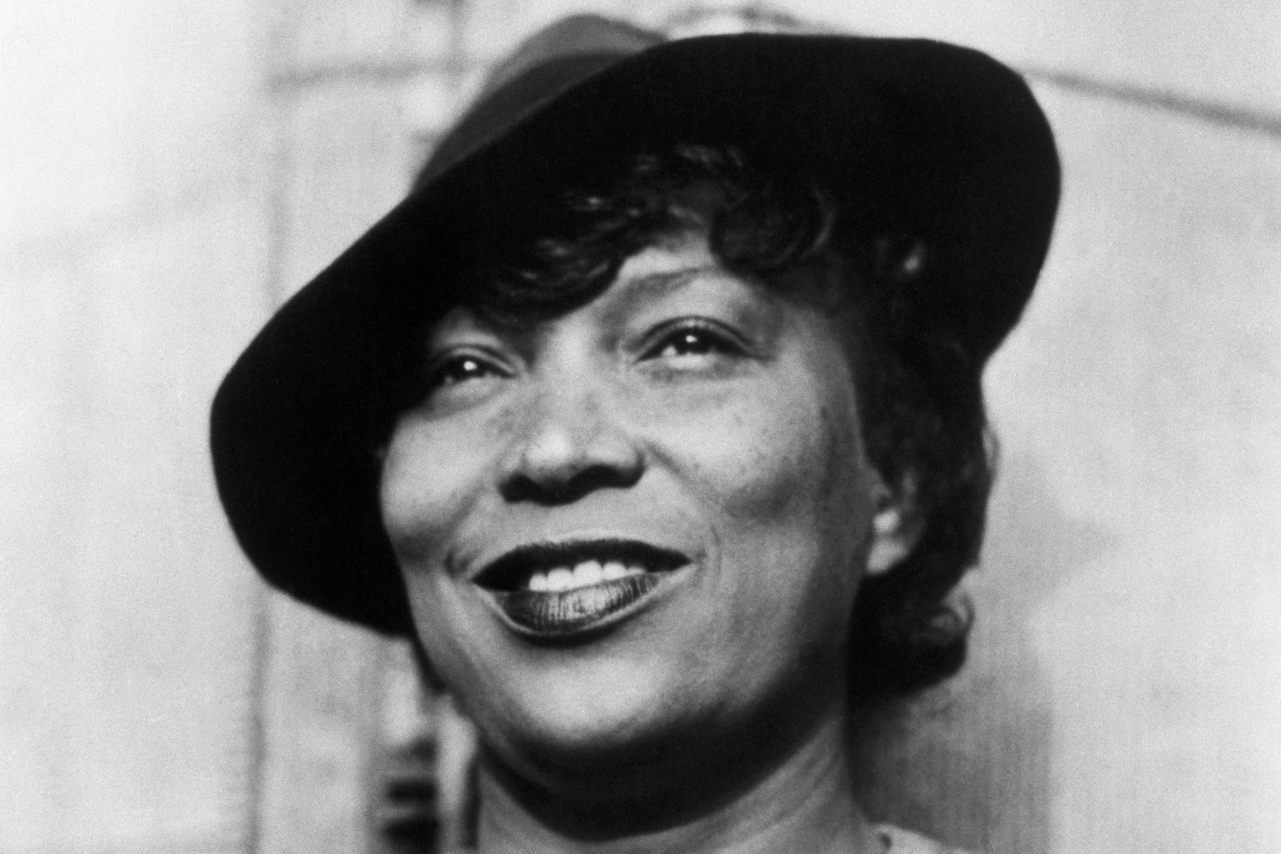
Zora Neale Hurston was an author, filmmaker, anthropologist, and leading light of the Harlem Renaissance.

AS FAR AS MARJORIE HARRELL knew, her sophomore English teacher in 1958 was just an old woman—quiet, tired, a bit sick. It was only after the teacher died a couple of years later that Harrell learned that she had been one of the most unique, critical figures in Black literature and culture during the 20th century. Harrell, a historian who grew up and still lives in Fort Pierce, Florida, a small coastal city halfway between Miami and Daytona Beach, realized years later that her teacher was Zora Neale Hurston, the world-renowned author of Their Eyes Were Watching God—a 1937 novel considered a classic of both the Harlem Renaissance and the American South.

For Harrell, the belated realization—some three decades later—was a spark. In 2004, with support from the larger Fort Pierce community, Harrell and others established the Zora Neale Hurston Dust Tracks Heritage Trail, named for Hurston’s 1942 autobiography Dust Tracks on a Road. It offers “all of the places she touched when she was alive,” Harrell says.

The trail, on its own, isn’t much. It highlights eight locations, with informational markers, that were relevant to Hurston’s life and final years in Fort Pierce. But the history it encodes into the city, of Black life thriving on its own during segregation in the American South, is monumental.

“Zora Neale Hurston was the best writer of Black literature there was,” Harrell says. “She was better than James Baldwin, because she used the language and she didn’t change anything. Zora told it like we talked and like we were.”

Hurston had spent her final years in lush and colorful Fort Pierce, along the Treasure Coast, some 30 years after her time as a core figure of the Harlem Renaissance and a subsequent career traveling and writing as an anthropologist.
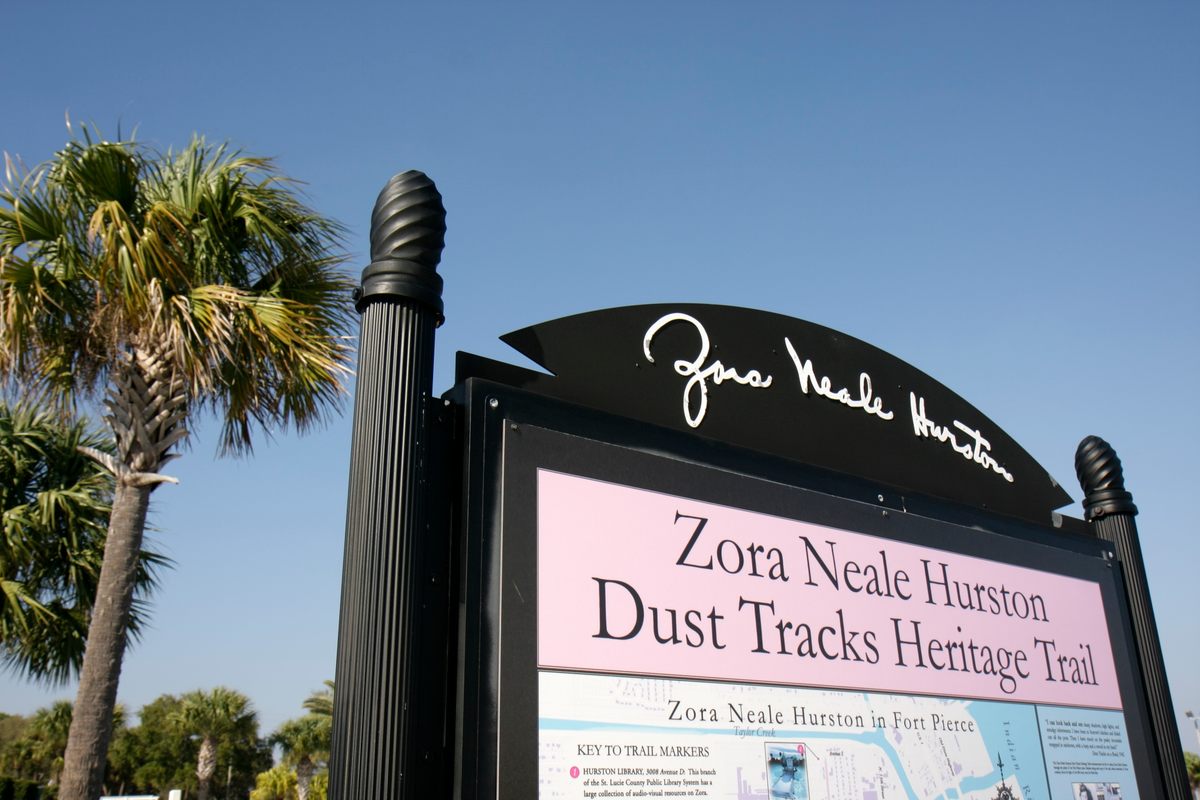
The preservation of the Dust Tracks Heritage Trail relies on the Fort  Pierce community.
The preservation of the Dust Tracks Heritage Trail relies on the Fort Pierce community. JEFFREY GREENBERG/UNIVERSAL IMAGES GROUP VIA GETTY IMAGES

In 1957, newspaper publisher C.E. Bolen convinced Hurston to move to Fort Pierce and write for his local Black newspaper, The Chronicle. He made promises he couldn’t keep. “He would tell you he was going to give you this big check, and the big checks never came,” Harrell says with a laugh, but Bolen connected Hurston with Clem C. Benton, a local physician and community leader.

Benton helped her get a position teaching English at a Lincoln Park Academy (trail marker 2), and offered her a small home he owned (trail marker 3), where she could live rent-free. Both were a short walk from the building that housed The Chronicle (trail marker 5). This triangle formed the core of Hurston’s life in Fort Pierce. But there was more to it than that.

Outside of writing and teaching, Hurston kept a fairly active social calendar—one that often intrigued and shocked Fort Pierce’s Black community. She spent time with Benton and his family, joining them on Sundays for meals prepared by his daughter Arlena and Margaret, and acquainted herself with other Black people around town. But she also befriended white people—uncommon in the Jim Crow South. Hurston frequented the home of A.E. Backus (trail marker 8), a white artist who supported Black artists and writers. Harrell says that Hurston was the only Black person around who could walk through the front doors of the white people who lived downtown.
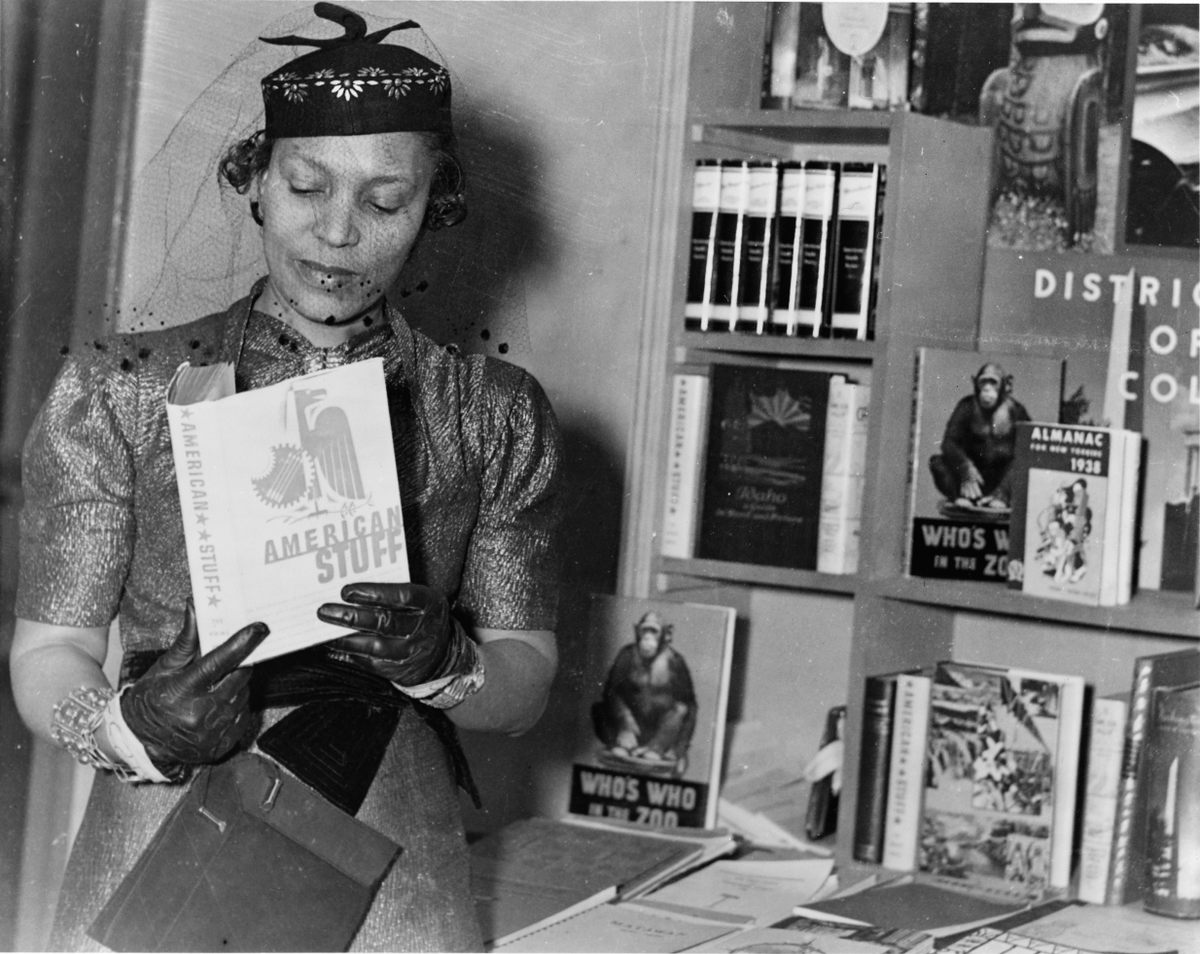
Hurston, seen here at a book fair in New York around 1937, kept a lively social calendar, even through health and financial difficulties later in life.
Hurston, seen here at a book fair in New York around 1937, kept a lively social calendar, even through health and financial difficulties later in life. PHOTOQUEST/GETTY IMAGES

Throughout her life, Hurston paid little mind to the limitations that were supposed to come with her race or gender. She grew up in Eatonville, Florida, one of the first all-Black towns to be incorporated in Florida (in 1887) and only 130 miles from Fort Pierce. To her, the self-sufficiency of Black communities was the norm, despite and to some extent because of segregation.

Later, Hurston studied at Barnard College in New York under pioneering anthropologist Franz Boas, whose ideas on cultural relativism heavily influenced her own research and thinking as an anthropologist and folklorist. During her studies and after, she traveled throughout the South and the Caribbean, studying Black cultures and rituals—both the basis of her fieldwork and the inspiration for her fiction.

Hurston carried this self-assuredness into her life in Fort Pierce, even as life began to take its toll.

Hurston lived in her Fort Pierce home, through financial struggles, until she suffered a stroke in late 1959. She lived out her final days in a welfare home for Black people, and died on January 28, 1960. Her friends and acquaintances around Fort Pierce and beyond raised funds for her funeral, held at Peek’s Funeral Home, now Sarah’s Memorial Chapel (trail marker 7).
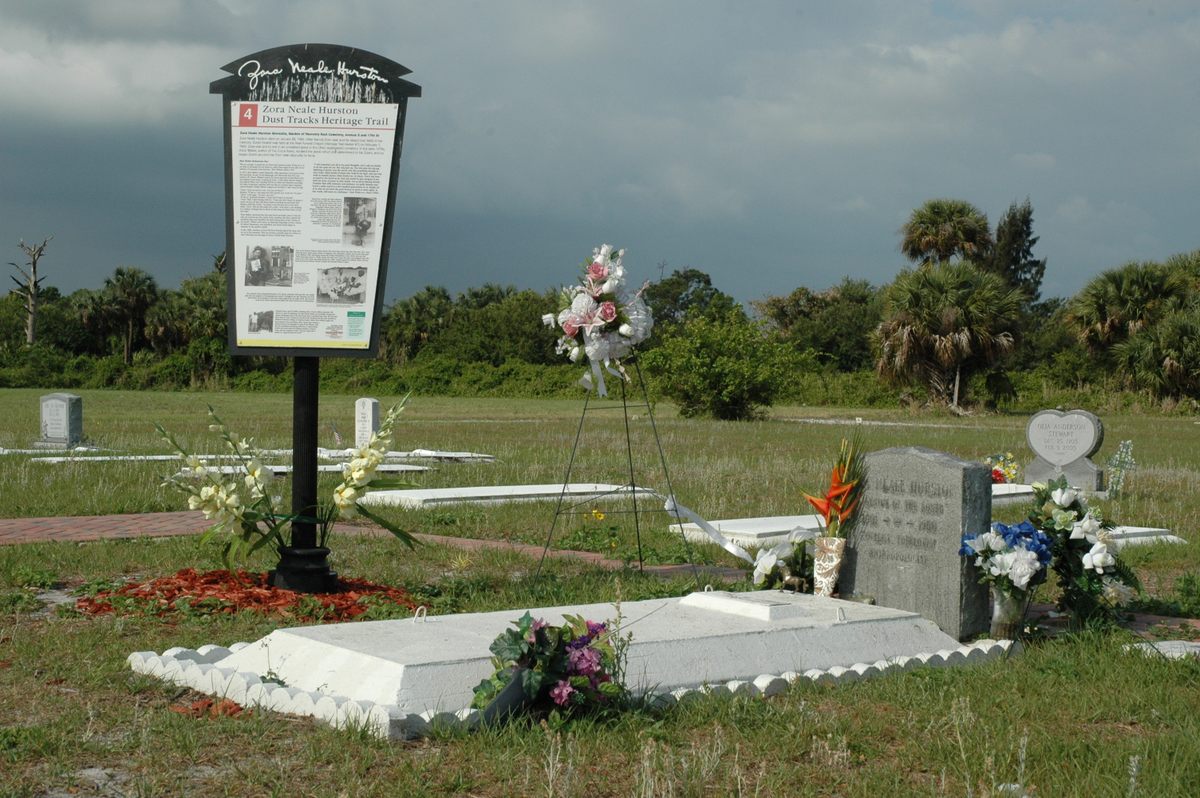
Hurston's grave has a stone installed by author Alice Walker: “A GENIUS OF THE SOUTH.”
Hurston’s grave has a stone installed by author Alice Walker: “A GENIUS OF THE SOUTH.” COURTESY ST. LUCIE COUNTY COMMUNICATION DIVISION

Hurston was buried in a donated plot in the Garden of Heavenly Rest (trail marker 4). By the time Harrell and others were choosing spots for the historical trail, Hurston’s time in Fort Pierce had already been memorialized in a few ways. Renowned Black writer Alice Walker’s impactful 1975 essay “In Search of Zora Neale Hurston” in Ms. Magazine described Walker’s experience in Fort Pierce, which included her placing a tombstone on Hurston’s grave: “A GENIUS OF THE SOUTH.”

Walker’s essay helped what is now officially the Zora Neale Hurston House, an unassuming, flat-roofed box, gain National Historic Landmark designation in 1991. Page Putnam Miller, a former lobbyist for the National Coordinating Committee for the Promotion of History, nominated Hurston’s final home for protection. Miller’s team had been charged with helping the National Park Service add more landmarks to celebrate great American women, and in nominating Hurston’s home was tasked with educating the voting committee about her.

“[Getting Zora’s House designated] was a particular challenge,” Miller says. “We had to educate the committee and overcome the architectural bias that was built into the ways National Historic Landmarks had been approached in the past.”

While maintaining this heritage has been challenging, “the local community is very supportive of the trail and Zora,” says Kathleen Flynn, a librarian at the posthumously dedicated Zora Neale Hurston Branch Library in Fort Pierce (trail marker 1). Community members, she says, are largely responsible for keeping the sites intact. For example, the old Chronicle building is now owned by Tessa Jeanne Adams, Harrell’s daughter—and Harrell herself now lives there as well.
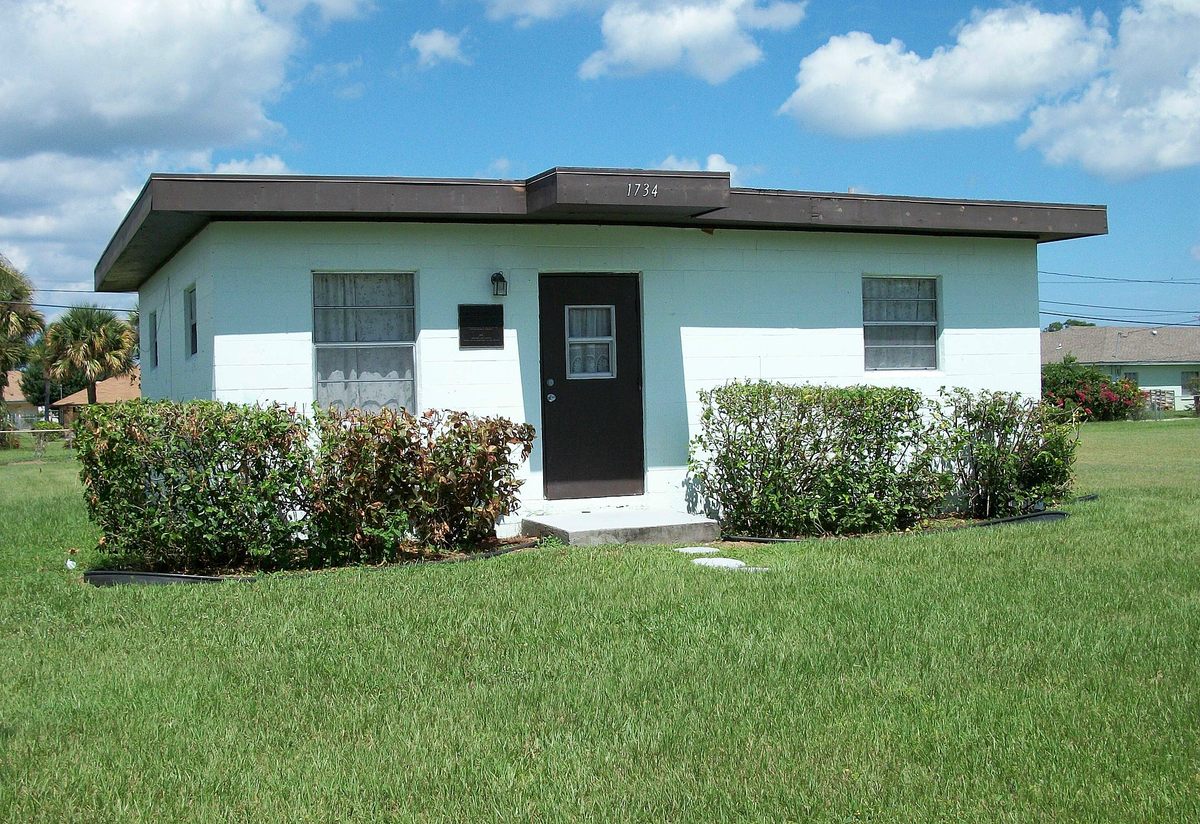
The unassuming Zora Neale Hurston House, where the author lived the last few years of her life, is now protected as a National Historic Landmark.
The unassuming Zora Neale Hurston House, where the author lived the last few years of her life, is now protected as a National Historic Landmark. SEBASTORRENTE/WIKIMEDIA/CC BY-SA 3.0

Marvin Hobson, current president of the Zora Neale Hurston Florida Education Foundation and an associate professor at Indian River State College, worked with Harrell and members of the nonprofit organization to acquire, in 2019, the building in which Hurston died, now the Agape Senior Recreation Center. The center already features a Hurston exhibit, and recently gained a local historic designation from St. Lucie County. The Foundation is working to raise $600,000 for renovations, which will include changing its name and turning it into a museum and community center in Hurston’s honor.

Limited awareness, resources, and funding means that the work to maintain Hurston’s legacy continues—work that falls largely to volunteers dedicated to preserving the writer’s contributions to Black culture and literature.

“[Hurston] wasn’t worrying about who was going to take care of her, or her finances even. She was able to see the work that she had right in front of her and focus on that and allowed other people to take care of her, and that worked for her,” Hobson says. “She was provided for by doing her work and that’s what we’re trying to do.”
Opinion: My fellow educators are quitting in droves. Here’s why.

By Brenda Cassellius February 9th Washington Post at 1:08 p.m. EST

Brenda Cassellius is the superintendent of Boston Public Schools. She served previously as commissioner of education in Minnesota.

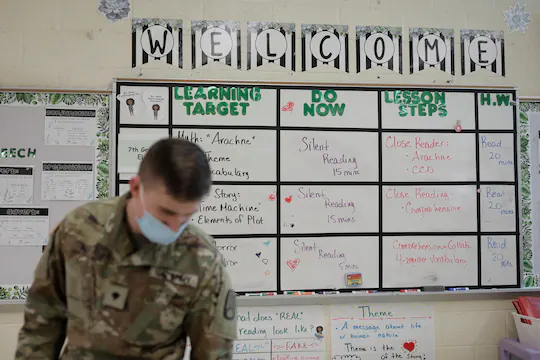
Last month, I returned to teaching in a classroom after two decades. As the superintendent of schools in Boston, I got a lot of media coverage for working as a fourth-grade substitute teacher at Nathan Hale Elementary School on a day when more than 1,000 Boston school employees called in sick. Yet I was just one of hundreds of district staffers who pitched in to help.Opinions to start the day, in your inbox. Sign up.

Like school districts and employers across industries, Boston Public Schools has faced intense staffing challenges for the better part of two years, challenges made worse by the pandemic.

Now, as we enter the pandemic’s third year, America’s public schools are at risk of defaulting on their moral obligation to millions of children. Teachers, aides, principals, bus drivers, school lunch workers, custodians and other school staff are leaving in droves or are out of service due to illness. A dearth of substitutes and backup workers means day-to-day decisions about whether a school can remain open are the norm.

In Boston, we have consistently had a 20 percent job-vacancy rate since the summer in our food and nutrition services department. We have been short more than 100 bus monitors and approximately 30 bus drivers on any given day. And that’s in addition to teacher and other staff absences that can erode children’s learning experiences. The pandemic has accelerated our staffing challenges, but this concerning trend has been at our doorstep for the better part of a decade. Fewer recent college graduates are choosing teaching, and a 2021 survey showed that nearly one-third of America’s teachers were thinking about leaving teaching earlier than they’d planned.

Once seen as a stable career that came with the potential to make a significant positive impact on a community, teaching can no longer compete with positions offering more flexibility and higher pay. We need solutions to school staffing that go beyond what any one city or state can provide. Our state and federal government partners must work with us.

The road map to ensuring academic recovery and a return to stability for our students must include plans for modernizing neglected schools. We need funding forexpensive HVAC systems. Some outdated buildings should be torn downand rebuilt. We must also provide significant resources to confront the urgent mental health crisis our students face — they have unfairly carried an outsize burden these past two years.

There are additional common-sense steps we can take to address the critical shortage of teachers if we put our heads together, listen to the best ideas and muster the political will. First, to avoid a mass exodus of exhausted educators, we must offer retention bonuses that reward educators for staying in public schools. America’s teachers have weathered some of the worst of the logistical and cultural battles of covid-19, and they’ve earned this recognition. Retention bonuses would also help build a deeper bench of young teachers.

We need to recognize that choosing a career in teaching is as important as joining the military; both are critical to our national security and economic sustainability. We should offer free college tuition to students who commit to public education careers and loan forgiveness to current teachers who remain in the profession for 10 years. Let’s also set a national minimum starting salary for teachers of $75,000 per year. And let’s eliminate fees for teacher’s licenses, tests and fingerprinting.

Beyond that, the federal Education Department should create a national teacher licensing system. Suchlicensing would help create uniformly high standards from state to state and allow teachers to easily transfer their credentials when they move. And, as we ramp up our efforts to rebuild our teaching corps, we should create incentives to welcome back recently retired teachers who can fill gaps without reducing their pensions.

Let’s not forget the teaching aides who help to ensure our students get the individual attention and guidance they need. These roles will be critical in a time of recovery. Establishing an AmeriCorps program for college students or recent grads to become teaching assistants or aides in exchange for tuition reimbursement would be a huge benefit to our teachers and students.

Finally, we should train and license our service members to drive school buses. While Massachusetts offered its National Guard to help school districts with transportation challenges, Guard members had licenses to drive vans only. We need bus drivers. Let’s learn and grow from this opportunity and incorporate large-vehicle training as part of their military training. This seems like an easy win.

Our teachers and other staff need help, but most important, our students are depending on us. They get one chance for a solid education. For their sake, we must map a way forward that draws more people to education careers and keeps good teachers in the classroom.1902 CommentsGift Article

Montgomery County votes to hire its first Black woman as superintendent

By Donna St. George at 9:58 a.m. EST Washington Post Feb 8th 2022

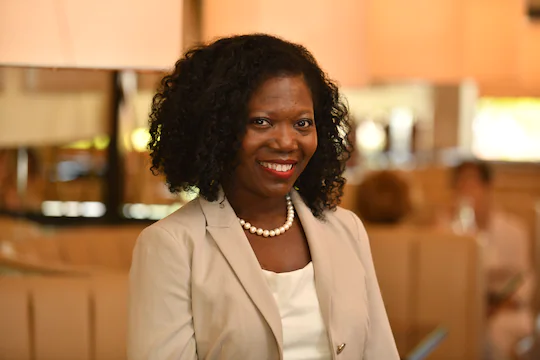
Montgomery County voted to hire its first woman as schools superintendent — an African American educator who was a leader during the pandemic — a milestone in Maryland’s largest school system and another marker of its ever-increasing diversity.

Interim superintendent Monifa B. McKnight, 46, won unanimous approval from the eight-member county school board at a Tuesday meeting.She has been described as one of four finalists in a diverse group of candidates.

McKnight is expected to become the district’s second African American leader, following Superintendent Paul L. Vance, at the helm from 1991 to 1999. Her appointment is contingent on successful negotiations on a four-year contract and support from the state superintendent.

Brenda Wolff, president of the school board, called the appointment historic and noted that it comes during Black History Month, in a building that in the 1950s served as the school system’s only high school for Black students.

She said that McKnight, who has worked in Montgomery County for two decades, has the experience and vision to meet challenges ahead and help all students reach their potential. Still, she acknowledged that the system of 160,000 students has struggled amid the intense strain of the pandemic.

“It has been a rough two years,” she said. “I say we have to let the healing begin, and it starts today.”

As interim superintendent, McKnight presided over the district as it was engulfed in turmoil when winter break ended and the omicron variant was surging. Worried parents and teachers wanted coronavirustesting to precede a return to school, which did not happen. Others asked for the option of temporary remote learning, which was eventually allowed.

Her administration stumbled as it navigated the crisis, starting with one approach, halting it after state officials objected, then moving on to another. McKnight apologized to the community at one point, saying she was sorry for any stress caused by problems in communication about changing covid guidelines, disruptions from bus staffing shortages, and snow closures and delays.

As the upheaval went on, the teachers union voted no confidence in how the school board and McKnight were managing the surge, and the union for administrators and principals sent a letter saying the system lacked an effective plan and had “never been in such a crisis state.”

Afterward, the issue of race was raised by Black pastors who alleged in a sharply worded letter that McKnight was being vilified in a political attempt to destroy a professionally qualified woman of color. They said a string of county and union leaders appeared to be using backdoor politics to publicly discredit her — a charge that the leaders rejected.

Dr. Monifa B. McKnight has been named permanent superintendent of Montgomery County Public Schools. The Montgomery…Posted by Montgomery County Public Schools on Tuesday, February 8, 2022

In remarks at the school board meeting — where her husband, son, mother and other family members looked on — McKnight’s voice broke as she spoke. “It is emotional because I don’t take this responsibility lightly,” she said. “I care for the children in the school system as I do for my own.”

She said she was “absolutely humbled and honored” to be chosen, particularly as many students are struggling with trauma “in a way that we have never seen before.” She acknowledged the toll on staff, who have gone “above and beyond in every way possible,” and parents, who are enduring difficult changes.

“Every time we have had to pivot, the families have had to pivot,” she said.

School superintendent decision nears in Montgomery County, as issues of race arise

With 209 schools, Montgomery County is among the nation’s largest school systems, with an operating budget of nearly $2.8 billion. Its student body is 33 percent Hispanic, 25 percent White, 22 percent Black, 14 percent Asian and 5 percent multiracial — far different than the mostly White system of years ago.

Jennifer Martin, president of the Montgomery County Education Association, the 14,000-member teachers union, said the school system has been more receptive to employee unions in recent weeks, though many educators still have concerns about covid response plans.

“We’re looking at this as a time for a fresh start,” she said. “We know that student success will be rooted in our ability to work collaboratively.”

Andrew Ginsburg, a father of two, said he was disappointed by the choice but had no idea how other finalists compared because the process was so secretive. Pointing to voices of frustration in recent weeks — teachers, principals, parents and students who staged a walkout — he asked: “This is the person who the Board of Education thought was best to lead us going forward? It’s kind of baffling to me.”

Jennifer Reesman, a leader in the parent organization Montgomery County Families for Education and Accountability, said she believed the school board was hesitant to “make big, bold change,” especially with so much pandemic-related stress, and she wished McKnight well.

“Our community will do better if she is wildly successful,” Reesman said, adding that she hoped McKnight would lead strongly in “returning normalcy to the school system.”

McKnight has led the school system since June, following the retirement of Superintendent Jack R. Smith. Smith, who announced he was stepping down less than a year into his second four-year contract, cited medical issues with a grandson that resulted in a move to be with his daughter’s family in Maine.

Montgomery County school superintendent announces retirement

McKnight was Smith’s handpicked choice for deputy superintendent, and it was widely believed she would become a superintendent candidate when he left.

Byron Johns, education chair of the county branch of the NAACP, said he expects McKnight will continue to build on the work Smith did and accelerate the progress. She brings an even temperament to a job that can involve divergent interests, and stays focused on what’s best for kids, he said. “She has a certain amount of humility and is results-oriented,” he said.

McKnight’s annual salary as interim superintendent was $295,000, with her contract ending June 30. Negotiations for her new contract are expected to begin in coming days. One issue that may arise is her place of residence, which is in Prince George’s County. Her son, Ayden, who turned 10 on Tuesday, attends a public school there.

McKnight’s career in the school system included work as a middle school principal, for which she was honored in 2015 as Maryland Principal of the Year.

She later served as director for secondary leadership development programs, then went to Howard County as chief school management and instructional leadership officer before returning to Montgomery County as deputy superintendent in 2019.

Montgomery County taps interim leader for state’s largest school system

Her education began in South Carolina, where she grew up, and she earned a bachelor’s degree from South Carolina State University. She holds a master’s degree from Bowie State University and a doctorate in educational leadership and policy from University of Maryland, College Park.

Opinion: The data are clear: The boys are not all right

By Andrew Yang February 8th 2022 at 1:54 p.m. EST Washington Post

Andrew Yang is the founder of the Forward Party and a former candidate for New York mayor and U.S. president.

Here is one of the biggest problems facing America: Boys and men across all regions and ethnic groups have been failing, both absolutely and relatively, for years. This is catastrophic for our country.

The data are clear. Boys are more than twice as likely as girls to be diagnosed with attention-deficit/hyperactivity disorder, according to the Centers for Disease Control and Prevention; are five times as likely to spend time in juvenile detention; and are less likely to finish high school.

Unfortunately, it doesn’t get better when boys become adults. Men now make up only 40.5 percent of college students. Male community college enrollment declined by 14.7 percent in 2020 alone, compared with 6.8 percent for women. Median wages for men have declined since 1990 in real terms. Roughly one-third of men are either unemployed or out of the workforce. More U.S. men ages 18 to 34 are now living with their parents than with romantic partners.

Economic transformation has been a big contributor. More than two-thirds of manufacturing workers are men; the sector has lost more than 5 million jobs since 2000. That’s a lot of unemployed men. Not just coincidentally, “deaths of despair” — those caused by suicide, overdose and alcoholism — have surged to unprecedented levels among middle-aged men over the past 20 years.

Research shows that one significant factor women look for in a partner is a steady job. As men’s unemployment rises, their romantic prospects decline. Unsurprisingly, according to a Pew Research Center analysis of data from 1960 to 2010, the proportion of adults without a college degree who marry plummeted from just over 70 percent to roughly 45 percent.

Many boys are thus often growing up raised by single mothers, the share more than doubling between 1980 and 2019, from 18 percent to 40 percent. A study from 2015 found that “as more boys grow up without their father in the home, and as women … are viewed as the more stable achievers, boys and girls alike [may] come to see males as having a lower achievement orientation. … College becomes something that many girls, but only some boys, do.”

Yes, men have long had societal advantages over women and in some ways continue to be treated favorably. But male achievement — alongside that of women — is a condition for a healthy society. And male failure begets male failure, to society’s detriment. Our media, institutions and public leadership have failed to address this crisis, framing boys and men as the problem themselves rather than as people requiring help.

This needs to change. Helping boys and men succeed should be a priority for all our society’s institutions. Schools that have succeeded in keeping boys on track should be expanded, by both increasing the number of students they serve and exporting their methods to other schools. Vocational education and opportunities should be redoubled; the nation’s public school system should start the process for early age groups, and apprenticeship programs should be supported by the federal government. Nonprofits helping boys and men — such as Big Brothers Big Sisters of America and the YMCA — should receive more investment.

Resources that keep families together when they want to stay together, such as marriage counseling, should be subsidized by the government — a much more cost-efficient approach than dealing with the downstream effects. The enhanced child tax credit should be renewed, helping stabilize families.

Drives for national service and contribution, such as an American Exchange Program or national service years, should be resuscitated. And businesses and industries that employ large numbers of men, such as manufacturing, should be invested in and reinvigorated.

On a cultural level, we must stop defining masculinity as necessarily toxic and start promoting positive masculinity. Strong, healthy, fulfilled men are more likely to treat women well.

The above is, of course, a prodigious undertaking. But I see the need around me all the time.

A number of my friends have become detached from society. Everyone hits a snag at some point — losing a job, facing a divorce — but my male friends seem less able to bounce back. Male dysfunction tends to take on an air of nihilism and dropping out. As a society, we don’t provide many avenues for healthy recovery.

Here’s the simple truth I’ve heard from many men: We need to be needed. We imagine ourselves as builders, soldiers, workers, brothers — part of something bigger than ourselves. We deal with idleness terribly.

“A man … with no means of filling up time,” George Orwell wrote, is “as miserable out of work as a dog on the chain.” Left to our own devices, many of us will fail. And from our failure, terrible things result for the country, well beyond any individual self-destruction.2595 CommentsGift Article

Recovery from COVID takes time

Post-COVID recovery: An agenda for resilience, development and equality

Patient education:

Recovery after COVID-19 (The Basics) Written by the doctors and editors at UpToDateAll topics are updated as new evidence becomes available and our peer review process is complete.Literature review current through: Jan 2022. | This topic last updated: Dec 08, 2021.

What is COVID-19?COVID-19 stands for “coronavirus disease 2019.” It is caused by a virus called SARS-CoV-2. The virus first appeared in late 2019 and quickly spread around the world.

People with COVID-19 can have fever, cough, trouble breathing (when the virus infects the lungs), and other symptoms.

Since COVID-19 is a fairly new disease, experts are still studying how people recover from it. They are also studying the possible long-term effects. This article has information about recovery after COVID-19, including the ongoing symptoms some people have. More general information about COVID-19 is available separately. (See “Patient education: COVID-19 overview (The Basics)”.)

When will I get better after having COVID-19?For most people who get COVID-19, symptoms get better within a few weeks. But some people, especially those who got sick enough to need to go to the hospital, continue to have symptoms for longer. These can be mild or more serious.

Doctors are still learning about COVID-19. But they generally describe 2 stages of illness and recovery:

●”Acute COVID-19″ – This refers to symptoms lasting up to 4 weeks after a person is infected. Most people with mild COVID-19 do not have symptoms beyond this stage, but some do.

●”Post-COVID conditions” – This refers to symptoms that continue beyond 3 months after being infected. This is more common in people who were critically ill, meaning they needed to stay in the intensive care unit (“ICU”), be put on a ventilator (breathing machine), or have other types of breathing support.

Different terms have been used when people have persistent symptoms, meaning symptoms that last longer than a few months. These include “long-COVID,” “chronic COVID-19,” and “post-COVID syndrome.” Doctors also use the term “post-acute sequelae of SARS-CoV-2 infection,” or “PASC.”

What symptoms are most likely to persist?This is not the same for everyone. But symptoms that are more likely to last beyond a few weeks include:

Feeling very tired (fatigue)
Trouble breathing
Chest discomfort
Cough

Other physical symptoms can also continue beyond a few weeks. These include problems with sense of smell or taste, headache, runny nose, joint or muscle pain, trouble sleeping or eating, sweating, and diarrhea.

Some people have ongoing psychological symptoms, too. These might include:

-Trouble thinking clearly, focusing, or remembering
-Depression, anxiety, or a related condition called post-traumatic stress disorder (“PTSD”)

It’s hard for doctors to predict when symptoms will improve, since this is different for different people. Your recovery will depend on your age, your overall health, and how severe your COVID-19 symptoms are. Some symptoms, like fatigue, might continue even while others improve or go away.

How long will I be contagious?It’s hard to know for sure. In general, most people are no longer contagious by 10 to 14 days after their symptoms started. But this depends on several things, including how severe the infection was and what symptoms they continue to have. It’s important to talk to your doctor or nurse to figure out when you are no longer considered contagious.

When should I call my doctor or nurse?Some fatigue is common, and can persist for a few weeks into your recovery. But if you had COVID-19 and continue to have bothersome symptoms (such as severe fatigue, or chest discomfort or shortness of breath) after 2 to 3 weeks, call your doctor or nurse. You should also call if you start to feel worse or develop any new symptoms. They will tell you what to do and if you need to be seen.

Depending on your symptoms, you might need tests. This will help your doctor or nurse better understand what is causing your symptoms and whether you need treatment.

How are persistent COVID-19 symptoms treated?In general, treatment involves addressing whichever symptoms you have. Often that means combining a few different treatments.

If you are tired, try to get plenty of rest. You can also try the following things to help with fatigue:

●Plan to do important tasks when you expect to have the most energy, typically in the morning

●Pace yourself so you do not do too much at once, and take breaks throughout the day if you feel tired

●Think about what tasks and activities are most important each day, so you don’t use more energy than you need to

If you are not sleeping well, improving your “sleep hygiene” can help. This involves things like going to bed and getting up at the same time each day, avoiding caffeine and alcohol late in the day, and not looking at screens before bed.

Depending on your situation, you might also need:

●Medicines to relieve symptoms like cough or pain

●Cardiac rehabilitation – This involves improving your heart health through things like exercise, dietary changes, and quitting smoking (if you smoke).

●Pulmonary rehabilitation – This includes breathing exercises to help strengthen your lungs.

●Physical and occupational therapy – This involves learning exercises, movements, and ways of doing everyday tasks.

●Treatments for anxiety or depression – This can involve medicine and/or counseling.

●Exercises and strategies to help with memory and focus

Is there any way to avoid persistent COVID-19 symptoms?The only way to avoid this for sure is to avoid getting COVID-19. It’s true that most people who are infected will not get very sick. But it’s impossible to know who will recover quickly and who will have persistent symptoms.

The best way to prevent COVID-19 is to get vaccinated. In addition to protecting yourself, getting the vaccine will also help protect other people, including those who are at higher risk of getting very sick or dying. People who are not vaccinated can lower their risk by social distancing, wearing face masks in public, and washing their hands often.

Will getting the COVID-19 vaccine make my symptoms worse?Some people worry that getting the vaccine will make persistent symptoms worse. But this is not likely to happen. After getting vaccinated, most people’s symptoms will get better or stay the same. And the vaccine will lower your risk of getting infected again in the future.

Gaithersburg reviewing streets, other memorials named after those with ties to slavery

BY DAN SCHERE |JULY 9, 2020 | 4:35 PM

Gaithersburg resized

The Gaithersburg City Council is reviewing the history of streets and other memorials named after people with ties to slavery. Among the names under review is Benjamin Gaither, the man after whom the city is named.

Gaither, a landowner in Montgomery County, was a member of a family whose roots extended to the Jamestown Colony in the 1600s, Bethesda Magazine reported in 2009. The Gaithers settled in Maryland after the Revolutionary War. Benjamin and his wife Margaret stayed in the area that is Gaithersburg today.

Benjamin Gaither maintained an enslaved labor force, like most landowners at the time, Karen Lottes, the program coordinator of the Gaithersburg Community Museum, wrote in an email to Bethesda Beat. According to census records, he owned 10 slaves in 1800 and 11 slaves in 1810, Lottes wrote.

Another man who owned slaves in Gaithersburg was Frederick A. Tschiffely, who bought 268 acres of farmland in the area where the Kentlands is today, according to state historical records. Tschiffely owned slaves, and in 1856, tried to sell one by placing an advertisement in the Montgomery County Sentinel.

Resident David Goldberg lives on Tschiffely Square Road, which is named after the slave owner. He hopes city officials will change the name.

He wrote to the City Council this month with the request.

“I don’t like living on a street named after a guy who owned slaves,” he said in an interview on Wednesday.

The discussion over the renaming of streets comes after the death of George Floyd, a Black man who died on May 25 in Minneapolis after a white police officer pressed his knee into Floyd’s neck for several minutes. Floyd was on the ground and said repeatedly that he could not breathe, as seen in a video.

That officer, Derek Chauvin, and three others have since been fired and charged criminally.

In the weeks since Floyd’s death, protests have broken out across the country, with some resulting in the removal or destruction of Confederate monuments due to the belief that they uphold slavery’s racist legacy. Those opposed to removing the memorials say the history needs to be remembered, despite the wrongdoings of the past.

In Montgomery County, the County Council has asked County Executive Marc Elrich and Planning Board Chair Casey Anderson to review the names of county streets and facilities. Additionally, there have been multiple petitions asking for schools in the county to be renamed.

During a Gaithersburg City Council meeting last month, Council Member Ryan Spiegel asked the city staff to compile a list of streets and facilities that might be named after people with ties to slavery.

Spiegel, in an interview on Wednesday, said Gaither and Tschiffely are just two examples of slaveholders who lived in the city. The city’s staff is conducting a review that has a much broader scope, Spiegel said.

“Many of the names for Montgomery County’s history can be traced back one way or another to slave ownership or other racist policies and practices from the eras from which they come,” he said.

Spiegel said the city will have to consider nuances, such as in cases in which a street is named after a son or grandson of a slave owner.

The review of the names, Spiegel said, is in the early stages.

“I don’t want to leave the impression that we’ve made a decision and we’re definitely changing names or have a path forward. I think this is something that needs to be a community discussion,” he said.

Spiegel said there are also outstanding questions over how the name of a street — or the city, for that matter — might be changed.

“I don’t exactly know how that works. Does the city have free rein, broad, local government authority to make decisions to change names? What are the logistical implications? Do we have to work with the postal service to make sure it all works out? Do we have to work with public safety services to make sure first responders have updated names of maps and streets?” he said.

Mayor Jud Ashman said on Tuesday that renaming can be complicated, but it is worth taking the matter up for consideration.

“The fact is, Maryland was a slave state and Montgomery County was no exception,” he said.

“I don’t think any renaming would be undertaken lightly. But at the same time, we have to reckon with what the history is.”

Dan Schere can be reached at daniel.schere@bethesdamagazine.com

The History of Lynchings in Montgomery County

Where Slavery Slept

BY MARK WALSTON |SEPTEMBER 27, 2010 | 12:00 AM Bethesda Magazine

Execution of a slave, in The Anti-Slavery Record, vol. 2, no. 1,... |  Download Scientific Diagram

For more than a century, the small stone building stood on the site of today’s National Naval Medical Center in Bethesda, its weathered walls attesting to its early 19th-century origins. A photographer from the federal Historic American Buildings Survey captured its crumbling state in the 1940s—the chimney collapsed, a sagging center door flanked by a shuttered window, holes in the shingled roof of the story-and-a-half building admitting the rain and rotting the joists.

The nearby manor house of the estate on which the deteriorating structure once sat had long vanished. But the small stone building remained, a remembrance not only of Bethesda’s past, but of a troubling period in the county’s history: a period when slave quarters such as this were commonplace.

On the eve of the Civil War, more than 5,400 slaves resided in Montgomery County, accounting for more than one-third of all residents. Today, their quarters are often the only visible reminders of their existence. No one is certain how many slave dwellings have survived; the passage of time has obscured many buildings’ original use. But throughout the county, about two dozen documented slave quarters remain—out of the thousands that once dotted the landscape. All serve as reminders of the captive pain of an earlier generation and offer insight into lives often hidden from history.

By the 19th century, the quarters had become a symbol so firmly connected with slavery in all its horrible aspects that Harriet Beecher Stowe needed look no further for a connotative title for her incendiary novel. Sympathetic readers in 1852 well understood the implications of the “small log building close to ‘the house,’ ” the meaning behind Uncle Tom’s Cabin.

That novel had its genesis partially in slave life in the Bethesda area. Stowe recounted how in her work—subtitled Life Among the Lowly—the character of Uncle Tom was to some extent based on her reading of the 1849 autobiography of Josiah Henson, once a slave on the farm of Isaac Riley, not far from the current intersection of Old Georgetown Road and Rockville Pike. Henson described the slave housing on the Riley farm as “log huts, of a single small room, with no other floor than the trodden earth, in which ten or a dozen persons—men, women, and children—might sleep, but which could not protect them from dampness and cold.”

Those log huts no longer remain—although Riley’s house still stands at the corner of Old Georgetown Road and Tilden Lane. Now owned by the Maryland-National Capital Park and Planning Commission, it’s periodically open to the public. Attached to the unassuming, late 18th-century frame house is a wing constructed of logs that has familiarly become known as “Uncle Tom’s Cabin”—a mistaken appellation, perhaps, since it wasn’t actually Henson’s cabin, but used primarily as a kitchen. However, a passage in Henson’s memoir relates that, after escaping to Canada and later returning to the farm a freeman, he still spent the evening in “the cabin used for a kitchen, with its earth floor, its filth, and its numerous occupants.”

The arrangement was not uncommon. Domestic servants were often assigned sleeping areas within, above or adjacent to the service rooms of the main house—kitchens, sculleries, pantries and the like. At the Beall-Dawson house in Rockville, a substantial brick dwelling built around 1815 and today operated as a museum by the Montgomery County Historical Society, slaves lived in rooms above the kitchen wing, their quarters plain and unadorned, the plaster walls whitewashed but devoid of the finishes—mantles, chair rails and moldings found throughout the house. In addition to sleeping in these rooms, the domestic slaves carried out the daily chores of sewing, spinning, providing nursery care and whatever else was demanded. A narrow staircase led down to the kitchen below, and a slight flight of stairs went up to the second-floor bedroom in the main block, thus keeping the slaves out of sight but well connected to their expected duties of attending to the household.1 

Such arrangements, however, were reserved for the domestic servants of the wealthier Montgomery County residents. Most owners held fewer than 10 slaves, the majority of whom worked the fields; for them, the accommodations were decidedly more meager. Single male farmhands often were lodged above or adjacent to free-standing farm buildings—meat houses, barns and stables. At Needwood Mansion, an 1857 manor house situated near Redland and now housing Montgomery County Department of Parks, the second story of the estate’s stone icehouse was put to use as slave quarters. The upper room, accessible by an exterior staircase, measured 12 feet by 18 feet. The stone walls were coarsely plastered and a stove flue rose from one wall, about the only indications of human habitation.

Stand-alone quarters for families and groups of slaves often were found on the larger Montgomery plantations, sometimes in a village setting, with rows of identical buildings. A pattern was followed: The closer the quarters were to the main house, the more they resembled the master dwelling in finishes and materials. If the “Big House” was of brick or stone, so were the quarters, albeit scaled-down and constructed purely for aesthetic reasons, the owner not wanting unsightly buildings cluttering the view of the rear yard. The farther from the main house, however, the cruder the dwelling.

The Oakley Cabin on Brookeville Road, just west of the town of Brookeville, is now a museum operated by the Montgomery County Department of Parks. It was built in the 1820s as one of three slave dwellings that sat some 400 yards in front of the main house. Notched oak and chestnut logs, hewn square, the interstices daubed with clay and straw, were stacked atop a fieldstone foundation prised from the surrounding land. Inside the 21-by-15-foot cabin were three rooms, two down—the communal area with a wood floor and a hearth at one end—and a sleeping loft above reached by a boxed staircase. The arrangement, though scant, was decidedly more luxurious than the typical quarters for field hands.

Although wood was the primary building material—as it was for the majority of dwellings in the county—stone and brick quarters did exist. But, being generally more costly to build than log or wood frames, they were found primarily in the yards of the wealthier farmers. At historic Far View, near Brookeville, the stone quarters mirror the Oakley cabin in size and floor plan, with a centered door and flanking window on the northern bay nearest the chimney end matched by a door and window in the southern facade. The quarters offers few other indications of its slave inhabitants, having been converted by its private owners to use as a modern guest house.

Some slaves lived in long, multiunit quarters, often barracks-style, with up to a dozen men, women and children—related and not—living together in an open space that afforded no privacy. Others lived in dormitories, with the interiors partitioned into a common space and a series of small chambers. In 1848, a slave owner in the county advertised the sale of one such dormitory on his plantation near Brookeville, a quarter “25 by 15 feet, log, one and one half stories, divided into seven rooms, lathed and plastered above.”

At Riverview, an early 19th-century estate near Seneca, a large stone quarters, dormitory in style, was built on an L-plan next to the main house, forming an open-ended, U-shaped courtyard. The date “1835” is inscribed in the lintel of the main door. The longer leg of the quarters, about 16 by 30 feet, was believed to be the sleeping area; the shorter leg served as communal space. Other traces of the slave inhabitants were erased in the 1950s, when the building’s interior was substantially altered in its conversion as a youth hostel, offering overnight shelter to hikers and bikers along the nearby Chesapeake and Ohio Canal.

Duplexes were also common arrangements for county slaves, with two units built together, connected by continuous exterior walls. At Mount Carmel, near Dickerson, just such a double quarters was built of local stone, 36 feet in length and divided into two separate living units, each with its own exterior entrance, both with one room down and a loft above. Stone fireplaces with brick stacks rise from the ends of the quarters; one is incised with the date “1833.” John Trundle, who owned the estate in the early 19th century, willed Mount Carmel to his daughter, Mary E. Gott, in 1836, shortly after the quarters were constructed. At the time of emancipation, Mary owned 10 slaves—seven of whom were members of a single family, the Halls, including the matriarch, Fanny, and her six children, all living together in the double quarters. Evidence of their occupation was obliterated when these quarters, too, were remodeled into a guest cottage.

Mark Walston is an author and historian raised in Bethesda and now living in Olney.1 2View Comments

Related Stories

NOVEMBER-DECEMBER 2009

The History of Rockville

The county seat since 1776 was a sleepy farm town until the 1950s.NOVEMBER-DECEMBER 2009

The History of Potomac

A search for riding country gives way to “genteel country living.”NOVEMBER-DECEMBER 2009

The History of Kensington

A onetime country retreat became a classic Victorian-era community.

Uncover a heritage of heroes in Montgomery County, Maryland

At the Josiah Henson Museum and Park, visitors can feel the weight of the past. Interpretive exhibits based on Henson’s writing reveal details of everyday life on a plantation, while a log kitchen offers an immersion into an enslaved cook’s experience. The venue is one of many African American heritage sites throughout Montgomery County, Md., which played a key role in the Underground Railroad.

Almost 80 percent of American tourists participate in cultural heritage activities during their travels, and more of them are seeking out opportunities closer to home. Travelers from the D.C. area can find a rare combination of heritage sites and outdoor experiences in nearby Montgomery County. Home to one of Maryland’s largest collections of African American history, the area has links to heroic abolitionists like Harriet Tubman and Frederick Douglass, and offers heritage sites that range from hiking trails evoking the Underground Railroad to living history centers that depict 19th-century plantation life.

Along with the Josiah Henson Museum and Park, African American heritage sites such as Woodlawn Manor Cultural Park & Underground Railroad Experience Trail, Button Farm Living History Center and Oakley Cabin African American Museum and Park give visitors to Montgomery County a deeper appreciation for the efforts of freedom seekers.

“We live in a time where all folks are waking up to other histories,” said Sarah Rogers, the executive director of Heritage Montgomery. “If you learn, you care, and if you care, you want to preserve this place.”

Heritage sites that evoke life before emancipation

Being close to the free North and having access to several bodies of water made Maryland an important location for the Underground Railroad. The Potomac River, C&O Canal and Seneca Creek, for instance, made it more feasible for enslaved African Americans to reach cities like Baltimore and D.C., both of which had large free Black communities. Montgomery County in particular became a gathering point for freedom seekers, largely because of its geography. The county is close to the Mason Dixon line separating the North and South, as well as Pennsylvania, offering easier access to the Ohio Valley and up to and across the Great Lakes into Canada.

The Reverend Josiah Henson, for example, escaped enslavement on the Issac Riley plantation by fleeing to Canada in 1830. Henson then became a conductor on the Underground Railroad, helping 118 enslaved people escape to Canada, and later published an autobiography that included vivid depictions of his enslavement. That autobiography, “The Life of Josiah Henson, Formerly a Slave, Now an Inhabitant of Canada,” heavily influenced Harriet Beecher Stowe’s famous novel, “Uncle Tom’s Cabin,” which became an inspiration for the abolitionist movement.

That history comes alive at the new Josiah Henson Museum and Park. “Josiah Henson’s narrative provides direct insight into the remarkable events he endured, and the freedom he eventually secured for himself, his family and numerous others who were enslaved,” said Cassandra Michaud, the senior archaeologist for Montgomery Parks. Michaud led archaeological investigations that uncovered more than 50,000 artifacts at the Josiah Henson site, largely from kitchen fireplace sweepings, and was a member of the design and construction team for the museum. Visitors can learn context around Henson’s story at the log kitchen, where audio recordings feature formerly enslaved people describing their work experiences. Another exhibit showcases Henson’s direct quotes alongside illustrations created specifically for the museum.

“This site is unusual in that the visitor is learning about the history from the viewpoint of someone enslaved,” Michaud said.

For a more active immersion, visitors can head to the Woodlawn Manor Cultural Park & Underground Railroad Experience Trail. The four-mile route is scenic, but poses challenges meant to evoke an enslaved person’s attempt to escape. “It’s really exploring what it would be like if you decided to run. And it’s quite eye-opening,” said Rogers. Hikers can go it alone or follow a guided trek that provides historical context along the way. Nighttime hikes are also available and can give visitors a deeper sense of what the search for freedom often required.

Afterwards, visitors can explore Woodlawn’s stone barn interpretive center, where exhibits unpack the lives of enslaved people, as well as local communities that were founded by newly emancipated people.

“One of the biggest points that’s examined is the relationship that the Society of Friends, also known as the Quakers, had with slavery. They really started to reflect [on enslavement] and ask hard questions in the early 1800s,” said Rogers.

Experiences that help communicate “the deeper story of slavery”

The story of the Quaker communities in Montgomery County offers a solid jumping off point for a visit to The Oakley Cabin African American Museum and Park. The property, on the site of what used to be an African American roadside community, was once home to three nearly identical log cabins. One of the cabins, known as Oakley Cabin, has been preserved and turned into a living museum. Inside, historical artifacts depict how a formerly enslaved person would have lived after being newly freed. Tours are available that describe life for the area’s African American families during the Reconstruction Era in the 1800s, but the outside of the property is also open to visitors, including surrounding trails and a picnic area.

Anthony Cohen, a historian and the president of Button Farm Living History Center, wants visitors to Montgomery County to think about the “after-effects” of slavery, from Reconstruction to the Jim Crow era to our present legal and justice systems. After leading a walking group through Underground Railroad towns from Maryland to Canada in 1996, Cohen was tapped to help Oprah Winfrey prepare for her role in the film “Beloved.” He created an immersive experience of what plantation life for an enslaved person would have been like, from menial labor to an overnight escape attempt.

The experience inspired Cohen to establish Button Farm Living History Center, where visitors and school groups can participate in “hands-on, tactile” educational programs that interpret plantation life in Maryland and the story of the Underground Railroad.

“All of the experience is in real time, true to life, and we use that as a point of engagement to talk about and communicate the deeper story of slavery that you don’t find in history books,” Cohen said.

On hour-long Button Farm Almanac tours, visitors can go behind the scenes of how the property operates. That could mean encountering cotton plants in the museum garden, where more than 75 varieties of heirloom vegetables and herbs that appeared in Montgomery County’s earliest agricultural records are grown. Children might be prompted to consider what a historical artifact, like a clam shell, would have been used for on the plantation. From those hands-on activities, visitors “get an insight into how enslaved Montgomery Countians lived,” Cohen said.

Those learning experiences also tend to prompt discussions about connections that can be drawn from slavery to today, because Cohen makes it a point to ask visitors thoughtful questions.

“We always ask them, ‘What are the modern parallels? What are the correlations? What is unjust today in similar ways that slavery was unjust then?’ We want them thinking about those issues,” Cohen said.

Learn more about visiting Montgomery County’s African American Heritage Sites

An Old Bridge Speaks About Race and History

 David Rotenstein posted 12-26-2018 11:44 Preservation Leadership Forum

PatriciaTyson.jpg

Patricia Tyson has lived in her Silver Spring, Maryland, neighborhood for most of her life. She believes that the nearby Talbot Avenue Bridge, which is slated for demolition in early 2019 to make way for the construction of the new Purple Line light rail, has a voice. When Tyson was a child growing up in the African American hamlet of Lyttonsville, the bridge’s rattling wood deck announced her parents arriving home from a long day’s work. Today Tyson says that the bridge speaks to people about history and reconciliation. On a warm fall day in September 2018, Tyson introduced more than 200 people to the bridge’s voice during a festival celebrating its centennial. 

“When I was growing up here, the bridge had a voice. It still has a voice,” Tyson said. “It bridged the gap between two or three neighborhoods. By having this celebration and by the many events that have been happening, it has brought these communities closer together.” 

One Bridge, Multiple Stories 

The Talbot Avenue Bridge was completed in 1918 to carry cars and pedestrians over the Baltimore and Ohio Railroad. Nearly a century later, as plans for the new light rail line moved forward, Montgomery County officials determined that the bridge was unsafe, and they closed it to vehicular traffic in spring 2017. When architectural historians evaluated the bridge for the National Register of Historic Places, they determined it eligible for listing as an engineering resource and recommended that it be documented prior to demolition on that basis. 

TalbotBridge2017.jpg
The Talbot Avenue Bridge in June 2017. | Credit: David Rotenstein

But Lyttonsville residents like Tyson have a different understanding about the bridge’s historical significance. For most of the 20th century, Lyttonsville was the “other side of the tracks” from Silver Spring, a sundown suburb where racially restrictive deed covenants prevented African Americans from buying and renting homes—and where Jim Crow rigidly segregated public spaces and businesses. The only African Americans who lived in unincorporated Silver Spring were domestic servants. As late as 1967, people who lived there touted its appeal to whites moving from neighboring Washington, D.C. “It’s nice; there’s no colored here,” one resident told magazine writer Judith Viorst.

To the African American residents of Lyttonsville, the bridge was an essential lifeline connecting them to jobs in Silver Spring and Washington. It also enabled them to access busses to movie theaters and stores in Washington, where their presence and money were welcome. But these facets of Lyttonsville’s history had been rendered invisible. Published histories and historic preservation documents had omitted Lyttonsville and elided the roles that segregation and Jim Crow played in Silver Spring’s history. 

Lyttonsville’s remaining African American residents—many who lived there before urban renewal have moved or passed away—repeatedly told planners working for the Maryland Transit Authority and the Montgomery County Planning Department about the bridge’s importance and their attachment to it. The planners, however, didn’t seem to understand what they were hearing; to them, the bridge was infrastructure—simply old metal and wood. 

Uplifting Black History

In 2016 I began interviewing Lyttonsville residents about the community’s history and its erasure. Their narratives prominently featured the bridge and their attachment to it. As a folklorist and historian, I was sensitive to the importance of space and the significant role that the “other side of the tracks” plays in racialized land-use regimes. 

My first blog post about the bridge inspired The Washington Post to cover the story. Within a year, a local songwriter had composed an instrumental tune about the bridge; more news stories had been published; a community meeting had been held; an  affordable housing and social justice activist based in the United Kingdom had written about the bridge; and a local filmmaker had produced a short documentary about it. By the end of 2017, lifelong Lyttonsville resident Charlotte Coffield was telling people, “The Talbot Avenue Bridge has taken on a life of its own.” 

HarveyMatthewsPopUp.jpg
Former resident of River Road in Bethesda, Maryland, Harvey Matthews reads a pop-up museum panel on April 21, 2018.| Credit: David Rotenstein


In April 2018 I curated a Talbot Avenue Bridge pop-up museum. At the same time, Lyttonsville residents were forming a committee to plan the centennial celebration. They invited residents from Rosemary Hills, an adjacent neighborhood first developed in the 1940s, as well as people who lived across the bridge in the North Woodside neighborhood.

Since the 1980s, North Woodside and Lyttonsville residents had found themselves in pitched battles over the bridge: North Woodside wanted it closed, while Lyttonsville wanted it to remain open. Some Lyttonsville residents believed that the North Woodside positions regarding the bridge were racially motivated. The 2017 documentary sparked heated conversations and laid the foundation for confronting the difficult history and finding reconciliation. 

Anna-Charlotte.jpg
Anne White, right, and Charlotte Coffied listen to speakers during the bridge’s centennial celebration on September 22, 2018. | Credit: David Rotenstein

Anna White moved to North Woodside a decade ago. Until 2016 she knew little about the bridge’s history or about Lyttonsville. For White, the bridge was a scenic amenity where her children enjoyed watching trains pass below. After reading about the bridge in the The Washington Post, White sought more information. “When I heard the history of the bridge, it made me, you know, feel the bridge was all the more important and important to save, as well,” White said in a 2018 interview. “I feel that the bridge is an important civil rights location in this community.” 

The Talbot Avenue Bridge began speaking to White. “I think there’s … the literal sound of the bridge, which we aren’t hearing now,” she said. “And then there’s the figurative voice of the bridge which you can’t put in words, but … when you walk over it, and you think of the past hundred years of history that this bridge has seen and been part of, it does have a voice and a story to tell if we can listen to it.” 

White reached out to her neighbors to understand their feelings about the bridge, and she began forming friendships with Lyttonsville residents. She interviewed them to learn their stories and became sensitized to the social impacts of erasure. 

A Birthday Party for the Bridge 

As one of the centennial planners, Anna White worked collaboratively to design a festival that would celebrate the bridge’s history and lay the groundwork for building future bonds between North Woodside and Lyttonsville. 

DavidFakunle.jpg
Drummer and member of the Washington Revels Jubilee Voices David Fakunle walking across the Talbot Avenue Bridge to perform at the centennial celebration on September 22, 2018. | Credit: David Rotenstein

White met with North Woodside neighborhood leaders, providing them with examples of the racially restrictive covenants that had kept her neighborhood segregated for most of the 20th century. As a result of her efforts, the North Woodside-Montgomery Hills Civic Association’s board of directors unanimously approved a proclamation renouncing the neighborhood’s racism and the covenants that had been written to uphold it. David Cox, the organization’s president, read the proclamation in an emotional statement during the centennial celebration. 

The centennial planning committee met in Lyttonsville’s Gwendolyn E. Coffield Community Recreation Center and in members’ homes on both sides of the bridge. Early on, members agreed that all decisions would be made by consensus. They selected speakers; hired musicians; invited local officials; and raised more than $2,000 to fund performers, supplies, and a professional sound service. North Woodside got a block party permit to close nearby streets, and local officials helped with traffic control. 

Featured performers included The Washington Revels’ Jubilee Voices and folk singer Lea Morris. Jay Elvove also performed his song, “Talbot Avenue Bridge.” Speakers besides Cox included current and former residents of the Lyttonsville, Rosemary Hills, and North Woodside neighborhoods and then–Montgomery County executive, Isiah Leggett. 

Though the Talbot Avenue Bridge will be demolished, it will continue to connect space and people through conversations about race and history. Its voice, amplified by old and new residents, tells people why old places really matter. 

David Rotenstein is a public historian and folklorist based in Silver Spring, Maryland. He has worked in public history historic preservation for 35 years and he writes about gentrification, erasure, and industrial history.

In the Workplace: Prioritizing Mental Health in the Workplace—The Time is Now for Nonprofits

woman with depression with her head in her hands

From JULY 1, 2021 ADVANCING PHILANTHROPY

The COVID-19 pandemic has intensified mental health issues at an astonishing rate, with a swell of stress, anxiety and isolation that has consistently worsened since early 2020. While there is much to be optimistic about today, coping with the emotional and mental fallout from COVID-19 will continue for years to come.

According to one Centers for Disease Control report, which surveyed adults across the U.S. in late June 2020, 31% of respondents reported symptoms of anxiety or depression, 13% reported having started or increased substance use, 26% reported stress-related symptoms, and 11% reported having serious thoughts of suicide in the past 30 days. The National Institute of Mental Health (NIMH) reports that these numbers are nearly double the rates we would have expected before the pandemic. As in prior studies, this survey showed that risk factors for reporting anxiety symptoms or suicidal ideation included food insufficiency, financial concerns and loneliness.

What was initially thought to be a temporary separation from office life became a radical transition in our work culture today. After all the government-imposed lockdowns, curfews, social distancing, and quarantines, work became more remote, isolating, and socially disconnected. Although all these safeguards were put in place to protect us from a deadly pandemic, the aftermath of this dramatic shift has moved mental health to a new level of importance for nonprofits to address.

african american man sitting at a desk with his head in his hands

The landscape of our workforce has drastically changed, and this has not happened without consequences to the workers themselves. Social distancing and remote work have separated us from our colleagues, donors, and populations we serve—that separation has caused a great deal of emotional disconnectedness and loneliness. Because of this, it has never been more critical for nonprofits to develop and implement, employee mental health and wellness programs.

Over the last couple of years, the conversation around mental health has become more open and public, but where the discussion still falls short is around the stigma faced by working professionals at all levels. Discussing mental health in the workplace is still a difficult subject and one that potentially puts employees at risk of being diminished or unfairly treated by colleagues and organizational leadership. The fear of bias and discriminatory attitudes toward those with a mental illness is what keeps many suffering in silence.

It’s great that organizations are promoting Employee Assistance (EAP) programs and listing available resources. However, we still have a long way to go before the workplace becomes a comfortable environment to disclose a mental illness without the fear of judgment or consequences.

For everyday people (working professionals, seniors, and students), when we disclose a mental illness, we fear losing the three things that matter the most in our lives: family, friends, and our jobs!

Disclosing a mental illness shouldn’t mean giving up anything or losing those who should be supporting you, but for many, that fear is real.

Leaders need to openly show support in order for change to take place. When leaders are vulnerable about mental health and share their experiences or the experiences of those closest to them, it helps create transparency—and acceptance—in the workplace. Sharing stories makes it easier for employees to ask for help when they need it. These stories can also help take the fear out of their own disclosure.

To talk about mental health, you have to understand the stigma and the power it has over people and their decisions about taking care of their mental health. The stigma associated with mental illness can be divided into two types: (1) social stigma, which involves the prejudiced attitudes others have around mental illness; and (2) self-perceived stigma, which involves an internalized stigma the person with the mental illness suffers from.

Some key statistics that help give insight to the growing concern about mental health in both the United States and Canada include:

  • One-in-five Americans and Canadians has a mental illness. (NIMH and the Center for Addiction and Mental Health)
  • Forty-one percent of Americans have dealt with an untreated mental illness. (Mental Health First Aid)
  • On any given week, more than 500,000 Canadians are unable to go to work because of mental health or mental illness. (Canadian Mental Health Association)
  • Forty million Americans suffer from anxiety. (Anxiety and Depression Association of America)

Nonprofit leaders today have the responsibility to look after their people and that requires two very important elements: continuing education and the willingness to leave their comfort zones. The goal for leaders should be to promote the acceptance and inclusion of those managing a mental health challenge or suffering from profound grief and loss. Normalizing conversations about mental health is still one of the best ways to reduce stigma within the workplace.

It’s critical that nonprofits recognize that mental health is just as important as physical health. Those who invest and prioritize mental health, wellness and self-care can create a healthier work culture for their employees.

Promoting mental health and wellness can positively impact employee retention and the recruitment of top talent. These investments can also show a significant improvement in employee engagement, morale and job satisfaction. Nevertheless, where so many organizations fall short is how to act and when to start. Both the research and employees say that the time is now.

Cultivating a culture of empathy, psychological safety and wellness requires consistency and effort. As nonprofit leaders, we have the power to support our employees with dignity and compassion. Leadership today is about taking care of the people responsible for the work, not just the work itself. Now, more than ever, it is essential to instill the importance of nurturing an environment of openness to better support our employees.

Social distancing and remote work have separated us from our colleagues, donors, and populations we serve — that separation has caused a great deal of emotional disconnectedness and loneliness.

We are entering a very interesting period of this pandemic, where the adrenaline and fear have worn off and the crisis is subsiding. However, a number of challenges remain for our sector. As nonprofit professionals begin to work out new flexible work options and return to the office, leaders have an opportunity to be more proactive moving forward when it comes to mental health and wellness. There are several ways organizations can help with this transition that also support employee mental health. Here are just a few helpful strategies:

  • Check-in and listen (regularly)
  • Practice gratitude
  • Create no-meeting days
  • Encourage self-care breaks
  • Celebrate small wins together
  • Make it OK to talk about feelings and uncertainty
  • Recognize and reward good work
  • Prioritize wellness

From May through October, there are various awareness days you can observe at your organization, such as Mental Health Awareness Month in May, Minority Mental Health Month in July, National Suicide Prevention Week in September, and World Mental Health Day on Oct. 10. Take this time to share resources, articles and inspirational stories of lived experiences and recovery—you never know who it will help.

To everyone in the AFP community who is an advocate, caregiver, or willing to share their story of lived experience: Your VOICE changes the mental health and addiction discussion. Your EFFORTS help eliminate the stigma associated with mental illness and recovery. And Your ACTIONS save lives every day.

Words like mental illness, addiction, and suicide can immediately and forever change a person’s life. They did for me. For those who suffer in silence, this can be a life or death issue. I don’t believe most people fully realize how much effort, strength and courage it takes to pull yourself out of a mentally dark place. To anyone struggling right now with their recovery, mental illness, or profound grief and loss—you are brave, you are strong, and you will get through this. Most importantly, always remember, you are not alone.

Talking about mental health today isn’t just a moment, talking about mental health today is a movement. This movement needs more advocates, activists and champions. And while tackling mental health can be challenging, organizations and nonprofit leaders are in a powerful position to help change attitudes and offer a vital support system.

______________________________________________________________________________

ian adair

Ian Adair is a nonprofit industry influencer, TEDx speaker, and recognized expert in leadership, fundraising, and nonprofit management. He is a speaker, writer and advocate for mental health awareness and addressing mental health in the workplace. Ian is the author of “Stronger Than Stigma, A Call To Action: Stories of Grief, Loss, and Inspiration!” He is the executive director of the Gracepoint Foundation, the philanthropic arm of Gracepoint, one of the largest behavioral health organizations in Florida. Gracepoint impacts the lives of more than 30,000 individuals each year seeking mental health, medical, and addiction services in the Tampa Bay area.