Loading

Posts by Paul Costello1

The Origin of Black History Month—And Why It Still Matters

African American historian Carter G. Woodson, date unkown. PHOTO FROM BETTMANN/GETTY IMAGES

No one has played a greater role in helping all Americans know the Black past than Carter G. Woodson, the individual who created Negro History Week in Washington, D.C., in February 1926.

Woodson was the second Black American to receive a Ph.D. in history from Harvard—following W.E.B. Du Bois by a few years. To Woodson, the Black experience was too important simply to be left to a small group of academics. Woodson believed that his role was to use Black history and culture as a weapon in the struggle for racial uplift. By 1916, Woodson had moved to D.C. and established the “Association for the Study of Negro Life and Culture,” an organization whose goal was to make Black history accessible to a wider audience. Woodson was a strange and driven man whose only passion was history, and he expected everyone to share his passion.

This impatience led Woodson to create Negro History Week in 1926, to ensure that schoolchildren would be exposed to Black history. Woodson chose the second week of February to celebrate the birthdays of Abraham Lincoln and Frederick Douglass.

It is important to realize that Negro History Week was not born in a vacuum. The 1920s saw the rise in interest in African American culture that was represented by the Harlem Renaissance, where writers such as Langston Hughes, Georgia Douglas Johnson, and Claude McKay wrote about the joys and sorrows of Blackness. Meanwhile, musicians like Louis Armstrong, Duke Ellington, and Jimmie Lunceford captured the new rhythms of the cities created in part by the thousands of Black Southerners who migrated to urban centers like Chicago. And artists like Aaron Douglas, Richmond Barthe, and Lois Jones created images that celebrated Blackness and provided more positive images of the African American experience.

There is no more powerful force than a people steeped in their history.

Woodson hoped to build upon this creativity and further stimulate interest through Negro History Week. He had two goals: One was to use history to prove to White America that Black people had played important roles in the creation of America and thereby deserved to be treated equally as citizens. By celebrating heroic Black figures—be they inventors, entertainers, or soldiers—Woodson essentially hoped to prove our worth, and by proving our worth, he believed that equality would soon follow. His other goal was to increase the visibility of Black life and history, at a time when few newspapers, books, and universities took notice of the Black community, except to dwell upon the negative. Ultimately Woodson believed Negro History Week—which became Black History Month in 1976—would be a vehicle for racial transformation forever.

The question that faces us today is whether or not Black History Month is still relevant. Is it still a vehicle for change? Or has it simply become one more school assignment that has limited meaning for children? Has Black History Month become a time when television and the media stack their Black material? Or is it a useful concept whose goals have been achieved? After all, few—except the most ardent rednecks— could deny the presence and importance of African Americans to American society. Or as my then-14-year-old daughter, Sarah, put it: “I see Colin Powell every day on TV. All my friends—Black and White—are immersed in Black culture through music and television. And America has changed dramatically since 1926. Is not it time to retire Black History Month, as we have eliminated ‘White’ and ‘colored’ signs on drinking fountains?” I will spare you the three-hour lesson I gave her.

I would like to suggest that despite the profound change in race relations that has occurred in our lives, Carter G. Woodson’s vision for Black history as a means of transformation and change is still quite relevant and quite useful. African American History Month, with a bit of tweaking, is still a beacon of change and hope that is still surely needed in this world. The chains of slavery are gone—but we are all not yet free. The great diversity within the Black community needs the glue of the African American past to remind us of not just how far we have traveled but lo, how far there is to go.

The Power of Inspiration

One thing has not changed: We still need to draw inspiration and guidance from the past. And through that inspiration, people will find tools and paths that will help them live their lives. Who could not help but be inspired by Martin Luther King’s oratory, commitment to racial justice, and his ultimate sacrifice? Or by the arguments of William and Ellen Craft, or Henry “Box” Brown, who used great guile to escape from slavery. Who could not draw substance from the creativity of Madam C.J. Walker or the audacity and courage of prize fighter Jack Johnson? Who could not continue to struggle after listening to the mother of Emmett Till share her story of sadness and perseverance?

I know that when life is tough, I take solace in the poetry of Paul Laurence Dunbar, Langston Hughes, Nikki Giovanni, or Gwendolyn Brooks. And I find comfort in the rhythms of Louis Armstrong, Sam Cooke, or Dinah Washington. And I draw inspiration from the anonymous slave who persevered so that the culture could continue.

Let me conclude by re-emphasizing that Black History Month continues to serve us well, in part because Woodson’s creation is as much about today as it is about the past. Experiencing Black History Month every year reminds us that history is not dead or distant from our lives.

Rather, I see the African American past in the way my daughter’s laugh reminds me of my grandmother. I experience the African American past when I think of my grandfather choosing to leave the South rather than continue to experience sharecropping and segregation, or when I remember sitting in the backyard listening to old men tell stories. Ultimately, African American History—and its celebration throughout February—is just as vibrant today as it was when Woodson created it 94 years ago. That’s because it helps us to remember there is no more powerful force than a people steeped in their history. And there is no higher cause than honoring our struggle and ancestors by remembering.

This essay originally appeared in the “Our American Story” series published by the National Museum of African American History and Culture. It has been edited for length and clarity, and is republished here with permission.


LONNIE G. BUNCH III is the 14th Secretary of the Smithsonian. As Secretary, he oversees 19 museums, 21 libraries, the National Zoo, numerous research centers, and several education units and centers. Previously, Bunch was the director of the Smithsonian’s National Museum of African American History and Culture. A widely published author, Bunch has written on topics ranging from the Black military experience, the American presidency, and all-Black towns in the American West, to diversity in museum management and the impact of funding and politics on American museums. His most recent book, A Fool’s Errand: Creating the National Museum of African American History and Culture in the Age of Bush, Obama, and Trump, which chronicles the making of the museum that would become one of the most popular destinations in Washington. Learn more about Bunch’s life and work at The Smithsonian.

15 Most Valuable Learning Websites That Are Free

You know how passionate we are about learning, and we want to see you grow, thrive, and succeed for free. We hope you get value from this article.

01— iTunes U Free Courses

iTunesU is gaining a lot of momentum as a great alternative to traditional studying. The beauty about taking a course through iTunesU is it’s a seamless integration between your Apple devices — making studying anywhere, anytime, a possibility.

If you can listen to a podcast, you can work iTunes U. Many Universities use this platform to share their courses. What caught our mind was the Open Course Psychology with Professor Paul Bloom. He covers religion, hunger, lust, and much more.

Other genres of courses include Art and Architecture, Personal Finances and World History.

02— Harvard Extension

Imagine putting a Harvard qualification on your CV? Well, it’s a possibility with Harvard Extension where you can study virtually, from anywhere in the world — for free.

Some examples of free courses that you can take online include Justice, Humanitarian Response to Conflict and Disaster and Introduction to Family Engagement in Education.

As reported by Business Insider, you can “audit these classes for free or opt to pay $50-$200 for features like graded homework and certificates of completion that you can add to your resume or LinkedIn profile.”

03— Skill Share

Labelled the “Netflix of learning,” Skill Share has over 10,000 courses available, and you can sign up for a 2-month free trial. You can learn a lot in 2-months! But even better, is that once your trial is over — it’s only $2.49 a month!

We loved the “Introduction to 3D Printing: An Easy Start to Your First 3D Design” given by designer and technologist, Lauren Slowik.

One of the most popular courses of 2020 was Still Life Photography: Capturing Stories of Everyday Objects at Home by Sean Dalton and iPhone Photography: How to Shoot & Edit Conceptual Photos on Your Phone by Amelie Satzger.

04— Hong Kong University of Science and Technology

Ergonomics in Action, Psychology of Personal Growth and Digital Design are just some of the FREE courses you can do through the Hong Kong University of Science and Technology.

HKUST was ranked Asia’s number one for 2 years in a row in QS Asian University Rankings 2011 and 2012.

Through this dynamic facility, we recommend “Making Sense of the News: News Literacy Lessons for Digital Citizens” taught by several highly reputable lecturers. It’s a 6-week course helping you to discern fake news, propaganda, hoaxes, satire, advertising, and rumors from the real-deal.

05— Coursera

One of the most well-known free online learning portals is this one, which offers over 3,000 courses!

The platform joins hands with 200+ leading universities and companies and offers anything from a 1-day course to a 12-month course.

The only time you will need to pay for anything, is if you decide to get the certificate to confirm that you’ve completed and passed the course, but if you’re doing it just for yourself — you’re good to start right now!

We really liked the sound of Foundations of Mindfulness, a 5-star rated course given by Dr. Elizabeth Slator.

06— Udacity

Not all courses offered on Udacity are free, but a large portion are — so you’ll need to sift through them carefully to find out which one best suits you.

As reported on Guru99, “The courses offered by Udacity are highly interactive, like quizzes and exercise. Students can get benefit from a project review system which produces detailed expert project review quickly.”

Some options available are Intro to the Design of Everyday Things, Introduction to Virtual Reality and Networking for Web Developers.

07— Google Digital Garage

We raved about this one in our video Top 10 Most Useful Online Courses That are FREE, explaining that there are over 100 courses to choose from. With Google Digital Garage there are zero-time limits, unlimited access, beautifully set out modules and videos.

Courses include Managing your time effectively, creating a long-term social media plan and the one we mentioned, Fundamentals of Digital Marketing, where you’ll learn to identify your online goals, how to build an online presence, how to market your online presence and how to analyze and adapt to online change.

08— Stanford University

The online portal for Stanford University is well laid out, easy to follow and tough to choose which of the amazing courses you’ll begin with… and all of this at no cost to you.

There are free courses covering Arts & Humanities, Engineering, Education, and Health & Medicine. Right now, you could register for the 60-day “Introduction to Internet of Things” course, or you could sign up for Congenital Hypothyroidism: What Every Primary Care Provider Needs to Know.

09— LinkedIn Learning

When we went to check out some of the courses available on LinkedIn, the name that caught our eye was Seth Godin. And if you’ve watched our videos, you’ll know we’ve spoken about him quite a bit.

He offers a quick course titled Creativity at Work: A Short Course from Seth Godin and we watched it immediately. It was worth it.

You can sign up for free for one month to access over 15,000 courses and thereafter it’s around $10 a month.

As Seth Godin says, “If it scares you, it might be a good thing to try.”

10— Open Culture Online Courses

There are 1,700 free courses to choose from if you head to Open Culture. As they say on their website, “… you’ll find 200 free philosophy courses, 105 free history courses, 170 free computer science courses, 85 free physics courses and 55 Free Literature Courses in the collection, and that’s just beginning to scratch the surface.”

We particularly liked the Creative Reading and Writing by William S. Burroughs and Growing Up in the Universe.

11— Lifehack Fast Track Class

What we appreciated about this method of free online learning was what Lifehack called their courses — “Life Multipliers.”

Basically, adding value to your life through additional studying.

Costing you nothing, you can start these courses today:

– No More Procrastination

– Focus Like a Top Achiever

– Spark Your Learning Genius

And they’re all quick and easy to follow. You’ve got nothing to lose, so give this site a try and enhance your marketability.

12— Alison

You could be one of 20-million students who benefit from Alison. These learners come from 195 different countries, and they’ve chosen courses from over 3,500 offered.

As the site affirms, they “believe that free education, more than anything, has the power to break through boundaries and transform lives.” And we couldn’t agree more.

Some of their most popular courses include the Diploma in Workplace Safety and Health, Free Online Writing Skills Courses and the Diploma in E-Commerce Web Development.

13— eDX

Just today, around 400,000 people are learning through eDX. With more than 160 member universities, this is one site that will not leave you disappointed.

Their vision says it all:

“As a global nonprofit, we’re relentlessly pursuing our vision of a world where every learner can access education to unlock their potential, without the barriers of cost or location.”

We were drawn to the Protecting Children in Humanitarian Settings course, which is a 12-week program only requiring a commitment of 3–5 hours a week. This is just one of over 3,000 courses available.

14— MIT OpenCourseWare

Very active on Twitter, we love that the Massachusetts Institute of Technology is continually striving to bring us the best in free online learning.

You can follow them yourself, @MITOCW. A recent Tweet said, “We are so excited to partner with Julie Shah & David Kaiser to help share materials from their project on Social & Ethical Responsibilities of Computing. Look for more information this fall!” So, that’s something to look out for!

Many of their courses are available in Chinese, Korean and Turkish.

15— Academic Earth

They launched their first free course in 2009 and have never stopped growing. Courses range from accounting, and management to social science and humanities and everything in between.

We love their curated playlists which delve deeply into a group of topics, for example, Love Is In the Air — Perspectives on emotion, love, dating, marriage, and sex from psychology, English, and economics or You Are What You Eat — A variety of perspectives on food and drink, from French Culture to Cannibalism.

Aluxers, we loved compiling this article for you, and we hope you gain so much value from it.

We’d really appreciate it if you took the time to follow us, and of course, a bunch of claps if you enjoyed reading.

Project CHANGE sings the Blues

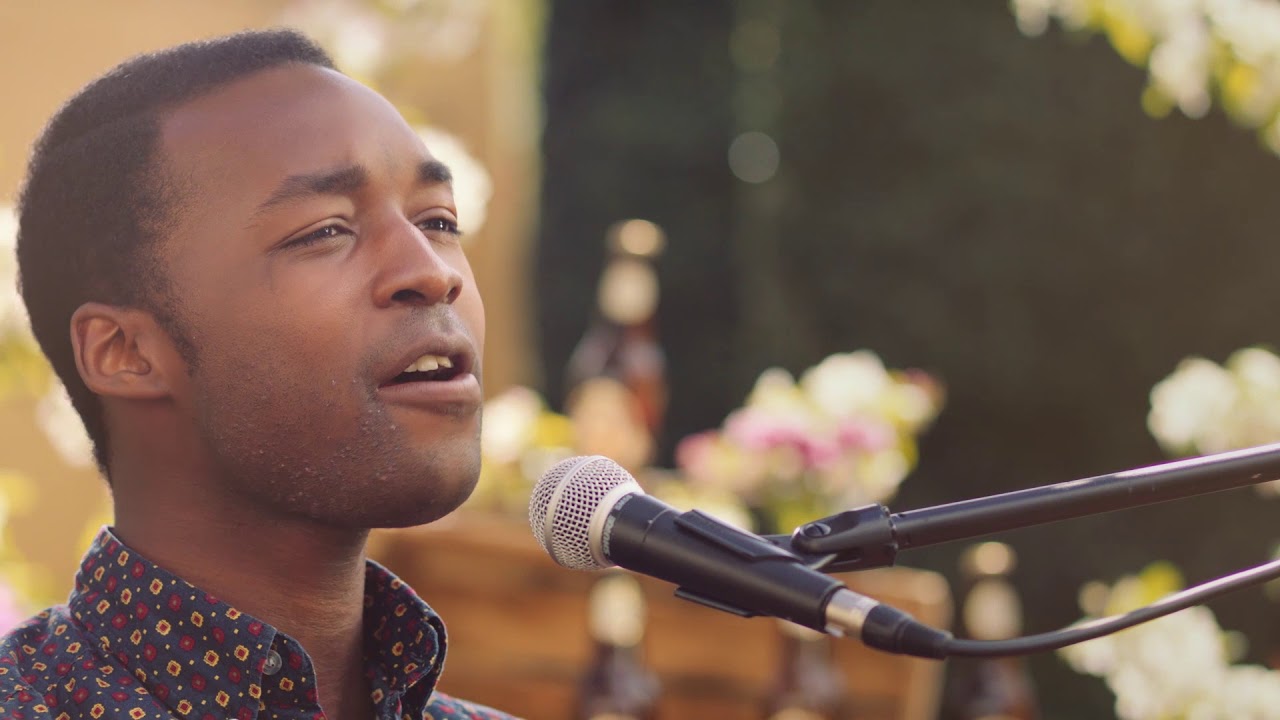
Jalen N'Gonda 'If Only Honey Was As Sweet As You' - The Henry Westons  Sessions - #cheltjazzfest - YouTube

Today Project CHANGE was treated to a Master Class in Music from the inimitable Jalen N’gonda. Those who know the team for the last three years might recognize the family name.

Jalen is back from the UK to do some recording in NYC and to spend some time with the family. Then he heads back to London. He discovered his musical talent late or at least revealed it late, and his parents could hardly believe that their son was a singer-songwriter. They had never heard him sing.

Jalen shared his love of music and discussed with the team how music is a language all kids can relate to. He explained how the heart of all Pop music comes from the Blues, people giving themselves permission to sing their deepest heart song.

Usually the team are happy to share lunch and head back out, but today, they lingered, like they could not get enough of his soul music.

We even started working on our own song:

On this cold Friday morning
Greeting a new year dawning
Being asked to sing, without warning!
You can hear a band forming.


Thank you Jalen.

https://photos.app.goo.gl/H9x6zoAZWibkrifr5

New book challenges Civil War’s old myths

By Jonathan M. Pitts Yesterday at 6:06 p.m. EST Washington Post

Regular folks and history buffs who believe Maryland leaned strongly toward the Confederacy during the Civil War era have never lacked evidence for the claim.

It was a Marylander, after all, on the U.S. Supreme Court who wrote the opinion in the infamous 1857 Dred Scott case, which found that Black people were not citizens — a ruling that helped spark the fighting. And Marylanders voted for a Southern sympathizer, not Abraham Lincoln, for president in the election of 1860. Then, some 20,000 Marylanders took up arms for the Confederacy.

But such facts can be deceiving if looked at in a vacuum — or so say the scholars behind a critically acclaimed new book that aims to explode long-standing myths about the period.

In “The Civil War in Maryland Reconsidered,” a collection of 13 essays assembled and edited by Baltimore historians Charles W. Mitchell and Jean H. Baker, are independent thinkers from as far away as California and England and as close as Johns Hopkins University. They point out, among other things, that contrary to popular belief, Maryland judges refused to put the Dred Scott decision into effect; that more Marylanders voted, in total, for the three presidential candidates who backed the Union than they did for John C. Breckinridge, the Southern Democrat who carried the state in 1860, and that four times as many Old Line State men fought for the Union than for the South.

Maryland, in short, was less sympathetic to the Confederate cause, and more behind the Union, than generations of historians have implied, says Mitchell, a self-taught Civil War expert, author and editor who got the sprawling essay project rolling four years ago.

History, he says, is framed by the values of those who pass it along. In the case of Maryland’s antebellum and Civil War history, the men and women who shaped it first were people who held to the notion that the Southern cause — far from being a bloody campaign to preserve slavery — was a matter of states’ rights. They viewed it as a noble crusade that failed only because the Union side was better equipped and funded.

The earliest chroniclers, he says, were Confederate veterans. The generations of historians who succeeded them wrote at a time when powerful Democrats, North and South, were still working to deny African Americans full enjoyment of their freedoms.ADVERTISING

“The same Confederate sympathizers who had lost the war worked hard to win it in the history books, and for many years, they succeeded,” Mitchell says, including in textbooks used in Maryland well into the 20th century.

It wasn’t until the last 20 years or so, Mitchell adds, that younger scholars began training their focus on the kinds of period documents their forebears ignored.

By diving into court and estate records, schedules of enslaved people, letters written by ordinary citizens, articles in the Black press and more, those scholars, including several represented in the book, began to put together a more comprehensive history — one that weakens Maryland’s “Lost Cause” narrative.

Mitchell and Baker, a former history professor at Goucher College and the author of multiple award-winning books, conceived “The Civil War in Maryland Reconsidered” as an entry in that new vein. Early reviewers say they’ve struck a blow for a more accurate, fuller telling of the state’s story.

“The deeply researched and tightly written essays in this volume provide new information and insights on the role of a crucial border state in the Civil War,” writes James McPherson, author of the Pulitzer Prize-winning book “Battle Cry of Freedom: The Civil War Era,” in his blurb on the essay collection’s book jacket.

And William W. Freehling, another leading Civil War scholar, adds that “multiple generations’ perspectives yield exciting insights on a state as torn as the nation itself: No student of the American Union’s fall and rebirth can afford to miss the revelations.”

For years, the editors say, the “Southernizing” of Maryland history meant omitting important realities inconvenient to the prevailing narrative, including how African Americans lived before, during and after the war. Three of the book’s authors help to fill that void.

University of Maryland history professor Richard Bell, author of the award-winning 2019 book “Stolen: Five Free Boys Kidnapped into Slavery and Their Astonishing Odyssey Home,” focuses on how a black market network of human traffickers functioned in the slave state of Maryland.

His essay, “Border Wars,” describes how those who ran this “reverse Underground Railroad” kidnapped African Americans in the free commonwealth of Pennsylvania, took them to Baltimore, and kept them in “pens” before selling them into enslavement in the Deep South.

Another author, Jessica Millward of the University of California at Irvine, brings to life individuals such as Charity Folks, a woman who was born into slavery in Anne Arundel County in the mid-1700s and was later freed. By describing how she gave birth to both free and enslaved children, Millward illustrates how such factors as gender could complicate the supposedly clear distinction between slavery and freedom in Maryland.

And it’s Johns Hopkins professor Martha Jones, a prominent scholar of African American history, who combs old court records to show that the Dred Scott ruling had little practical impact locally. Though it portended catastrophe for the state’s 87,000 free Blacks, Jones demonstrates that Maryland judges overwhelmingly defaulted to state laws that kept the group’s essential rights intact.

Mitchell himself adds twists to a topic that has long held his attention. In his 2007 book, “Maryland Voices of the Civil War,” he drew on personal letters and other original source documents to argue that his home state never seriously considered secession.

In his essay, “Maryland Is This Day True to the Union,” Mitchell draws on petitions, pamphlets, voting statistics and public meeting records. They show that even though Breckinridge, the Southern sympathizer, carried the state in the 1860 presidential election, his 45 percent of the state vote was dwarfed by the 54 percent who went for the three pro-Union candidates (including Lincoln, who finished fourth).

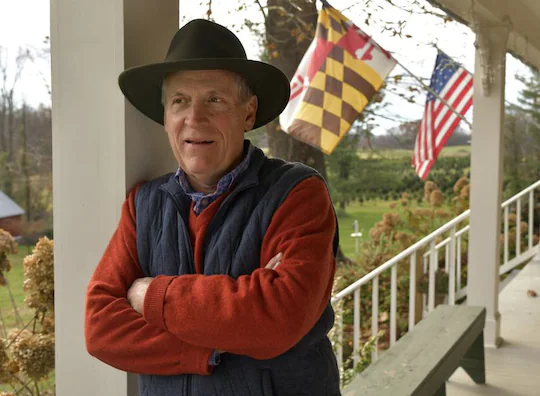
Mitchell reiterated the point in a conversation from his home, a rustic 1800s-era farmhouse where Civil War memorabilia is on display. It includes the Union discharge papers of the great-grandfather of his wife, Betsy.

“During the so-called secession winter of 1860, it was actually Union voices that predominated in this state,” he says, adding that his research shows that sentiment remained through the war.

The Louisiana State University Press published “The Civil War in Maryland Reconsidered” late last year. It includes contributions from other prominent historians, who focus on such matters as women’s organizations that supported the Union, the horrors that Union soldiers discovered when they arrived at Antietam after that battle ended and the successful recruitment of Union soldiers in Baltimore.

The book is the 13th written or edited by Baker, including a biography of Abraham Lincoln’s wife, Mary Todd Lincoln, and several influential works on the American suffragist movement.

It’s the third for Mitchell, whose interest in the Civil War was awakened years ago when Betsy inherited a box of memorabilia. The Parkton, Md., man works full time as alumni director for his alma mater, St. Paul’s School.

The new book is unlikely to hit the bestseller lists, he concedes, but he hopes it will add to the unfolding history of the war in his state, helping his fellow Marylanders better grasp who they were and are.

“As a historian, you always look for original source materials that can help you tell a new story or put something you think you know in a new light,” he says. “There’s always something new.”

— Baltimore Sun

Exhausting Martin Luther King Jr.’s legacy

By Robin Givhan Senior critic-at-large January 11, 2022 at 7:36 p.m. EST

The president traveled Tuesday to Atlanta to deliver a speech on the sanctity of voting rights — a geographic choice that speaks to the reality that nothing about this democracy is assured. Nothing is certain. Georgia gave Democrats the edge in the Senate and it was critical in helping Joe Biden win the presidency. It is also the state where election officials have been under extended duress as Republicans demanded recounts, alleged fraud and passed new laws that made voting more of an obstacle course than a walk in the park.

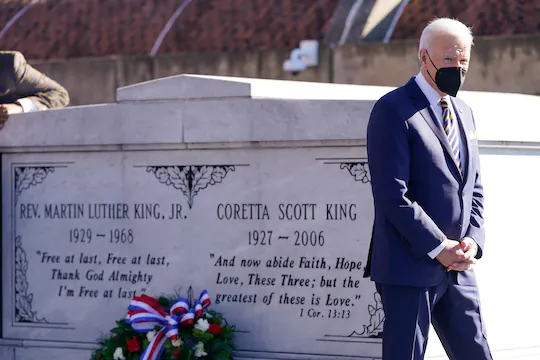
Biden’s visit included a stop at the Martin Luther King Jr. Center for Nonviolent Social Change, a ceremonial laying of a wreath at the crypt of King and his wife Coretta Scott King, private time with their family and a visit to the historical Ebenezer Baptist Church where King was once senior pastor. Biden also spoke from the Atlanta University Center Consortium, an institute that straddles Clark Atlanta University and Morehouse College, from which King graduated. On a day trip that only had the president on the ground for a few hours, there was an awful lot of MLK.

But then, there is always a lot of MLK whenever the subject turns to racial justice, equal opportunity and the dream of a colorblind society. Everyone lays claim to King’s legacy with such certitude that if as many people marched alongside him in the 1960s as have said they did, then there would have been virtually no one standing on the sidelines wielding batons and casting aspersions. The dream of which King spoke would be a reality. And the January holiday in his honor would be a celebration of the American experiment’s completion rather than a remembrance of a promise yet to be fulfilled. But we like our history pretty.

The president arrived in Atlanta with Vice President Harris and a group of Democratic lawmakers — none of whom were Sen. Joe Manchin III (D-W.Va.), who seems to be the only Democratic senator who matters, never seems to want what his colleagues want or always seems to have issues with what they want or the speed with which they want it. Biden was also accompanied by activists seeking the passage of the John Lewis Voting Rights Advancement Act and the Freedom to Vote Act, legislation aimed at ensuring unencumbered access to the polls and minimum federal standards for the way in which elections are conducted. Opponents argue that election security needs to be ramped up to prevent fraud; and, they don’t want Washington setting rules about how local elections are run. Those differing points of view are muddied and tortured by no small number of conservatives who see ballot stuffing and other subterfuge even when there is no evidence it exists. It’s all stalled because of the filibuster, which requires 60 votes in the Senate for legislation to pass.

Biden calls for changing the filibuster in major voting rights speech

In the midst of this, MLK is inspiration, retort, rallying cry and protective cover. The civil rights leader’s name is the conservative rebuttal to concerns about systemic racism. King’s name is a love song for bootstrapping individualists. It’s akin to a glide path to a safe landing for anyone accused of trying to elevate themselves by diminishing others.

During his speech, the president remarked that King’s family had offered a kind of reprimand to those who use his name in vain: “It’s not enough to praise their father. They even said on this holiday, don’t celebrate his birthday unless you’re willing to support what he lived for and what he died for.”

The conservative attachment to MLK is often more romantic than that of his more direct heirs, who are the voting rights activists who have taken to the streets, who agitate for change, who do the hard work of organizing — some of whom decided not to attend Biden’s speech to underscore their exasperation, impatience and disillusionment with the president’s sense of urgency in seeing voting rights legislation passed.

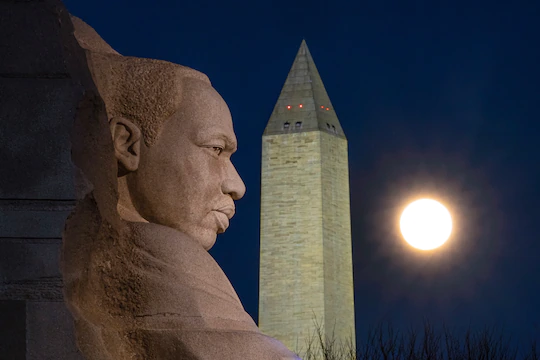
As the memory of King has aged, it’s taken on a smooth-edged, golden hue. Quotations from his speeches have been memorialized in stone but they’ve also been repeated so often and with such disregard for context that they’ve taken on the depth and specificity of a daily horoscope. The words mean whatever you want them to mean.

King was only 39 years old when he died, and while he was more liberal than radical, it’s hard to imagine that he would be so revered if he were a 30-something activist today — a Black man marching in the streets and advocating for fair wages, voting rights, racial justice and a more equitable form of capitalism. He and his fellow protesters would likely be blamed for stirring the pot and creating upheaval in places where everything was just fine before they showed up spouting their un-American ideas — which is precisely what happened in his day.

Over time, King has been recast as a warmhearted preacher who just wanted everyone to get along and only the most base among us disagreed with him. Biden called out some of those wretched names as he was making his plea to lawmakers to stand on the right side of history.

“So I ask every elected official in America, how do you want to be remembered? The consequential moments in history, they present a choice,” Biden said. “Do you want to be on … the side of Dr. King or George Wallace? Do you want to be on the side of John Lewis or Bull Connor? Do you want to be the side of Abraham Lincoln or Jefferson Davis? This is the moment to decide to defend our elections, to defend our democracy.”

But everyone sees themselves on the side of King. Everyone basks in the glow of his legacy. Few people see themselves as the moral equivalent of Connor, the segregationist head of Alabama public safety who loosed the dogs and opened fire hoses on civil rights activists. They see themselves under the heading of populists protecting the jobs, homesteads and rights of working-class America. They are not Davis, the leader of the Confederacy. They are proud Southerners protecting their history and heritage. They are not Wallace, the segregationist governor of Alabama standing in the doorway of the University of Alabama as Black students tried to enter. They are concerned parents worried about critical race theory and fretting that their children will be made to feel bad for being White.

As Biden stood in the late afternoon sun, the background populated with young people, he argued for democracy’s future by appealing to the country’s sense of history. He made plain his desire to get rid of the filibuster so the stagnating legislation could pass. “I’ve been having these quiet conversations with members of Congress for the last two months,” he said. “I’m tired of being quiet.”

He pounded the lectern. He said “damn” and then backpedaled to “darn.” He warned of democracy’s fragility. And he invoked King’s name, forever hopeful that its glow isn’t so blinding that it can still enlighten.

Image without a caption

By Robin Givhan
Senior critic-at-large

Quotes from MLK’s “Letter from Birmingham Jail.”

Letter from the Birmingham Jail by Martin Luther King Jr.

“I must make two honest confessions to you, my Christian and Jewish brothers. First, I must confess that over the past few years I have been gravely disappointed with the white moderate. I have almost reached the regrettable conclusion that the Negro’s great stumbling block in his stride toward freedom is not the White Citizen’s Counciler or the Ku Klux Klanner, but the white moderate, who is more devoted to “order” than to justice; who prefers a negative peace which is the absence of tension to a positive peace which is the presence of justice; who constantly says: “I agree with you in the goal you seek, but I cannot agree with your methods of direct action”; who paternalistically believes he can set the timetable for another man’s freedom; who lives by a mythical concept of time and who constantly advises the Negro to wait for a “more convenient season.” Shallow understanding from people of good will is more frustrating than absolute misunderstanding from people of ill will. Lukewarm acceptance is much more bewildering than outright rejection.”


― Martin Luther King Jr., Letter from the Birmingham

“In a real sense all life is inter-related. All men are caught in an inescapable network of mutuality, tied in a single garment of destiny. Whatever affects one directly, affects all indirectly. I can never be what I ought to be until you are what you ought to be, and you can never be what you ought to be until I am what I ought to be…This is the inter-related structure of reality.”

― Martin Luther King Jr

“We know through painful experience that freedom is never voluntarily given by the oppressor; it must be demanded by the oppressed.”
― Martin Luther King Jr., Letter from the Birmingham

“One has not only a legal, but a moral responsibility to obey just laws. Conversely, one has a moral responsibility to disobey unjust laws.”
― Martin Luther King Jr., Letter from the Birmingham

“We will have to repent in this generation not merely for the hateful words and actions of the bad people but for the appalling silence of the good people.”
― Martin Luther King Jr., Letter from the Birmingham

“So I have tried to make it clear that it is wrong to use immoral means to attain moral ends. But now I must affirm that it is just as wrong, or even more so, to use moral means to preserve immoral ends. ”
― Martin Luther King Jr., Letter from the Birmingham

“The early Christians rejoiced when they were deemed worthy to suffer for what they believed. In those days the Church was not merely a thermometer that recorded the ideas and principles o popular opinion; it was a thermostat that transformed the mores of society.”
― Martin Luther King Jr., Letter from the Birmingham Jail

“Just as Socrates felt that it was necessary to create a tension in the mind so that individuals could rise from the bondage of myths and half-truths to the unfettered realm of creative analysis and objective appraisal, so must we see the need for nonviolent gadflies to create the kind of tension in society that will help men rise from the dark depths of prejudice and racism to majestic heights of understanding and brotherhood.”
― Martin Luther King Jr., Letter from the Birmingham Jail

“Wherever the early Christians entered a town the power structure got disturbed and immediately sought to convict them for being ‘disturbers of the peace’ and ‘outside agitators.’ But they went on with the conviction that they were a ‘colony of heaven’ and had to obey God rather than man. They were small in number but big in commitment. They were too God-intoxicated to be ‘astronomically intimidated.’ They brought an end to such ancient evils as infanticide and gladiatorial contest. Things are different now. The contemporary Church is so often a weak, ineffectual voice with an uncertain sound. It is so often the archsupporter of the status quo. Far from being disturbed by the presence of the Church, the power structure of the average community is consoled by the Church’s silent and often vocal sanction of things as they are.”
― Martin Luther King Jr., Letter from the Birmingham Jail

“Let us all hope that the dark clouds of racial prejudice will soon pass away and the deep fog of misunderstanding will be lifted from our fear-drenched communities, and in some not too distant tomorrow the radiant stars of love and brotherhood will shine over our great nation with all their scintillating beauty.”
― Martin Luther King Jr., Letter from the Birmingham

“Shallow understanding from people of goodwill is more frustrating than absolute misunderstanding from people of ill will. Lukewarm acceptance is much more bewildering than outright rejection.”
― Martin Luther King Jr., Letter from the Birmingham Jail

“For years now I have heard the word “Wait!” It rings in the ear of every Negro with piercing familiarity. This “Wait” has almost always meant “Never.” We must come to see, with one of our distinguished jurists, that “justice too long delayed is justice denied.”
― Martin Luther King Jr., Letter from the Birmingham Jail

“I have consistently preached that nonviolence demands that the means we use must be as pure as the ends we seek. I have tried to make clear that it is wrong to use immoral means to attain moral ends. But now I must affirm that it is just as wrong, or perhaps even more so, to use moral means to preserve immoral ends.”
― Martin Luther King Jr., Letter from the Birmingham

“Injustice anywhere is injustice everywhere. Anyone who lives inside the US can never be considered an outsider anywhere in the country”
― Martin Luther King Jr., Letter from the Birmingham

“I must confess that over the past few years I have been gravely disappointed with the white moderate. I have almost reached the regrettable conclusion that the Negro’s great stumbling block in his stride toward freedom is not the White Citizen’s Counciler or the Ku Klux Klanner, but the white moderate, who is more devoted to “order” than to justice; who prefers a negative peace which is the absence of tension to a positive peace which is the presence of justice; who constantly says: “I agree with you in the goal you seek, but I cannot agree with your methods of direct action”; who paternalistically believes he can set the timetable for another man’s freedom; who lives by a mythical concept of time and who constantly advises the Negro to wait for a “more convenient season.” Shallow understanding from people of good will is more frustrating than absolute misunderstanding from people of ill will. Lukewarm acceptance is much more bewildering than outright rejection.”
― Martin Luther King Jr., Letter from the Birmingham Jail

“Actually, we who engage in nonviolent direct action are not the creators of tension. We merely bring to the surface the hidden tension that is already alive. We bring it out in the open, where it can be seen and dealt with.”
― Martin Luther King Jr., Letter from the Birmingham Jail

“My friends, I must say to you that we have not made a single gain in civil rights without determined legal and nonviolent pressure. Lamentably, it is an historical fact that privileged groups seldom give up their privileges voluntarily. Individuals may see the moral light and voluntarily give up their unjust posture; but, as Reinhold Niebuhr has reminded us, groups tend to be more immoral than individuals.”
― Martin Luther King Jr., Letter from the Birmingham

“We know through painful experience that freedom is never voluntarily given by the oppressor, it must be demanded by the oppressed.”
― Rev. Dr. Martin Luther King Jr., Letter From Birmingham Jail

“All too many others have been more cautious than courageous and have remained silent behind the anesthetizing security of stained-glass windows”
― Martin Luther King Jr., Letter from the Birmingham Jail

“More and more I feel that the people of ill will have used time much more effectively than have the people of good will. We will have to repent in this generation not merely for the hateful words and actions of the bad people but for the appalling silence of the good people.”
― Martin Luther King Jr., Letter from the Birmingham Jail

“Oppressed people cannot remain oppressed forever. The urge for freedom will eventually come. This is what has happened to the American Negro. Something within has reminded him of his birthright of freedom; something without has reminded him that he can gain it.”
― Martin Luther King Jr., Letter from the Birmingham Jail

“Will we be extremists for hate or will we be extremists for love? Will we be extremists for the preservation of injustice ― or will we be extremists for the cause of justice?”
― Martin Luther King Jr., Letter from the Birmingham Jail

“Lukewarm acceptance is much more bewildering than outright rejection.”
― Martin Luther King Jr., Letter from the Birmingham Jail

“the question is not whether we will be extremist, but what kind of extremists we will be. Will we be extremists for hate, or will we be extremists for love? Will we be extremists for the preservation of injustice, or will we be extremists for the cause of justice?”
― Martin Luther King Jr., Letter from the Birmingham Jail

“I am coming to feel that the people of ill will have used time much much more effectively than the people of good will.”
― Martin Luther King Jr., Letter from the Birmingham Jail

“Before the pen of Jefferson etched the majestic words of the Declaration of Independence across the pages of history, we were here. For more than two centuries our forebears labored in this country without wages; they made cotton king; they built the homes of their masters while suffering gross injustice and shameful humiliation—and yet out of a bottomless vitality they continued to thrive and develop. If the inexpressible cruelties of slavery could not stop us, the opposition we now face will surely fail.”
― Martin Luther King Jr., Letter from the Birmingham Jail

“Nonviolent direct action seeks to create such a crisis and establish such creative tension that a community that has consistently refused to negotiate is forced to confront the issue. It seeks so to dramatize the issue that it can no longer be ignored.”
― Martin Luther King Jr., Letter from the Birmingham Jail

“History is the long and tragic story of the fact that privileged groups seldom give up their privileges voluntarily. Individuals may see the moral light and voluntarily give up their unjust posture; but, as Reinhold Niebuhr has reminded us, groups are more immoral than individuals.”
― Martin Luther King Jr., Letter from the Birmingham Jail

“. . . the white moderate who is more devoted to order than to justice; who prefers a negative peace which is the absence of tension to a positive peace which is the presence of justice; who constantly says, “I agree with you in the goal you seek, but I can’t agree with your methods of direct action”; who paternalistically feels that he can set the timetable for another man’s freedom; who lives by the myth of time; and who constantly advises the Negro to wait until a “more convenient season.” Shallow understanding from people of good will is more frustrating than absolute misunderstanding from people of ill will. Lukewarm acceptance is much more bewildering than outright rejection.”
― Martin Luther King Jr., Letter from the Birmingham Jail

We will have to repent in this generation not merely for the vitriolic words and actions of the bad people but for the appalling silence of the good people. We must come to see that human progress never rolls in on wheels of inevitability. It comes through the tireless efforts and persistent work of men willing to be coworkers with God, and without this hard work time itself becomes an ally of the forces of social stagnation.”
― Martin Luther King Jr., Letter from the Birmingham Jail0

“In deep disappointment I have wept over the laxity of the church. But be assured that my tears have been tears of love. There can be no deep disappointment where there is not deep love.”
― Martin Luther King Jr., Letter from the Birmingham Jail

Dr. King was bold. Don’t make him bland.

By E.J. Dionne Jr.Columnist|Follow January 16, 2022 at 8:00 a.m. EST

This holiday weekend, Americans will celebrate the Rev. Martin Luther King Jr. of their choosing. That’s not surprising. But it is a problem.

If the devil can quote scripture for his purposes, it’s not shocking that all of us are inclined to cite the pronouncements of historical figures that ratify our own views. Liberals love to remind people of Ronald Reagan’s warm words about immigrants. Conservatives are fond of citing certain John F. Kennedy quotations about tax cuts and national security.Opinions to start the day, in your inbox. Sign up.

King’s role in our history was not that of a politician but of a prodder of our national conscience and a critic of our failures. In his all-too-brief lifetime, he was often condemned as a radical by defenders of the status quo.

The holiday in his honor is thus quite different from, say, Presidents’ Day or the Fourth of July. They are unambiguous celebrations of our country. In principle, at least, MLK Day is a time to reflect on the urgency of social change and the racial and economic injustices that required, as King insisted, repentance and reform.

Colbert I. King: Martin Luther King Jr.’s words on voting rights resonate all too well today

In practice, precisely because King has become in retrospect a consensual hero, we have turned him into a consensual figure. My Post colleague Robin Givhan said it well in a fine essay this past week: “As the memory of King has aged, it’s taken on a smooth-edged, golden hue.”

King has become a man for all viewpoints partly because he was many things at once.

Image without a caption

He was a militant civil rights leader and a preacher of the Christian Gospel. He was a believer in racial concord and an agitator — in the best sense of that word — against the racism that permeated our institutions. He believed in the conversion of adversaries, but getting there often required confrontation and discomfort. King was far more a “both/and” figure than an either/or, yet the capaciousness of his worldview did not stop him from drawing clear moral lines.

Among his many addresses and sermons, a March 1968 speech at Grosse Pointe High School in Michigan offers one of the best illustrations of why it is so easy — and so misleading — to quote King out of context.

Conservatives love to note that King believed in individual achievement and responsibility, which is true. “It’s very important for people to engage in self-help programs and do all they can to lift themselves by their own bootstraps,” he said that day. “I think there is a great deal that the Black people of this country must do for themselves and that nobody else can do for them.”

But that comment came in the course of a critique of an “over-reliance on the bootstrap philosophy” as it applied to Black Americans, given that “no other ethnic group has been enslaved on American soil” and “that America made the Black man’s color a stigma.” He noted that a Mississippi arch-segregationist, Sen. James O. Eastland, was among those receiving a share of the “millions of dollars a year in federal subsidies not to farm and these are so often the very people saying to the Black man that he must lift himself by his own bootstraps.”

“Well,” King concluded, “that appears to me to be a kind of socialism for the rich and rugged hard individualistic capitalism for the poor.”

The Post’s View: Martin Luther King, Jr. did not give up. Those fighting for democracy must follow his example.

Similarly, King believed profoundly in moral uplift and the need for individual redemption. “Naturally, I believe in changing the heart,” he said. “I happen to be a Baptist preacher and that puts me in the heart-changing business and Sunday after Sunday I’m preaching about conversion and the need for the new birth and regeneration. … I’m honest enough to see the gone-wrongness of human nature.”

Here again, however, King was making a case against “the notion that legislation can’t solve the problem, that you’ve got to change the heart.” On the contrary, King argued, only legislation could guarantee racial justice.

“It may be true that morality cannot be legislated, but behavior can be regulated,” he said. “It may be true that the law cannot change the heart but it can restrain the heartless. It may be true that the law can’t make a man love me, but it can restrain him from lynching me, and I think that’s pretty important.”

King was so reasonable and balanced that we forget how angry he could get at injustice, and how impatient he was in his 1963 Letter from Birmingham Jail with “the white moderate, who is more devoted to ‘order’ than to justice.” They are words worth remembering in our current struggles over voting rights.

King earned this holiday not by being bland but by being bold. He was killed because he dared to challenge us to change. He challenges us still.

Montgomery Co. Public Schools teacher’s union votes no confidence; council holding emergency session

Classrooms not Zoom”: Rally held to reopen Montgomery County Public Schools  | WDVM25 & DCW50 | Washington, DC

By Stephanie Ramirez Published  January 13, 2022 6:54PM Updated 6:54PM NewsFOX 5 DC

MONTGOMERY COUNTY, Md. (FOX 5 DC) – The Montgomery County Education Association, which represents thousands of Montgomery County Public School teachers, announced on Thursday that out of nearly 7,000 members voting in a day, around 94% voted “no confidence” in both the Montgomery County School Board and Interim Superintendent Dr. Monifa McKnight.

The vote comes after a much anticipated MCPS virtual meeting ended in more frustration and little specifics shared on the current state of COVID-19 within MCPS’ more than 200 schools.

The response: the Montgomery County’s Education and Culture Committee is now planning an emergency session with MCPS next Thursday to discuss details not shared in the Wednesday night meeting.

Many MCPS families were still wanting to know about the staffing shortages and are looking for a more clear explanation of how decisions will be made on whether a school will go back to virtual instruction.

PREVIOUS COVERAGE: Montgomery County community conversation falls flat for MCPS parents, students

“You know what, we’ll do it again. We’ll have another community conversation, and we will take the feedback you’ve provided, and we will figure out how we do we share the information so that it is information that is important,” said the Interim Superintendent during Thursday’s Board of Education Meeting.

The Thursday school board session is where MCPS shared some of the facts and figures participants were looking for Wednesday night.

For example, a graph showing the bus driver shortage last week showed Jan. 5 had the largest shortage with 208 drivers absent. The school board was told 70 drivers called out between 4:30 a.m. and 7:30 a.m.

School leaders were also told prior to the start of the school year that MCPS had a bus driver shortage of around 140 drivers. School and transportation leaders got that number down, but it shot up again to a little over 110 drivers just before the winter break.

READ MORE: Montgomery County schools not likely to receive National Guard assistance for bus driver shortage

On teacher shortages, MCPS provided the snapshot of substitute teacher requests for next week. The graphic showed at least 889 requests are already in for Monday, January 13th. A little over half were still unfilled by the time of the presentation.

MCPS also told the school board they hired 550 new subs since the beginning of the school year and processed around double the amount of applications, but the hiring process takes time.

MCPS also told the school board it was updating virtual education with changes likely in effect or being shared next week. Part of those plans include teachers recording the same lessons they’re teaching classes to have virtual instruction more in-line with in-person instruction on the elementary level.

For secondary students, teachers will decide whether to have the students Zoom-in for live instruction or meet virtually during a non-instruction period.

Town Hall with new AmeriCorps CEO

The NonProfit Times

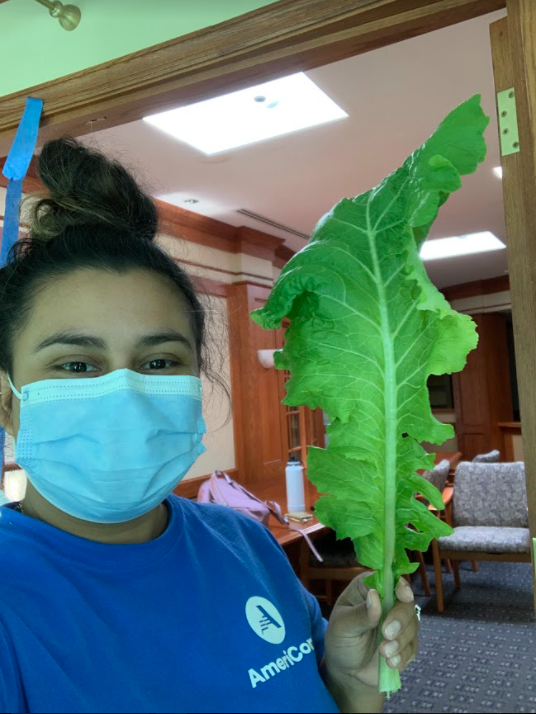
Project CHANGE member securing food for families

Family Learning Solutions has Oneyda Hernandez serving this year and Oneyda is leading the way to provide food security for families by teaching them how to grow vegetables hydroponically. Here is a recent report.

Partnership with ACRT, Clifton Park Baptist Church, Project Change-AmeriCorps and University of Maryland, Public Health
Over the summer of 2021, we established a partnership with the Clifton Park Baptist Church to assist in the organization of essential food rescue services for those in need by supplying staff to help harvest the fresh produce grown in their hydroponic garden. FLS AmeriCorps Member Oneyda Hernandez is one of the individuals responsible for helping to maintain these gardens and works alongside the church’s volunteers to package the hydroponic lettuce into food rescue packages in preparation for distribution to community members. 

Prior to this, FLS is fortunate to have created partnerships with ACRT (September 2020) and Project Change-AmeriCorps (September 2018), and University of Maryland (November 2020) whose support has helped us expand our mentoring, tutoring, and FGH initiatives into the wider community.