Loading

Posts by Paul Costello1

Second Annual AmeriCorps MD Story Festival December 2nd 2016

storyfestival

Four Maryland based AmeriCorps programs- Project CHANGE. CASA, Maryland Conservation Corps, and Volunteer Maryland, totaling 50 plus members met at the beautiful CASA mansion on Friday to network and share experiences and stories from their service year. Each member was invited to share a story from their time so far at AmeriCorps and then, for the group to come up with a title in the form of “How X did Y,” such as “How Ariana’s Aunt inspired her to do something more.” Out of all the stories, the group caucused to find the four most powerful stories that the whole group might hear. This process known as Living Stories, is  the signature process of the Center for Narrative Studies. (www.storywise.com) We were thrilled to welcome Sarah Kims and Valerie Staats from the head office.

storyfest4
These story titles told us what the AmeriCorps members were DOING- how they were making a difference, ether in helping a student reach her goal, or how sharing your past can effect someone else’s future.

Here are some of the other things AmeriCorps members do: -crash through the language barrier, help others get their groove back, turn on light bulbs, find a call to the wild,  discover their passion, dream even bigger, take initiative, find their calling, inspire young people, bridge the cultural gaps, inspire students to find their strengths, inspire themselves to do something more.

It was a fun and inspiring day. Thanks to Pablo Blank and all his CASA members and staff for making us so welcome.

HOW TO TELL BETTER STORIES

storyfest6

The members also were eager to learn about stories and how to tell better ones. They heard how a story is not a chronology. it is not this happens and this happens and this happens. No, it is a sequence that has a consequence. This happened BECAUSE this happened. And further, this consequence has to have a wider significance. It must matter. They learned that once you tell a story in public, you give it away- you no longer can control how people are going to hear it or interpret it. The power in a story is that it is our habitual human way of translating change into a form that we can grasp, and how we can draw attention to that moment of decision that makes all the difference.
storyfest5

THE FOUR BIG STORIES

We heard some amazing stories. The four that came out of the 50 stories shared were about-

  1. One moment of decision, in the face of huge opposition – from family and friends,  one member shared how she knows it was the right decision, to do AmeriCorps.
  2. The story of the feel good Buzz words that we all use to make ourselves happy, especially when it comes to the environment, words life sustainability. Yet the story pulled the veil back to show that in the name of these buzz words, sometimes we are doing more harm than good to the natural world, such as planting more trees that will die rather than saving the ones we planted and did not take care of. The story was both personal and a powerful plea from an advocate.
  3. The story of personal anguish and suffering, and how serving in AmeriCorps has enabled the member to turn her pain into something more, whereby she can offer “an ounce of hope” to the students who come to her, asking all sorts of advice about the challenges of  relationships and growing up. When you have been there, and seen abuse and the worst of human behavior, you can help young people strive to be their best.
  4. The story of an alumnus who confessed the feelings that he had about his own identity, and how his service at the YMCA was a way for him to be prouder of what he was and what he had to offer.

storyfest3

At the end, we were treated to more stories, about how the Conservation Corps member finally got to fight a forest fire, how one member working with wild birds got pooped on big time, how a member championing a student who was forlorn because someone had stolen his pencil, and how because the member was his advocate, he is a student she can lead and motivate.

There were lots of laughs, even some tears, and a lot of deep sharing that we hope sends the message to all AmeriCorps members that they are not alone, that their service creates a story that matters and that while they might not know it, their work is creating future stories of inspiration for others to serve.

As we wrapped up the day, I appealed to the members to make their year of service as memorable as they could make it. Or in other words, DO IT FOR THE STORY, because only in that way can they ensure that their experiences live on and have even greater chapters.
do-it-for-the-story1

Meeting with the Supervisors

Image result for best supervisorsToday Project CHANGE played host to our team member supervisors. After we introduced ourselves, the Supervisors got to sample what the Team experiences in this training space most Fridays-Bells and Whistles. What were the highlights that we can share, and what were the issues that we might invite reflection and feedback from the group.

The testimony of the Supervisors to the members was absolutely glowing. Here are a few of the comments we heard.

“competent, goes the extra mile, really gets the family support role, kids love her.
” really fitted into our teacher community, like one of the family. Just wish she would advocate more for herself. She takes initiative and is talking about starting some after school clubs. She manages to cope with a crazy schedule.”
“She is a real self-starter, always organized, even when I am not, always gets things done, and goes above and beyond.”
“Would love to work more with her, she has so much to offer, especially the language skills that we do not have.”
“They are smart, energetic and have really learned to be their best advocates, and are sometimes dedicated beyond what we could even expect.”
“The kids really love him, they know he cares, and he relates so well to the families.”
“She does a great job, organized, and on top of her job. She gets anxious when she is doing something totally new, but is willing to give it a try.”
“He is very caring, doing an excellent job, and now, one of the teachers has let him take the lead, and he loves the kids and they love and respect him.  He puts his all into it.”
“They are very professional, and know what they are doing. They work well with the students, and we are happy to have them.”

Thank you to the Supervisors for all you do to make Project CHANGE a success.


A Day of Service at Adopt A Playroom-Homeless Children’s Playtime Project


Today AmeriCorps Project Change are having a break in their training routine and heading down to DC to work with the Homeless Children’s Playtime Project, a very worthy cause. The team will be helping to lay some new carpet and to clean up a new play space for the kids. The day has been organized by one of our members, Diana Rubio. Diana is taking the lead on a number of projects for the Project CHANGE team this year.  Coming as it does the week before Thanksgiving, its appropriate that Project CHANGE reach out today to kids and to add their little efforts to help bring more joy into the world.

The Power of Peer to Peer Coaching

Today Project Change has the pleasure of a Master Coach, Lynn Feingold, who is taking the team through the process of Peer to Peer Group Coaching, the practice the team know as Bells and Whistles at each training meeting.

It begins with knowing how to truly listen, to be able to actively feed back to the speaker that you have heard them, what they say, how they feel, and how they understand themselves.

What the listener gives back is not what they heard so much as what the speaker heard himself or herself say. We presume that we speak and know  what we mean and how we feel, until someone mirrors back to us how we come across, and that perhaps our words were stronger than we intended, or that there is a feeling underneath the words that others are much more aware of than we are.

A powerful listener does not hear us so much as allow us to hear ourselves at a deeper level. That means however that we remain focused on the person speaking to us and not allowing distractions or the impulse to give advice or move the focus to ourselves.Along with Active Listening, the team are learning:

  • the power of the question
    We hear our colleague describe a problem but we usually have no sense of the situation, the duration, the story of the situation that is behind the problem. Hence, the first round of questions needs to flesh out the reality as it could be observed by someone else. Narrative Scholars sometimes call this mapping the Landscape of Action. Next, once we get a sense of a shared understanding of what is going on, we shift to map the landscape of Consciousness, as to meaning, and how important is this to you, and what are the assumptions or needs or desires behind the problem that make it a problem or a challenge?
  • the power of the pause
    Conversation is noise unless we allow ourselves and our partners the space to embody the words, to allow the words to become flesh. Lynn does the “How are you?” exercise, where on the fly, you ask it and get the on the fly response, “Fine.” Then, she does it with the asker taking a breath before asking, and the respondent taking a breath before answering, and suddenly, we have created a different conversation. A Coach holds the space for a conversation to expand and go deep. The body is always in the act. So, deep listening is spatial as well as emotional and mental. The coach has to learn the space that silence creates and pausing respects, to catch echoes and resonances that are too easily missed.
  • the power of a plan.
    The coaching session is part of an ongoing story of making a difference. Hence, the words need at some point to enter the world and instigate action. At the end of each session, the person with the challenge makes themselves accountable to DO something, or perhaps NOT do something, as a strategy for change that at the next session, they can report on.

    The power of peer to peer coaching as a narrative tool means we are sharing our stories in real time, when we don’t know how they are going to end, and at the same time, sharing our commitment  to being agents of change, and not victims of circumstances. We are recruiting an audience that is championing our leadership and on side with our intentions to do the best we can and be the best we can.  We can’t do that alone, and Peer to Peer coaching is a powerful means by which we can express that.

Do you Ask or Tell? Do you Express or Control how you feel?

Today the AmeriCorps Project CHANGE team learned about a new personal effectiveness tool known as Social Styles. Our expert John Dold put the members through their paces, inviting them to assess their personal styles under the headings of:

Expressives
Drivers
Amiables
Analyticals.

It created a fascinating discussion between us, as the expressives expressed their feelings and the drivers drove home their insights  while the Analytics sat back and more rationally examined what was going on, what did the data say, and the Amiables kept everyone happy. It was a perfect demonstration of the styles. We onsocvial-styles-1ly have one driver, and plenty of expressives. Who is surprised?

What did we learn? That we all have our preferred style and that others may have a personal style that is different and not necessarily compatible with ours. When we Expressives get frustrated with the team member who goes on and on about the details, we have to realize that the Analyticals get just as frustrated with the over-excited Expressives who gush and enthuse about every thing. Or the Amiables who want to keep everyone happy and find the dynamic and decisive style of a Driver to be too much. Its not that any style is wrong, but that we all need to be flexible and try on different styles to suit the need.

soc-sty3Vive La Difference it is when it comes to personality types. Whether one model fits or not, they all make the point that none of us come at the world in exactly the same way. We should not presume that our view is the only view. We are all shaped by so many different variables, from genes to upbringing and language, and culture that our AmeriCorps team is a model of diversity, in ethnicities, languages and personalities. Today we learn to cherish that.


soc-sty4

Questioning our own Cultural Assumptions Study Circles 2

20161021_124917
What if the achievement gap was a symptom of something bigger, something more basic than just students failing exams or dropping out? What then?

What if students fail or succeed due to circumstances and contexts over which they have little or no control? What then?

What if as spirited and motivated we are as  educators to remedy the problem,  we might be as much part of the problem as we are of the solution? What then? 

What if all our precious presumptions about equality and justice make us blind to reality,  and that our belief that students, given the same opportunities, rise or fall based on character or will power or grit is nothing more than a softer expression of hard discrimination? What then? 

Project CHANGE  today experienced Part Two of  the powerful Study Circles method. We in the helping and teaching professions can get so outward focused, we feel its a luxury or navel gazing to take some time doing some serious self-reflection on our practices, beliefs and goals. But we have to be reflective practitioners if we are keep our own learning alive. Last week, the team learned some basic techniques of mindfulness, to quiet that noise and focus on being, not doing. It was a perfect complement to the session today, when we took a pause to look at our own stories where race and prejudice may have got in our way and the way of our students.

The team were asked to take a ‘systems approach’ to the problem,  to focus less on instant fixes 20161021_131748and more on what behaviors and attitudes feed the problem, and what gets in the way of us getting a handle on it. There is so much to learn, and so much to unlearn. 

As Marion Wright Edelman said to us in an event two years ago, “Every child has the right to feel they can achieve and be successful.” If we create a system that tests and tests and tests, to screen out failure from success, or if we serve a culture that overlooks young people’s developing bodies, minds and souls, to privilege aptitude over attitude, then we are creating more failures to fix.  We are like that ingenious Irish fire brigade who to avoid unemployment, tried lighting the fires they then went to put out.

Today was hard. There was some heavy lifting, some hard topics, some tears, even some anger, but Yesenia led us through with great calm and compassion. She knew what the Project CHANGE team might be feeling, because three years ago, she was in the room not as a facilitator but as a member of another great AmeriCorps Team.

Thank you Yesenia. Thank you John Landesman and Study Circles. Thank you CHANGE team for the courage to have a fierce conversation.

20161021_125131


Mindfulness and the Practices of Self Care

mindfulnessToday, mindfulness expert Greg Robison presents to the AmeriCorps team on one of the core practices of self-care- Mediation and Mindfulness. After two months of service, the team are already showing some signs of stress. Its normal and to be expected, being tired, frustrated and challenged by some of the situations and some of the students who don’t do what they are told, etc etc. That is part and parcel of the work we do, but what do we do about it? Burnout is an occupational hazard of people in service and so mindfulness is a way of allowing our bodies to catch up and our minds to slow down. Or as Greg explains it, Mediation is moving out of the thinking mode to the sensing mode.


We are expected to multi-task and we are expected to change our best laid plans when the weather changes or the bus runs late. At every turn, the things that we think we can control run on a schedule different to ours. So we have to cope and we have to adjust. But that takes a toll on our nerves and on our patience. We need to sometimes get off the merry go round and sit, breathe, smell the roses, and let our bodies back into the conversation.

Stories of defining moments- Study Circles

stories-define-us

1900….1910….1920….1930….1940….1950….1960….1970….1980….1990….2000….2010….2015….


The sharing process of Study Circles lays down a timeline 1940–2016 and asks the members to think of some defining moments along that life journey, when your story was born, or came alive, or took a detour, or shifted into overdrive. And what stories came out! They were so powerful that the team, starving as they were, allowed the pizzas to grow cold, because they could not dare to leave the story circle. They wanted to be with their team mates, as each shared some amazing. disturbing or profound moment of transformation.

One member was 21, and innocently driving home late one night when police pulled him over, and before he knew it, he and his friends were surrounded by a dozen police all with guns drawn, and screaming at them to get on the ground. They complied and were all handcuffed, while the car was searched. After a terrifying ordeal, the police let them go with a casual,”You weren’t the guys we were looking for. You can go.” No apology. No explanation. No Nothing.

Another story was about a member in an advanced English class at college, being told by the professor that because the student had Latino origins, that she did not belong in this class because this was for native English speakers. Even when the member told her she spoke both as her native tongue, the teacher insisted that if she did the class, she would have to do extra work to be able to keep up. “No Way,” she told the professor. And at the end of the course, guess who got an A. How much does prejudice set a limit to the expectations teachers have for their students?

For some, the moment that changed everything was 9-11 when the color of their skin or their eyes, or their name became something that others feared. They were told to “Go back to where they came from.” ( which was New Jersey) Or a family was so disturbed by the hatred that they considered changing their family name and moving to a different part of town, where the color of their skin did not stand out as much.

These stories shape us but the point is that no story need define us. And as Yesenia skilfully asked the team at the end, imagine, just imagine that some of the kids you are teaching and tutoring, that this was their story. How might that effect the way you interact with them?

lexisnexis


Project CHANGE does STUDY CIRCLES- Part One

sutdy-circles-1
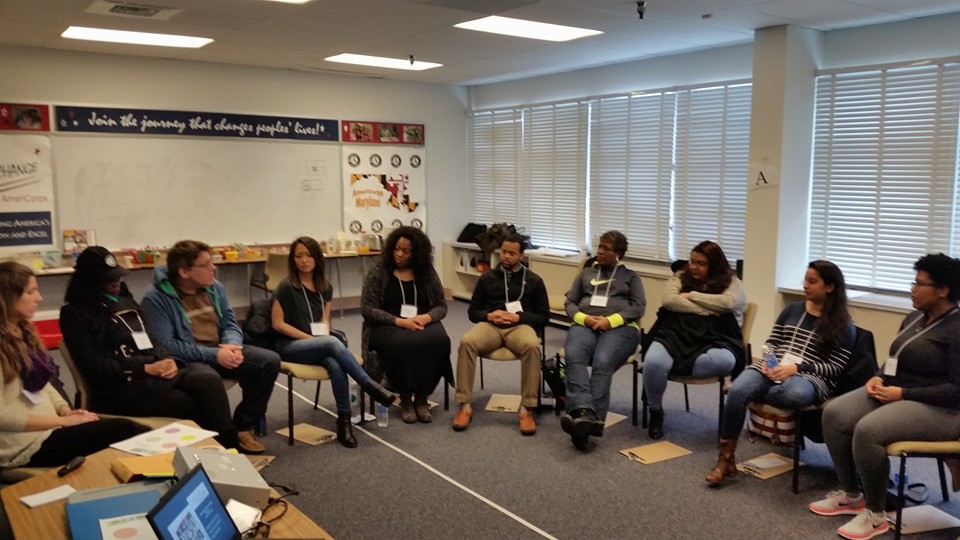
The Project CHANGE team experienced Part ONE of the Study Circles today, seeing the work that members Merary and Deepna are doing every day with school communities in Montgomery County, and being led by Yesenia, a Project CHANGE alumnus from 2013.

Study Circles teaches people how to design the structures of safety and trust that allow for difficult conversations around the issues of race. Sadly, race is one of the most reliable predictors of achievement in our schools and it does not have to be this way. study-circles-16

The achievement gap is one of the big buzz words in educational circles, but what does it look like on the ground? It is a complex mixture of teacher-student engagement and understanding, or lack thereof.

The Team today were invited to share their own family and school stories and to begin to build the shared story of concern and interest that will lay the foundation for confronting the issue of racism head on at the next meeting.

study-circles-2-16The other part of the day was to have some fun, playing kids games, and relaxing after another hectic week of service. A few early sniffles are being heard and some of the team look a little tired. Perhaps a long sleep and a revival weekend is in order.  They surely deserve it.

Project CHANGE serves to improve students’ Academic Engagement

scoresToday was an intense workshop on understanding the impact Project CHANGE aims to make in the lives of K-12 students from economically disadvantaged backgrounds in Montgomery County. We examined the official documentation and test trialed the evaluation instruments before we sat together to share experiences of our own education, and ask ourselves the keyquestion-

What were the influences that shaped our attitude to school, for better or for worse?” 

A lot of amazing stories came out- How a certain teacher or a coach took an interest, or how a student suddenly became competitive with their cousin or their classmates, or someone needed to get above a 2.0 grade average to be able to play on the school football team.

There were lots of different experiences but each of them in their own way demonstrated the lessons of the day, and how to help students develop a more positive and constructive attitude toward their education.  We used the research that says that students engage if they experience

SUCCESS,

develop CURIOSITY,

can express themselves with ORIGINALITY,

are allowed to foster RELATIONSHIPS,

are taught and mentored with ENTHUSIASM and

experience SAFETY.

The word is SCORES, as a way for the team to remember what the path to their goal is. There are there domains of academic engagement- cognitive, behavioral and emotional. CHANGE is about the third one, to help improve the attitude of students towards their school in all its dimensions.

We explored how AmeriCorps members, acting as mentors and tutors, can “infect” their kids with positivity and enthusiasm, and be a role model of learning.