Marc Fisher Associate editor and columnist focusing on Washington and its suburbs Washington Post July 30th 2025
Chris and Melissa Persak chose to live in Montgomery County, Maryland, the most religiously heterogeneous county in the nation, expressly because, Chris says, “we want to enjoy the diversity of our community.”M
The Persaks are Catholics who had two daughters in Montgomery County’s public schools a couple of years ago when their older child, then 9, came home with a book she’d taken out of her elementary school’s library. It was called “My Maddy,” and she had chosen it because Maddy is her sister’s name. The book turned out to be a story about a parent who is neither a Mommy nor a Daddy, but a combination of the two — a “Maddy.”
The Persaks, who believe that “a person’s biological sex is a gift bestowed by God that is both unchanging and integral to that person’s being,” as their lawyer later put it, did not like this book’s message.
As Supreme Court Justice Samuel A. Alito Jr. wrote in June in the case the Persaks had been pursuing for three years, the school board in their affluent D.C. suburb had introduced “LGBTQ+-inclusive” storybooks into the lower grades’ curriculum to “disrupt” children’s thinking about sexuality and gender.
The Persaks quickly learned that books similar to “My Maddy” were being assigned in their children’s classrooms to teach about human sexuality. They found out that Maryland law had long allowed parents to opt their kids out of sexuality lessons — except those on menstruation — that parents felt violated their religious beliefs. But when the Persaks asked about opting their daughter out, they were told that the rules had changed: Montgomery County Public Schools had moved instruction about “LGBTQ+ inclusion” out of the family life curriculum and into the English curriculum, allowing the school system to get around the state’s opt-out law.
The Persaks, and parents who agreed with them, could not opt out, nor could they get advance notice of when such books were to be used.
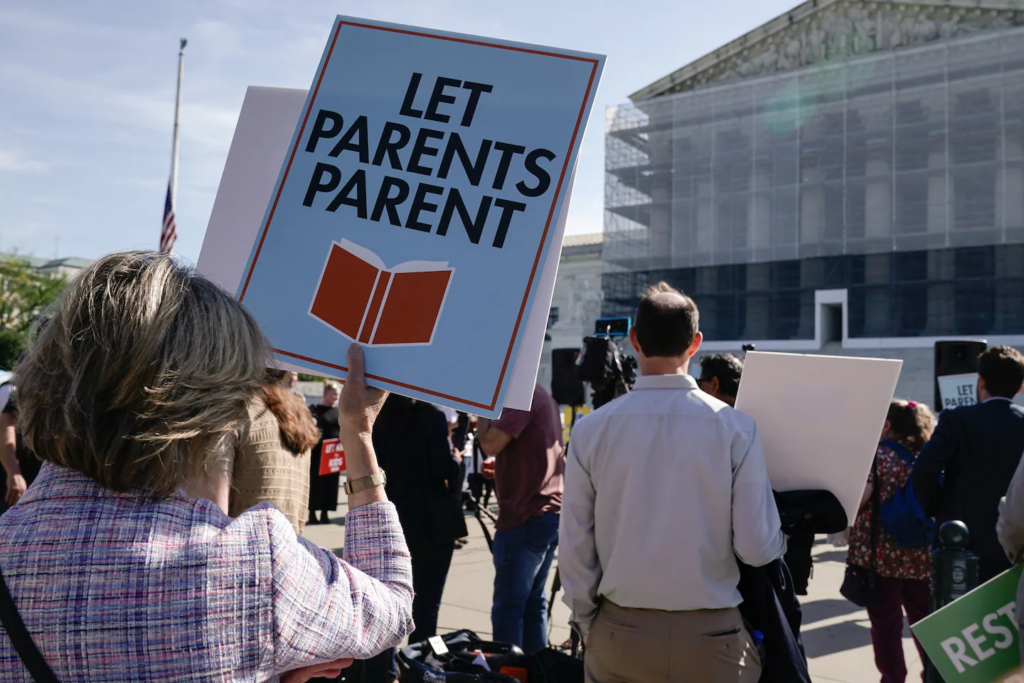
To zip ahead in this years-long story, the Supreme Court ruled last month in a 6-3 decision that the county must let parents opt their kids out of what Alito called “instruction that poses ‘a very real threat of undermining’ the religious beliefs and practices that the parents wish to instill.”
When school starts next month, the Persaks and other parents in their case expect to be informed about what books are being used and to get a chance to pull their kids out of lessons they believe conflict with their beliefs about “the biblical way to properly express romantic and sexual desires,” as their lawyer, Eric S. Baxter, wrote in his brief.
I speak with a forked tongue about this issue. The whole notion that parents have the right to determine what and how their children are taught in school strikes me as just one more reflexive rejection of expertise in a society increasingly enraptured with the notion that anyone is qualified to do anything. (“Hand me that scalpel, Dr. Surgeon — lemme show you how we do that back home!”)
Yet when the opportunity arose years ago, my wife and I joined other parents at our kids’ school in pushing to opt our children out of a grossly inappropriate lesson on the Holocaust that included showing the annoying, simplistic and wildly ahistorical 1997 film “Life Is Beautiful.”
How appallingly hypocritical of me. Or maybe not. This issue turns out to be one more example of how some of the best American institutions are designed to encourage compromise: Schools are generally built to protect the experts’ ability to deliver as their professions think best. Educators should decide what curriculum and what books best teach the next generation, just as judges get to interpret the law and doctors ought to lead patients toward the most efficacious treatments.
But each of those systems was also built to safeguard the public’s ability to weigh in:Just as jurors and voters serve as checks on judges and prosecutors, parents can use their votes to pick school board members and state legislators, who in turn can curb the excesses of educators.
Which takes us back to Montgomery County.
I asked to speak with the MCPS officials deciding how schools will comply with the court’s ruling this fall. That request was denied. The school system’s spokeswoman, Liliana Lopez, offered this statement: “We are working to determine next steps in order to meet the expectations of the Court’s ruling and remain true to our shared values of learning, relationships, respect, excellence and equity.” She said MCPS will update families and staffers before school starts.
Persak hasn’t heard from his daughters’ school. He expects MCPS to, as his lawyer put it, “rebuild trust with parents whom they slandered.” (At least one Montgomery County elected official said pro-opt-out parents were on the same side as “white supremacists and outright bigots.”)Advertisement
I hope the school system reaches out to parents who want to opt their kids out of lessons on sexuality. And I hope the county stands firm against those who would expand parents’ roles in choosing books and lessons. The last thing the county needs is the kind of cleansing of bookshelves now happening in nearby Virginia, where school boards have removed 223 books from libraries in the past five years.
Educators deserve to decide how best to achieve society’s goals in the classroom. And parents get to push back with their votes and, ultimately, by asserting their authority to raise their children as they see fit. All of this is inherently contradictory — and that’s exactly as it should be. The beauty of the system lies in the tension between opposing ideas.