A beautiful day in New York City isn’t just a day when the sun shines and Central Park is sky blue meeting lawn green, shining out in all its glory. It is also a day when New York hotel staff are happy to see you, and do their best to accommodate your needs, like checking in early or securely storing your baggage if you can’t.
When AmeriCorps Project CHANGE arrived last Friday, we were treated to an abundance of the first blessing, a magnificent day in Central Park, flowers blooming, happy people walking, biking, running. On the second score, we got the opposite- a bravura performance from the Hotel staff who could not do enough to frustrate, delay and confuse. If one wanted to experience New York City in all its extremes, the good, the bad, the ugly, we got it in the first New York hour. It is not what we signed on for, but it is what one can expect anytime in NYC and one has to be ready.
The manager- she could not cope with 11 rooms being booked through Expedia. “Why didn’t you book directly with us?” There was $200+ per room reason to use Expedia, but we didn’t tell her that. Working from a crammed space that looked like an annex to an Amazon storage facility, with parcels stacked everywhere, she asked us to give her the 11 separate 14 number booking references, which she laboriously wrote down on her notebook, and I mean lab-or-ious-ly.
She breathed out a sigh for each one, a sigh that got deeper and deeper until I thought by 7753, the 11th registration, she might have sighed herself out and needed CPR.
We had sent these same registrations to the manager two weeks before, after we had stayed at the hotel in person to ensure that there were going to be no problems. Two weeks back, the head manager gave us all assurances that they had all they needed. Show up two weeks later and it was as if our earlier planning trip was a total waste of time. It was. The Hotel was there to frustrate, diss and deceive and in that, they could not do enough.
Six rooms were ready, not 11, so rather than split the team, we decided to come back later when all rooms were prepared. When we did return, a different staff person-(only one person on duty) was on the phone taking a complaint from another unhappy customer who was demanding her money back. This staff person was writing a verbatim report of all that went wrong for someone else. “You kept us waiting” I thought she was writing down!
Despite 15 people suddenly showing up at her desk, she did her best to ignore us. When finally we managed to get some attention, she told us that all our rooms were cancelled because someone had come in and booked 10 rooms earlier in the day, and that we had to go back to the end of the line as far as having rooms ready. When we told her that we booked them in November 2021, she didn’t care. She was going to make us wait till after 5pm, and that was that. Check-In time was 3pm and seemed to be fine for any other guests who arrived while we were there. But it was not called La Quinta ( after 5 in Spanish) for nothing.
The luggage storage facility was the crawl space beside the front door, and any space out from that, all in public view and not secure at all. Some of our team were not happy to leave their bags so exposed, so another member, Dawn, stepped up to say she would stay because she had work to do and she would mind the bags for us. No Central Park sun for her.
So began our weekend in NYC. Central Park was perfect. The Imagine circle off 72nd street as always, was full of singers and artists keeping alive the legacy of John Lennon. “Imagine there’s no heaven,” Imagine NYC as the kindest place in the world. Imagine Early Check-ins. I’ll say you are a dreamer.
The team dinner at Harvest Kitchen was another highlight, where the food was amazing and the welcome and efficiency of the staff such a total contrast to the Hotel. The manager, Igor, was a chef himself and a long time New Yorker who made you want to come back. The team explored the night away in Times Square and good ice cream and good banter, ready for the next day of walking across Brooklyn Bridge and seeing Lion King. What was not to like?
New York is a great and fun place to visit and while it can bring out the best, it can often bring out the worst. If someone goes with a hunger to enjoy, and a curiosity to explore, and not let New York entitlement or cynicism or incompetence get you down, then it is always going to be fun.
But if you are sighing all the way instead of singing all the way, it’s best to stay home. New York doesn’t need more disgruntled, unhappy people. They work hotel desks. It doesn’t have to be that way, but enjoyment in the Big Apple, especially with a team of 20 people is going to take some generosity of spirit and stoic patience to ensure that no one misses out, that people are not left waiting, and that everyone’s interests are fairly accommodated. “Everyone out for themselves,” the stereotypical New York frame of mind of “Me Me Me’ will not work. To enjoy New York, the message is don’t be a New Yorker.
That is not what AmeriCorps is about and that is not why we visit NYC. Next time we visit, we will be closely checking vaccination forms ( some forgot) and also asking members for their license to enjoy, to make sure it is renewed and up to date before they come.
There is a song “If you go to San Francisco, wear a flower in your hair.” Perhaps New York needs a song too. Not “New York New York” and its cringeworthy “Top of the List, King of the Hill” arrogance , but try this, “if you are going to New York City, remember- come singing, not sighing.” Sinatra could sing that as a tribute to the poor manager who we clearly overburdened with our welcome. But she need not worry. We will not be back at that place anytime soon.
Many Thanks to Mary and Carl and Mary and Deborah, and Igor and Harvest Kitchen and Simba and John Roebling and Elton John and Amtrak. No thanks to the La Quinta Inn & Estates by Wyndham Central Park and their unmanagement team.
‘It’s Life or Death’: The Mental Health Crisis Among U.S. Teens
Matt Richtel spent more than a year interviewing adolescents and their families for this series on the mental health crisis.Published April 23, 2022Updated April 26, 2022Editors’ Note:This article examines the increase in anxiety, depression, self harm and suicide among U.S. adolescents. Parents and teenagers dealing with these issues can find resources here.
One evening last April, an anxious and free-spirited 13-year-old girl in suburban Minneapolis sprang furious from a chair in the living room and ran from the house — out a sliding door, across the patio, through the backyard and into the woods.
Moments earlier, the girl’s mother, Linda, had stolen a look at her daughter’s smartphone. The teenager, incensed by the intrusion, had grabbed the phone and fled. (The adolescent is being identified by an initial, M, and the parents by first name only, to protect the family’s privacy.)
Linda was alarmed by photos she had seen on the phone. Some showed blood on M’s ankles from intentional self-harm. Others were close-ups of M’s romantic obsession, the anime character Genocide Jack — a brunette girl with a long red tongue who, in a video series, kills high school classmates with scissors.
In the preceding two years, Linda had watched M spiral downward: severe depression, self-harm, a suicide attempt. Now, she followed M into the woods, frantic. “Please tell me where u r,” she texted. “I’m not mad.”
American adolescence is undergoing a drastic change. Three decades ago, the gravest public health threats to teenagers in the United States came from binge drinking, drunken driving, teenage pregnancy and smoking. These have since fallen sharply, replaced by a new public health concern: soaring rates of mental health disorders.
The decline in mental health among teenagers was intensified by the Covid pandemic but predated it, spanning racial and ethnic groups, urban and rural areas and the socioeconomic divide. In December, in a rare public advisory, the U.S. surgeon general warned of a “devastating” mental health crisis among adolescents. Numerous hospital and doctor groups have called it a national emergency, citing rising levels of mental illness, a severe shortage of therapists and treatment options, and insufficient research to explain the trend.
“Young people are more educated; less likely to get pregnant, use drugs; less likely to die of accident or injury,” said Candice Odgers, a psychologist at the University of California, Irvine. “By many markers, kids are doing fantastic and thriving. But there are these really important trends in anxiety, depression and suicide that stop us in our tracks.”
“We need to figure it out,” she said. “Because it’s life or death for these kids.”
The crisis is often attributed to the rise of social media, but solid data on the issue is limited, the findings are nuanced and often contradictory and some adolescents appear to be more vulnerable than others to the effects of screen time. Federal research shows that teenagers as a group are also getting less sleep and exercise and spending less in-person time with friends — all crucial for healthy development — at a period in life when it is typical to test boundaries and explore one’s identity. The combined result for some adolescents is a kind of cognitive implosion: anxiety, depression, compulsive behaviors, self-harm and even suicide.
This surge has raised vexing questions. Are these issues inherent to adolescence that merely went unrecognized before — or are they being overdiagnosed now? Historical comparisons are difficult, as some data around certain issues, like teen anxiety and depression, began to be collected relatively recently. But the rising rates of emergency-room visits for suicide and self-harm leave little doubt that the physical nature of the threat has changed significantly.
As M descended, Linda and her husband realized they were part of an unenviable club: bewildered parents of an adolescent in profound distress. Linda talked with parents of other struggling teenagers; not long before the night M fled into the forest, Linda was jolted by the news that a local girl had died by suicide.
“You have no control over what they’re thinking,” Linda said. “I just want to tell people what can happen.”
M at home in Minnesota last fall.
M is one of dozens of teenagers who spoke to The New York Times for a yearlong project exploring the changing nature of adolescence in the United States. The Times was given permission by M and the family to speak with M’s school counselor; M’s medical records were shared with The Times and, with the family’s permission, reviewed by outside experts not involved in M’s care.
“This is a typical outpatient,” said Emily Pluhar, a child and adolescent psychologist at Harvard University, describing M as “an internalizer.”
M, now 14, is tall, with red hair and blue eyes, and has a younger sister and older half brother. By turns shy and outspoken, M has thought extensively about pronouns and currently prefers “they.” At the beginning of seventh grade, M also asked to be called by the name of a popular Japanese anime character, whose first name starts with M. “I think we’re similar in that she’s, like, quiet and smart and plays electric bass, and I really like bass and guitars,” M said.
When M was 4, a psychologist the family consulted to assess M’s school readiness concluded that their “intellectual ability is in the very superior range,” according to the report. M enrolled in kindergarten as one of the younger class members.
At 10, M got a smartphone. Linda and her husband, Tony, both of whom had busy work schedules, worried that the device might lead to heavy screen time, but they felt it was necessary to stay in touch. At 11, M hit another adolescent milestone: puberty.
Over the last century, the age of puberty onset has dropped markedly for girls, to 12 years old today from 14 years old in 1990; the age of onset for boys has followed a similar path. Experts say this shift probably now plays a role in the adolescent mental health crisis, although it is just one of many factors that researchers are still working to understand.
When puberty hits, the brain becomes hypersensitive to social and hierarchical information, even as media flood it with opportunities to explore one’s identity and gauge self-worth. Laurence Steinberg, a psychologist at Temple University, said that ability to maturely grapple with the resulting questions — Who am I? Who are my friends? Where do I fit in? — typically lags behind.
The falling age of puberty, he said, has created a “widening gap” between incoming stimulation and what the young brain can process:
“They’re being exposed to this deluge at a much earlier age.”
M first got a phone at age 10, a concession their parents felt was necessary to stay in touch.
M’s first hint of trouble came in sixth grade, with challenges focusing in class. The school called a meeting with M’s parents. One teacher suggested testing M for attention deficit hyperactivity disorder, but Linda and Tony were skeptical. The number of A.D.H.D. diagnoses in the United States rose 39 percent from 2003 to 2016, according to the C.D.C., and M’s parents, both scientists in biomedical fields, were concerned that consulting an A.D.H.D. specialist would tilt the scales toward that diagnosis.
Instead, Linda tried to help M stay organized with an app that parents and students used to track assignments, test scores and grades. M felt put under a microscope.
“She would say, ‘Can you bring me your iPad so we can check Schoology?’” M recalled about Linda. “I would literally have an anxiety attack because I was so scared.”
By the fall of 2019 — seventh grade — M was struggling socially, too. A close friend got popular, while M often came home from school and got into bed. “I felt like a plus one,” M said. “I just wanted to be unconscious.” Other times, M said, “I just sat in my room and cried.”
The behavior seemed alien to Tony, who had lived a different childhood. As an adolescent in Vermont in the 1980s, he fished and played outdoors. By 15, he had his first serious girlfriend; in 1990, the summer before their senior year, he got her pregnant. Their son was born that December, and Tony and the mother shared custody.
Times have changed. Federal research shows that 38 percent of high-school-age teenagers report having had sex at least once, compared with roughly 50 percent in 1990. The teen birthrate has plummeted.
Rates of smoking, drugs, alcohol and sex declined among high school students over the last decade, continuing trends that started over two decades ago.
Experts cite multiple factors: public awareness campaigns, antismoking laws, parental oversight and a changing social lifestyle that is no longer strictly in-person.
Dr. Nora Volkow, director for the National Institute on Drug Abuse, described drug and alcohol use as “very much of a group dynamic.” She added: “To the extent that kids are not in the same place, one would expect a decrease in the behavior.”
A virtual crush
Drawings by M.
In the spring of 2020, M retreated further. Bewildered by online classes, M lied about participating, felt guilty and watched YouTube instead, devouring an anime series called “Danganronpa.” It is set in a high school where students learn from the evil headmaster, a bear, that the only way to graduate is to kill a peer.
M became enamored of one of the characters, Genocide Jack (sometimes known as Genocide Jill), who is described on one fan site as a witty “murderous fiend” who “kills handsome men” using scissors.
One night after dinner, M was upstairs and used scissors to cut both ankles. “I was mad at myself for not doing homework,” M said. “I was kind of thinking, ‘Oh, the pain feels good,’ like it was better than being stressed.” M couldn’t recall where the idea came from: “I wanted to hurt myself with anything.”
M’s parents noticed superficial scratches on M’s thighs that resembled cuts but did not raise the subject. Linda worried about the screen time but “it was pandemic,” she said.
When school ended for summer break, M’s mood improved. Over the summer, M discovered the mobile version of the “Danganronpa” video game and how to override the parental screen limits. M played all day.
“I was in front of my screen staring at Jack,” M said. “Then I was playing ‘Trigger Happy Havoc,’ and I was, like, more in love.”
“I was kind of just lonely,” M said. M fantasized about the future with Jack: “I’d want her to almost kill me but not, and then we could spend the rest of our lives together.”
An obsession with a virtual character is not uncommon, experts said. “This is a kid who is a bit lonely, a bit caught up in these narratives,” said Nick Allen, a psychologist at the University of Oregon. “There’s nothing new in coming up with stuff that freaks out their parents.”
Nonetheless, he added, “extremely powerful” online experiences like these can encourage users to think, “That is going to be my identity, my sense of the future, my sense of where I belong socially,” at a time when one’s identity is a work in progress.
Dr. Pluhar of Harvard noted that “the challenge and the progress” of modern adolescence “is there are so many types of identity” — more choices and possibilities, which in turn could be overwhelming. Among the factors shaping mental health, Dr. Pluhar said, is the mind’s churning and obsessing: “Rumination is a big piece of it.”
M had a name for the main source of their mental health challenges: “Loneliness.”
Elaniv
Tania Gainza, a social worker in Minnesota, and her daughter Elyana at home.
Health experts note that, for all its weight, the adolescent crisis at least is unfolding in a more accepting environment. Mental health issues have shed much of the stigma they carried three decades ago, and parents and adolescents alike are more at ease when discussing the subject among themselves and seeking help.
Indeed, Linda had begun having conversations with other parents who wondered whether the challenges their adolescents were facing represented typical moody teen behavior or something pathological. A colleague told Linda about her daughter’s eating disorder. A mother named Sarah confided that her middle-school-age daughter was in therapy for anxiety and depression. “I told her, ‘I understand where you’re at way better than you think,’” Sarah recalled.
How to Help Teens Struggling With Mental Health
Recognize the signs. Anxiety and depression are different issues but they do share some indicators. Look for changes in a youth’s behavior, such as disinterest in eating or altered sleep patterns. A teen in distress may express excessive worry, hopelessness or profound sadness.
Approach with sensitivity. If you are seeking to start a discussion with a teen who might be struggling, be clear and direct. Don’t shy from hard questions, but also approach the issue with compassion and not blame.
Get the correct diagnosis. Find the right doctor for your child by asking for recommendations. Ask the specialist about her experience treating specific conditions in children and the measurement tools she uses to make medical assessments.
Carefully consider medications. Press doctors on their experience treating children with specific drugs and make sure you understand their side effects and interactions with other treatments, as well as how to tell if a medication is working and how hard it is to wean off of it.
Don’t forget the basics. Young people, with developing brains, need eight to 10 hours of sleep to promote mental and physical health. Lack of sleep can interfere with development, and can dramatically impact mood. Physical activity is also vital.
In a nearby suburb, the parents of Elaniv Burnett were struggling to understand their daughter’s desperation. As a young child, Elaniv had been joyful, an eager student and graceful gymnast, her father, Dr. Tatnai Burnett, a gynecological surgeon at the Mayo Clinic, recalled: “The kind of kid where you go, ‘Huh, we should have more kids.’”
But in 2014, when Elaniv was 9, her parents’ marriage began to fracture, and Elaniv injured her ankle; she developed chronic pain, which sidelined her from gymnastics, and she went through a dark period. Then, in 2016, Dr. Burnett, who is Black, was held at gunpoint at home by the police, in full view of the family, after officers responded to a call of a possible intruder.
Recent research has found that wealth, education and opportunity do not shield Black families from mental health issues to the same degree they do for white families. From 1991 to 2017, suicide attempts by Black adolescents rose 73 percent, compared with an 18 percent rise among white adolescents. (The overall suicide rate remains higher among white adolescents.) The suicide rate leaped particularly for Black girls, up 6.6 percent per year on average from 2003 to 2017, new research shows.
In the fall of 2019, Elaniv was diagnosed with major depressive disorder. In a poem in her journal, she wrote: “Thoughts like racecars zoom constant in my head/ Self-hate and worthlessness/ Perpetual, they speed ahead.”
Elaniv began therapy, took medications and enrolled in an outdoor inpatient program in Utah. “We worked on ourselves, worked on our parenting, we changed so many things to try to help meet Elaniv where she was,” Dr. Burnett said. “We controlled electronics, monitored friendships.”
Elaniv’s mother, Tania Gainza, a clinical social worker, saw a generational trend. She had counseled an adolescent for years who was terrified of not meeting expectations. She heard about a local boy who killed himself seemingly without warning.
“There’s something different about this era or generation that makes them much more susceptible or vulnerable,” Ms. Gainza said. “There’s not that community, I guess.”
“They’re hanging out with friends, but no friends are there,” said Bonnie Nagel, a psychologist at the Oregon Health & Science University. “It’s not the same social connectedness we need and not the kind that prevents one from feeling lonely.”
Often, she said, online social connections amount to seeing “pictures of people hanging out, flaunting it, as if to say, ‘Hey, I’m very socially connected,’ and ‘Hey, look at you by yourself.’”
The pandemic factor
When Linda cleared M’s home of knives in the autumn of 2020, M began hitting their head with a barbell.
One day in the autumn of 2020, with the pandemic in full swing and eighth grade having gone fully remote, Linda found M sobbing in bed. M confessed to wanting to die.
Linda found an online therapist. After several sessions, “the therapist broke confidentiality,” Linda said. “She said, ‘You need to know about the knife.’”
In M’s night stand, Tony found a pocketknife and a box knife with a cat’s paw image on the handle that M had surreptitiously bought on Amazon and was using to self-harm. One night, M went further, tightening a red hair tie around their neck. “I was trying to see how far I could take it,” M said.
The following February, M entered full-day group therapy. A psychiatrist at the clinic notified the family that M had admitted to being unable to stop cutting, medical records show. Linda “de-knived the house,” she said, and hid all the pills. Then M engaged in a different kind of self-harm: hitting their head with an eight-pound workout barbell.
Linda recalled feeling stunned: “Oh, now I have to get rid of the blunt objects, too.”
M was discharged with a diagnosis of depression and a prescription for antidepressants. From 2015 to 2019, prescriptions for antidepressants rose 38 percent for teenagers compared with 15 percent for adults, according to Express Scripts, a major mail-order pharmacy.
Subsequently, M also received a diagnosis of attention deficit disorder, not A.D.H.D., and given a prescription for methylphenidate, the generic name for medications including Ritalin and Concerta. “I’m still not sure I believe it,” Linda said.
M’s middle school has a trained mental health counselor. In March 2021, M visited him for the first time. During that visit, on a scale of 0 to 10, M ranked hopelessness and anxiety at 9, expressing terror at returning to school, a fear of falling behind and a wish to die.
But M’s mood improved; at a meeting a month later, M ranked hopelessness and sadness at 5 and anxiousness at 2. M felt therapy was crucial but wasn’t sure the medications helped; the school counselor credited M’s improvement to family support and getting back to school. He cautioned the parents, though, that the pendulum could swing back.
Into the forest
Tania held an urn containing the remains of her daughter, Elaniv.
Around that time, Linda heard through the grapevine that a girl named Elaniv Burnett had died following an overdose. “I’m sorry, I can’t take it anymore,” Elaniv wrote in a note. Her mother rushed her, still conscious, to the hospital, where Elaniv expressed regret at the overdose and described her terror. She died four days later, at age 15.
The news was still on Linda’s mind a few weeks later when M fled into the forest.
M’s family had recently returned from visiting both sets of grandparents. One set criticized M’s pronouns, the other M’s heavy screen use. Linda said she felt judged. She stole a look at M’s phone and saw the troubling photos.
“Let’s go for a walk,” she said to M and went upstairs briefly. When she returned, M had vanished, so she followed them into the woods, texting as she frantically looked for flashes of M’s white dress.
Finally M texted back: “I don’t want to talk to you.”
Linda returned home, and Tony went out. He found M along a commonly used trail. They walked, mostly in silence. “Then they were ready to come home,” he recalled.
The school year ended, and M improved, the anxiety ebbing. M took joy spending time with a friend, in person, walking home, strolling the forest.
But a few weeks later, a hurtful text from the friend plunged M into despair again, “like I was back to having no friends.”
M used an exfoliating blade to cut both ankles. “I don’t know how to stop it,” M said. “I can bet $20 that I’ll be in the hospital next year.”
When Linda saw the cuts, she confronted M, who handed over the blade. M let Linda examine the wounds.
“I think that’s good,” Linda said. “They let me look.”
How the reporter Matt Richtel spoke to adolescents and parents for this series
In mid-April, I was speaking to the mother of a suicidal teenager whose struggles I’ve been closely following. I asked how her daughter was doing.
Not well, the mother said: “If we can’t find something drastic to help this kid, this kid will not be here long-term.” She started to cry. “It’s out of our hands, it’s out of our control,” she said. “We’re trying everything.”
She added: “It’s like waiting for the end.”
Over nearly 18 months of reporting, I got to know many adolescents and their families and interviewed dozens of doctors, therapists and experts in the science of adolescence. I heard wrenching stories of pain and uncertainty. From the outset, my editors and I discussed how best to handle the identities of people in crisis.
The Times sets a high bar for granting sources anonymity; our stylebook calls it “a last resort” for situations where important information can’t be published any other way. Often, the sources might face a threat to their career or even their safety, whether from a vindictive boss or a hostile government.
In this case, the need for anonymity had a different imperative: to protect the privacy of young, vulnerable adolescents. They have self-harmed and attempted suicide, and some have threatened to try again. In recounting their stories, we had to be mindful that our first duty was to their safety.
If The Times published the names of these adolescents, they could be easily identified years later. Would that harm their employment opportunities? Would a teen — a legal minor — later regret having exposed his or her identity during a period of pain and struggle? Would seeing the story published amplify ongoing crises?
As a result, some teenagers are identified by first initial only; some of their parents are identified by first name or initial. Over months, I got to know M, J and C, and in Kentucky, I came to know struggling adolescents I identified only by their ages, 12, 13 and 15. In some stories, we did not publish precisely where the families lived.
Everyone I interviewed gave their own consent, and parents were typically present for the interviews with their adolescents. On a few occasions, a parent offered to leave the room, or an adolescent asked for privacy and the parent agreed.
In these articles, I heard grief, confusion and a desperate search for answers. The voices of adolescents and their parents, while shielded by anonymity, deepen an understanding of this mental health crisis.
We are losing a generation: The devastating impacts of COVID-19
The first impact was the millions of lives lost due to the disease caused by the COVID 19 virus. The second was the human suffering caused by job instability and poverty. The third is on children and youth who should have been in school but were told to stay at home.
It is two years since the pandemic started. Nearly all countries decided that one of the main ways to fight the pandemic was to keep students out of school and universities. Public health experts had decided that keeping education institutions open would lead to further spread of the virus. To “flatten the curve” and prevent overcrowding of hospitals, kids would have to stay home.
Many European and some East Asian countries reopened school relatively quickly, conscious of both the obvious costs for kids and the scant evidence of the benefits of the complete closure. But in many countries in South Asia, Latin America, Middle East, and even in East Asia, school closures were maintained for exceptionally long periods. Our own countries, India and Peru, are tragically representative.
Most of the impact will be on children and youth who happened to be between 4 and 25 years old in 2020 and 2021, generating a huge intergenerational inequality. Being out of school for that long means that children not just stop learning, they also tend to forget a lot of what they have learned. In late 2020, the World Bank estimated that a 7-month absence from schools would increase the share of students in ‘learning poverty’ from 53 to 63 percent. An additional 7 million students would drop out of school. The effects on marginalized minorities and girls will be even worse. Our loss estimates have been revised upwards, and now we expect that, unless swift and bold action is taken, learning poverty can reach 70%.
Biggest losses for those with the least
In all countries—rich, middle-income and poor—kids from the poorest families are bearing the largest losses as their opportunities to maintain any educational engagement through remote learning are limited. Internet access for them is poor: only half of all students in middle income countries and just a tenth in the poorest countries have web access. The use of TV and radio and facilitating learning materials has helped, but it cannot replace interactive education. ‘Learning’ cannot just mean watching television or listening to the radio for a few hours a day.
The result is a widening of the already large inequality of opportunity. In the developing world, COVID-19 might lead to lower growth, higher poverty and more inequality for a generation, a terrible triple threat to global prosperity for decades to come.
“The future of a billion kids around the world is at risk. Unless we get them back in school again and find ways to remedy the effects of the interruption, COVID-19 will result in a huge setback for this generation.”
By late last year, we had hard data about learning losses in middle-income countries like Brazil and India. In the state of São Paulo, for example, educators decided to measure the status of learning continuously—as opposed to many countries who have postponed any type of learning measurement, maybe to avoid getting bad news. They find that after a year without in-person classes, students had learned 27 percent less what they would have learned in normal times. India’s Pratham, a well-regarded education NGO, has found that minimum proficiency levels have been cut by half in the state of Karnataka.
Three new “Rs” for a novel coronavirus
Encouragingly, by the end of 2021, schools had reopened in many countries. But nearly one in four education systems were still closed and many systems had reopened only partially. 1.5 billion children were back in class, though 300 million kids still need to be brought back to school safely. But that was before the Omicron variant of the virus. These numbers have changed since the start of this year.
We think a blend of reopened schools, remote learning and remedial programs can limit the damage caused by the disruptions and serve as a model response for future shocks—and maybe even make public education better than it was a couple of years ago.
Reopen schools safely. If you’re unsettled by the image of millions of kids sitting and staring at the TV, consider this: more than half the households in 30 African countries don’t even have electricity. For just too many children in the world, conditions at home are not conducive for learning, too many do not have Internet access, a decent device, or money to pay for data or books, and a space to study at home. And education is inherently a social endeavor: it requires incessant interaction. This means brick-and-mortar schools, which must open and be made safe for students and teachers. Investments are needed. Quite often there is money available for this and there is no dearth of guidelines from international agencies on how to reopen schools safely. What is generally missing in many countries is a national sense of urgency.
Invest in remote learning. World Bank and OECD teams completed an assessment of remote learning during the two years of the pandemic. The results are not always encouraging. But the pandemic showed that hybrid learning innovations -combining in-person and remote instruction through smart use of digital technologies— are here to stay. But investments in technology have to be cleverly coupled with investments in learning skills. The pandemic has quickened a change in mindset about the use of technology, and we have a small window of opportunity to get teachers and administrators to see technology as part of the learning process. Besides, this is not the last pandemic or natural disaster that might force schools to close. By facilitating the continuation of the learning process at home, better learning technologies in the classroom can also make the system more effective both when schools are open and when they have to be closed.
Remediate to recoup missed and lost learning. In the United States, students returned last Fall with about a third less learning in reading during the 2019-20 academic year than they normally would have. In many countries with long school closures, students are attending a grade without having grasped even a small portion of what was taught in the previous grade. If kids don’t catch up, particularly those in the early grades where losses are larger, they might eventually even drop out. Across the world, schools must adapt to the needs of students—both the fundamental skills of literacy and numeracy, and their mental health and well-being. Encouragingly, though, students who learned less last year tend to rebound faster than others—if they are provided access to remedial instruction. But this cannot be done without additional support to teachers and principals.
Averting a permanent loss
To help in these efforts, the World Bank Group is working on nearly a hundred COVID-related education projects in more than 60 countries. These projects sum up to $ 11 billion. These are record numbers for the World Bank, but a fraction of the $72 billion the US federal government is making available for public schools to reopen safely. We are supporting countries as diverse as Chile, Jordan and Pakistan. More efforts are needed to finance the return to classroom-based teaching, and help public schools adopt teaching techniques that blend on-line and in-classroom learning and teach students at the level they need today after the months and years they have been denied of an education, focusing on foundation skills and in their emotional wellbeing
We talk a lot about the value of education, but the value of education is only as good as what education, as a whole, values.
As a student of life and the broader world, I have seen how many industries and disciplines, such as software engineering and project management, have improved by looking at what they value, and realizing that what they previously valued was not sufficient to improve dramatically. From this, the Manifesto for Agile Software Development came forth, which has profoundly impacted and improved how software and other technology is made.
What I appreciated greatly about the original agile manifesto, is that it does not negate the value of the previous paradigm. But, instead elevates a new paradigm. This reduces some of the false dichotomy that happens in our thinking. So, in thinking about what I see as important to value and change in the field of education, I used the same style. So, what follows is the Education SystemONE Manifesto of Values with a similar structure, which also incorporates similar themes.
Education SystemONE Manifesto of Values
Education SystemONE is discovering more effective ways of learning. Through our research and practice we have come to value:
Effort over talent
Giving over taking
Action over planning
Real over simulations
Humanity over culture
Innovation over propriety
Learning over teaching
Evidence over eminence
Openness over ownership
Competency over curricula
Application over assignments
Accepting uncertainty over predictability
That is, while there is value in the items on the right, we value the items on the left more.
Effort over Talent
While it is recognized that there are biological, including neurological, factors that affect our ability to learn and reach specific competencies, it is also recognized that everyone can learn, and that the effort made to learn is what determines whether there is improvement in the outcomes, and it is this improvement that should be focused upon. Although, this focus on effort should not be mistake for a belief that any type of effort will lead to excellence. It is critical that one works both “smarter” and “harder” to be able to gain the competencies that is the goal of their education.
Giving over Taking
While it is recognized that we all have needs and wants, and thus we must and should take at times, it is also recognized that we are part of our family, a community, a humanity, and a world ecology. Each of these are necessary to provide us with our needs and wants, and only if they are healthy can we be healthy. Thus, we strive to take actions that support the health of each of the Circles of Context that we exist within, and work and give how we can, to support this health.
Action over Planning
While there is value in determining how we plan to accomplish things, planning on its own leads to nothing. Thus we must value action higher than planning. Further, it is only through action that we can get further so that we can see what plans are necessary to continue our journey. And thus, when combined with the recognition of the rapid change and actual uncertainty of the world around us, we are often better to take a strategy of “Ready! Fire! Aim!”, then to end up in an endless loop of “Ready, Aim, aim, aim, aim, aim, aim…” And so we recognize that we can plan best, by using an iterative approach which is truly data-driven.
Humanity over Culture
While there is value in the individual cultures and contexts that each human exists within; none the less, it is more important for us to value humanity and help humanity as a whole, more than any form of tribalism that our cultures dictate. Further, while every person is unique in the totality of their DNA, upbringing, skills, knowledge, and beliefs, and with different measures in different contexts, will be greater or lesser than each other; we none-the-less recognize that the inherent worth of each human is the same, and each person has the potential within them to have a fulfilling life and contribute to the world. Also, while it is appropriate and important to take actions that helps oneself, one’s family, and one’s friends; these should not have a negative impact on the world, and we must strive to take actions that lead to the ultimate benefit of all sentience.
Innovation over Propriety
While tradition has brought humanity to the state it is thus far, we can not grow and improve without questioning the status quo. We must be willing to question anything and potentially everything to see if it is still serving us well, or if a newer way can prove better.
Learning over Teaching
While there is often benefit to being “taught”, and there is value to earning “a piece of paper” such as a diploma, degree, etc. We should not confuse the proxy of the piece of paper, nor what a teacher shares with students, nor even the assessment of a student with what is actually learned. Yet, we also know that these proxies can have value, and that we have no choice in using proxies to understand what someone has learned. But recognizing the limitation of knowledge that we have of other’s knowledge, we endeavor to be as careful as possible in our judgement of what has been learned and the value it has to students.
Evidence over Eminence
While teachers and other experts are recognized as critical sources of knowledge, we should not fall into the fallacy of argument from authority. Instead, all of us must have humility in our knowledge and abilities, recognizing that it is always possible for us to be wrong, and that only be having an open mind can we reduce the risk of thinking we are right, when we are not. Yet at the same time, to avoid the fallacy of argument from authority we also need sufficient skepticism of all that we hear from others, to not believe something that does not actually have merit.
Openness over Ownership
While all humans should have a right to receive credit and earn compensation for the work they have done, and have a right to own property, including intellectual property, it is also clear that those who have chosen to share their property, especially intellectual property freely have had a greater probability of doing greater good for the world than by taking a strategy of focusing on profit motives first. Thus we work diligently to be able to release what is created in an open manner that allows for free access to others so that the benefit of the education system is multiplied.
Competency over Curricula
We recognize that learning activities and the the time spent doing these learning activities are necessary to reach the goal of attaining sufficient proficiency in that which is being learned, but that there is more than one way to reach a sufficient proficiency and that the amount of time spent on learning activities does not inherently mean that one has gained sufficient competency in that which they are working on learning.
Application over Assignments
While at the beginning stages of learning, there is a need to practice skills and use repetition to remember knowledge, the ultimate goal of all learning activities is to have students gain skills and knowledge that they can apply to their lives in the real world. Further, there is a recognition that in traditional education, a great deal of student effort is not used to its full potential, because student work usually only serves as a contrived learning activity. Therefore, student work that is real will be valued higher than work that is contrived or simulated. And student work that benefits the world as a whole is valued even higher.
Accepting Uncertainty over Predictability
While there is a natural desire to stand on solid ground, we must recognize that to a degree all knowledge is uncertain. And that the best method humanity has discovered to solve this paradox is to have faith in the process of science and build our beliefs based upon evidence.
COVID:19 Scale of education loss ‘nearly insurmountable’, warns UNICEF
NEW YORK, 24 January 2022 – More than 635 million students remain affected by full or partial school closures. On the International Day of Education and as the COVID-19 pandemic nears its two-year mark, UNICEF shares the latest available data on the impact of the pandemic on children’s learning.
“In March, we will mark two years of COVID-19-related disruptions to global education. Quite simply, we are looking at a nearly insurmountable scale of loss to children’s schooling,” said Robert Jenkins, UNICEF Chief of Education. “While the disruptions to learning must end, just reopening schools is not enough. Students need intensive support to recover lost education. Schools must also go beyond places of learning to rebuild children’s mental and physical health, social development and nutrition.”
Children have lost basic numeracy and literacy skills. Globally, disruption to education has meant millions of children have significantly missed out on the academic learning they would have acquired if they had been in the classroom, with younger and more marginalized children facing the greatest loss.
In low- and middle-income countries, learning losses to school closures have left up to 70 per cent of 10-year-olds unable to read or understand a simple text, up from 53 per cent pre-pandemic.
In Ethiopia, primary school children are estimated to have learned between 30 to 40 per cent of the math they would have learned if it had been a normal school year.
In the US, learning losses have been observed in many states including Texas, California, Colorado, Tennessee, North Carolina, Ohio, Virginia and Maryland. In Texas, for example, two thirds of children in grade 3 tested below their grade level in math in 2021, compared to half of children in 2019.
In several Brazilian states, around 3 in 4 children in grade 2 are off-track in reading, up from 1 in 2 children pre-pandemic. Across Brazil, 1 in 10 students aged 10-15 reported they are not planning to return to school once their schools reopen.
In South Africa, schoolchildren are between 75 per cent and a full school year behind where they should be. Some 400,000 to 500,000 students reportedly dropped out of school altogether between March 2020 and July 2021.
Follow-on consequences of school closures are on the rise. In addition to learning loss, school closures have impacted children’s mental health, reduced their access to a regular source of nutrition, and increased their risk of abuse.
A growing body of evidence shows that COVID-19 has caused high rates of anxiety and depression among children and young people, with some studies finding that girls, adolescents and those living in rural areas are most likely to experience these problems.
More than 370 million children globally missed out on school meals during school closures, losing what is for some children the only reliable source of food and daily nutrition.
In a normal year, up to half of Christine Jarboe’s first-graders start school knowing how to tie their shoelaces.
But thanks to the coronavirus pandemic, school hasn’t been normal for more than two years. So when Jarboe welcomed a fresh crop of Fairfax County Public Schools first-graders to her classroom in the fall for their first full year of in-person learning, she made a disturbing discovery.
“You’d say, ‘Okay, can you show me how to tie your shoes?’ and most of them would just kind of look at me, like, really confused,” Jarboe said. “They really weren’t sure even where to start.”
It was one of many “missing skills” that Jarboe discovered among her students over the course of the semester. She expected them to show up behind where they should be in academic categories such as reading. But what she hadn’t counted on was that her children would prove unable to do things such as cutting along a dotted line with scissors. Or squeeze a glue bottle to release an appropriately sized dot. Or simply twist a plastic cap off and on.
In interviews with The Washington Post, teachers around the country shared that they were confronting similar problems, dealing with pre-kindergartners, kindergartners and elementary-school students — as well as some middle-schoolers — who arrived unprepared for the school environment. Online learning left children, on average, four months behind in mathematics and reading before this school year, according to a McKinsey and Company study released in early April.
But children of the pandemic also are missing a more basic tool kit of behaviors, life skills and strategies, including tying their shoelaces, taking turns on the playground slide and sitting still in their chairs for hours at a time.
“There’s a huge gap that goes beyond the academics, it has to do with social and emotional components and just how to behave in school,” said Dan Domenech, the executive director of the American Association of School Administrators. “That is something young kids have not learned.”
As these issues persist well into the 2021-2022 school year, frazzled teachers — who know they must address basic behavioral challenges before they can begin to make up academic losses — are becoming creative.
A New York City elementary school imported “non-traditional” seats, including squishy red beanbags, that allow children to wriggle and squirm during lessons. Staffers at an elementary school in Oakland, Calif., weary of conflicts during recess, are training fourth- and fifth-graders as “safety leaders” to mediate between peers. And in Philadelphia, two teachers created a “literacy buddy room” in which fifth-graders and kindergartners pair off to read together, building literacy and relational skills at the same time.
In Fairfax County, Jarboe has kicked off a weekly shoelace tying contest. She provides laces to students who wear Velcro or slip-on footwear, and hands out small hourglass sand timers so children can time themselves. Since Jarboe began the competition two months ago, improvement has been rapid: As of early April, 17 of her 20 students have learned to fashion and dismember double knots with aplomb.
On a recent Thursday morning, 6-year-old Lucy Massey, wearing a pink headband, pulled a foot up to the seat of her plastic chair. She bent over a pink Converse and gripped the two ends of a hot pink lace.
“Count me off,” she told two friends, and the girls began reciting, “One … two … three … ”
Lucy’s fingers flew: First the left shoe, then the right. She blew a strand of hair from her forehead. Her friends chanted, “20 … 21 … 22 …”
“Twenty-four!” cried Lucy, triumphant, pointing to two perfect double knots and raising both hands for a star athlete’s fist pump. “Pretty good, huh?”
‘Little bickerings and fights’
Jenna Spear first noticed problems during story time.
Spear works as a teacher-naturalist for the Harris Center for Conservation Education in New Hampshire, visiting K-5 public schools in the state’s Monadnock region to educate students about nature. After a pandemic-imposed hiatus, she began visiting classrooms again this school year, offering lessons on topics as varied as birding and cartography.
Early on, she was watching a second-grade read-aloud when children began crushing forward, competing to be closest to the book. Spear sat back, feeling sad.
“Normally, when you read a story in second-grade, kids know to sit down so everyone can see the pictures,” Spear said. “But you’d have kids standing in front, like right in front, of everybody.”
As the year continued, she observed other patterns. Children easily grew frustrated with one another in group settings. They struggled with the concept of taking turns, pushing each other out of the way to see a caterpillar she was holding in her palm. And, when Spears walked the children into the woods for her traditional “quiet minute challenge,” they were unable to stay still and silent for even 30 seconds.
Frank Keil, a Yale professor of psychology who studies how children interpret the world, said these kinds of issues are to be expected after the nation’s youngest students were deprived of more than a year of in-person instruction. “A huge part of early schooling in the U.S. is being socialized, learning to sit still and listen quietly,” he said.
Being away from other children affected students from all socioeconomic backgrounds, Keil added: “Even affluent children coming from families in which dynamic back-and-forth conversations with peers and adults are the norm may need time to learn how to sit still and be more passive learners.”
In California’s Oakland Unified School District, principal Roma Groves-Waters said her first weeks and months overseeing Martin Luther King Jr. Elementary School this school year were pockmarked with small troubles.
She said “little bickerings and fights” broke out on the playground far more often than happened before the pandemic. Spats happened in the classroom, too, as children sat alongside peers for six hours in a row. Hybrid learning, Groves-Waters noted, required 2 ½ hours of continuous attention at most.
Things were especially difficult for incoming first-graders, she said. For these students, who had never before set foot in a school, the concept of walking in a line between classes — while refraining from touching other children nearby — was wholly foreign.
“Also, the idea of not talking out of turn, it’s like, ‘Wait for your turn! You’ll get a turn!’” Groves-Waters said. “Those poor teachers, they really felt the effects of the pandemic.”
Things are improving, she said, in part because the school started holding meditation and yoga sessions before and after lunch and recess to help children unwind. And Martin Luther King Jr. Elementary teachers trained fourth- and fifth-graders as safety leaders, instructing them in the principles of mediation.
“They help resolve the student conflicts,” Groves-Waters said, “because kids talk to each other better.”
Behavioral issues, albeit of a different kind, also are arising among older students.
Sean O’Mara, who teaches eighth-grade social studies at Keene Middle School in New Hampshire, said his students this year have no idea how to carry on a class discussion. Many — more than before the pandemic — prefer to work independently and are reluctant to share their ideas with others, much less venture into a discussion.
O’Mara thinks this is a legacy of online learning.
“During Zoom meetings, a lot of kids would not want to turn their cameras on, so they sort of retreated into anonymity,” he said. “There is still a segment of our students who would prefer to be quiet and [be] observers.”
In response, he devoted class time to explaining how conversations work: What body language signals, what to be thinking about while someone else is talking, how to offer civil disagreement. At the start of the year, he spent up to 20 minutes per class per day on these instructions. Now, as his students get “into a groove,” he can get by with a brief reminder.
“But we’re heading toward the end of the year,” he said. “My eighth-graders have to transition into high school … before they ever really got to know what it means to be a middle-schooler.”
Reading buddies and letter-writing
Teachers across the country are adapting — as they have done throughout the pandemic.
Amy Barker, a kindergarten teacher at Robert Morris School in Philadelphia, had an idea in the fall for tackling reading and behavioral problems in one swoop. Under the “Reading Buddy Program,” begun in September, Barker’s 13 kindergartners spend a half-hour every Friday afternoon reading books with teacher Jessica Scherff’s 13 fifth-graders. The students pair off and, taking turns, pick their way through whatever text they choose.
“It’s sharing the love of reading, getting kids to really enjoy sitting down with a book instead of their phone,” Scherff said.
“And it’s building the fifth-graders’ skills,” Barker added. “Without knowing it, they’re working on their literacy, and their comprehension, because the kindergartners are constantly asking them to explain.”
Both teachers said their students’ reading fluency has improved, the fifth-graders’ especially. And Tameron Dancy, the school principal, said the program has helped the older students gain social skills as well as self-esteem.
“When our older students are able to meet with, kind of take responsibility for, the younger ones, it just more rapidly develops that sense of leadership and responsibility in them,” she said.
The children also have become good friends, with the fifth-graders rushing to help the kindergartners open their milk cartons at breakfast. The program is going so well, Dancy said, that she wants to expand it to include first- and sixth-graders next fall.
And in Virginia’s Fairfax County, Jill Norris, a reading specialist at Stratford Landing Elementary, came up with her own way of teaching children that school should be enjoyable — adding a sprinkling of life skills along the way.
Norris, who enjoyed trading letters with her grandmother when she was a girl, turned her classroom into a post office. She placed a mailbox outside and promised students that if they left a letter in the box, she’d have a reply for them by next morning.
Norris has kept her promise, even though it has sometimes required up to two hours of letter writing in a night. She said the children’s handwriting and the substance of their letters have improved markedly over the course of the year.
“Dear ms. norris,” wrote a fifth-grade girl in a recent letter. “I know you neeD a Design for the reaDing room i got a iDea you ShouD Paint it [with pictures of] Book’s.”
“Dear Mrs. Norris,” wrote another student, a third-grade girl. “My Favorite Kind of books are grapic novels and I sometimes like Chapter books.”
“Dear Mrs. Norris,” wrote a second-grade boy, above a drawing of a cat. “I Love You.”
What’s your favorite animated Disney movie? That’s such a hard question, right? When it comes to Disney movies, it’s so hard to commit, isn’t it? I get it.
But when I think of a movie that has shaped my life and that I continue to draw inspiration from, I have to say it’s The Lion King.
In fact, when I thought of a visual to represent what The Positive MOM brand, I chose to design a logo that represented the epic moment where Rafiki presents Simba to the pride.
“The Lion King” follows the adventures of Simba, a feisty lion cub who cannot wait to be king, as he searches for his destiny in the great “Circle of Life.”
The film earned a Golden Globe® for Best Motion Picture—Comedy or Musical and inspired a Tony Award®-winning Broadway musical that is currently the third longest-running musical in Broadway history.
Every moment in The Lion King has significant meaning and purpose, and there about 89 minutes of valuable lessons we can learn as moms, as well as so many we can teach our children. It’s so exciting that today, August 29, the The Lion King roars to Its rightful place in the Walt Disney Signature Collection onBlu-ray™!
I learned so much about how the movie was made (and almost didn’t get made!) on The Lion King panel, the last day of D23 Expo, where executive producer Don Hahn, co-director Rob Minkoff, Mark Henn (Supervising Animator “Young Simba”), Tony Bancroft (Supervising Animator “Pumbaa”), Ernie Sabella (voice of Pumbaa), Jim Cummings (voice of Ed the Hyena), and new Disney Legend Whoopie Goldberg (voice of Shenzi) shared their favorite anecdotes and stories.
The Lion King is definitely one of the biggest animated films in history, with the most heart and classic humor. It’s a masterpiece that has stood the test of time.
“Remember who you are!” ~ Mufasa (James Earl Jones)
“Look, kid, bad things happen, and you can’t do anything about it.” ~ Timon (Nathan Lane)
“Everything you see exists together in a delicate balance…You need to understand that balance and respect all the creatures.” ~ Mufasa (James Earl Jones)
“Oh yes, the past can hurt. But the way I see it, you can either run from it or learn from it.” ~ Rafiki (Robert Guillaume)
“Being brave doesn’t mean you go looking for trouble.” ~ Mufasa (James Earl Jones)
“Hakuna Matata!” (And that’s Swahili for “No worries for the rest of your days!”) ~ Timon (Nathan Lane)
“Look inside yourself. You are more than what you have become.” ~ Mufasa (James Earl Jones)
“You can’t change the past.” ~ Simba (Matthew Broderick)
“We are all connected in the great circle of life.” ~ Mufasa (James Earl Jones)
“Change is good!” ~ Rafiki (Robert Guillaume)
Besides the legendary quotes, The Lion King teaches us unforgettable lessons about life and death, depression, shame, envy, betrayal, friendship, greed, respect, desperation, fear, leadership, sibling rivalry, love, devastation, forgiving yourself, and even marrying your best friend!
Co-directors Roger Allers and Rob Minkoff present archival footage of five original story pitches.
o Circle of Life – See how color creates emotion and meaning in the film’s iconic opening.
o Simba & Nala – See how elements proposed in story meetings evolve into what appears onscreen.
o Simba Takes Nala Out to Play – …And, sometimes what seems funny in story meetings never makes it into the film!
o Hakuna Matata – Co-directors Roger Allers and Rob Minkoff sing, act and dance their hearts out as they pitch the “Hakuna Matata” sequence.
o Rafiki and Reflecting Pool – Co-directors Roger Allers & Rob Minkoff pitch a sequence that became the emotional heart of The Lion King to Producer Don Hahn.
The Lion King Music (Sing along!) & More
o “Circle of Life”
o “I Just Can’t Wait to Be King”
o “Be Prepared”
o “Hakuna Matata”
o “Can You Feel the Love Tonight” (1994 Academy Award®–winning “Best Original Score and Best Original Song”)
The Lion King Galleries
o Visual Development – Explore a gallery of striking artwork that inspired the movie’s look and feel.
o Character Design – Trace the development of the film’s unforgettable characters through early concept art drawings.
o Storyboards – Examine storyboards created in the development of “The Lion King.”
o Layouts – Feast your eyes on layouts created in the development of “The Lion King.”
o Backgrounds & Layouts – Journey through a gallery of landscape paintings that shaped the world of “The Lion King.”
Hurry and get yours!
We’ve been watching The Lion King as a family non-stop since I got my pixie-dusted advanced copy.
It’s been a joy to transport ourselves to the beauty of Africa, to dance the hula with Timon and Pumba, cry during that scene that may not be mentioned (and watch it without fast-forwarding), and learn from the wisest and most enigmatic baboon in history: my beloved Rafiki.
This moving story is rated G so you can watch it with your little ones and start these necessary conversations with them. I’m so excited that this heartwarming classic is coming out of the Disney Vault and into our homes. While at D23 Expo, during the live-action panel, we all screamed when we heard the legendary tune and words:
Nants ingonyama
bagithi baba
sithi uhhmm ingonyama
We were taken back to the opening scene of The Lion King and remembered once again how adorable cub lions are when they sneeze.
In 2019, a reimagined live-action film, helmed by Jon Favreau, will delight audiences with the thrilling retelling of the original tale utilizing groundbreaking technological advances—as only Disney can do. Seeing that exclusive preview of The Lion King live-action movie makes me appreciate the breathtaking animation of The Lion King, 23 years later. I’ll be sharing more updates as they come available.
For now, let’s watch our Blu-ray, Digital, and DVD combo-packs (in English, Spanish, and French) and enjoy soul-stirring music of the first original Disney animated film and my favoritEST of all time!
What is the most soul-stirring lesson you learned from The Lion King? Are you excited for The Lion King’s first ever Digital and Blu-Ray release? Make sure to share your thoughts and to follow along with #TheLionKingBluRay. For more information, go to Movies.Disney.com/The-Lion-King and Follow on Facebook!
My father was always the storyteller in our family. Growing up, there were certain ones that became canon: the time his National Guard unit flattened an entire stand of trees trying to winch their tanks out of a swamp, or the night I was almost born on Manhattan’s FDR Drive.
And when I was a teenager, my dad told me about a night he was supposed to drive with his friend from New York City to his friend’s house on Long Island, and the car broke down. It was late, they couldn’t find a rental and my dad was ready to give up. But they finally found a car and arrived at the house around 3 a.m. That was the weekend he met my mom. Even after losing her to a long illness, my dad would still tell that story with joy.
Over the years, I’ve thought a lot about that particular tale. What if my dad had decided to go home? The story was wondrous, and it carried an undercurrent of anxiety. We were a family that was built on one lucky decision on a summer night in 1970.
Telling family stories is powerful, but not always in the way we think. Stories are a way of preserving family history, but more importantly, they create a sense of continuity and resilience, and — this is the thing we often forget — they build a framework to understand painful experiences and celebrate joyful ones.
“For almost any problem your family has, storytelling can help make it better,” says Bruce Feiler, author of “The Secrets of Happy Families” and “Life Is in the Transitions,” which chronicles his effort to gather stories from people across the country and identifies patterns that can help us all in times of change. “It can help your children in their life as they navigate changes. It can help parents grappling with work or health changes, or grandparents coping with aging and mortality.”
Parents who share stories about their childhood give children the knowledge that they are part of something bigger, and children who know more family stories may grow up with higher self-esteem and suffer less from depression and anxiety according to at least one small study. It can even help heal families who have faced trauma. But, like any other skill, family storytelling is a muscle that needs to be built.
It’s also not just about sharing the happy parts of our lives. Especially now, as the world enters the third year of the pandemic, we need to be willing to open up about painful memories, because it shows our children that they are not alone in going through something hard. The knowledge that their relatives and ancestors also had difficult times — wars, depressions, natural disasters — and made it through them can give children confidence.
“The more family members share stories with one another, the sturdier and richer their shared tapestry becomes,” says Dani Shapiro, author of the upcoming novel “Signal Fires.” “So often families carry unspoken burdens of secrecy and shame, and that shame leads to silence.”
Children pick up on these silences, even if they don’t know what is behind them. It’s not until “all the stories — the beautiful ones and the hard ones — are brought to light, that secrecy and shame is replaced by strength and a kind of liberation,” says Shapiro, who explores what happens when families hold back painful stories and secrets in her memoir “Inheritance” and her podcast, “Family Secrets.”
“When I speak about the power of storytelling, parents nod their heads and tell me they do this,” Feiler says. “Then I ask them, ‘When was the last time you told your children about something bad that happened to you?’ ” The way many parents scrub their stories of scary or painful details is a bit like the desire to sanitize a child’s environment, Feiler says. But if the environment is too sterile, children can’t develop the immunity they need. “We have this idea as parents that we don’t want to burden our children, but instead we burden them with ignorance,” he says. “Stories need to have some germs in them.”
So how do you build the muscle of storytelling in your family? Look to the elders, Shapiro says. “Create moments in which storytelling is possible. It doesn’t happen in the midst of a busy day or when everyone’s scrolling through social media on their phones. It requires some effort, perhaps even a family ritual.”
Children learn to tell their stories by listening to how their parents, grandparents and older relatives tell theirs. Whenever there are moments of contact with family members — dinners, gatherings, car trips — those are opportunities for storytelling, Feiler says — often with a built-in script. “You can ask, ‘How did you celebrate this when you were young?’ ” he says. If you’re stuck, try asking something such as: What did you wear when you did this? “Prom, graduation, school dance: It’s a foolproof opener for a parent or a grandparent.”
By nature, children are self-focused, so they like stories that relate back to them; like when a grandparent discusses their first day of school when a child is starting kindergarten. As a parent, I’ve found the phrase “tell me more” has powers that questions such as “How was your day?” and “Did you have a good time?” do not possess. Perhaps it’s because “tell me more” signals to your child — or to anyone else, for that matter — that you’re interested in the story itself, rather than the information within it. How we tell stories is, after all, as important as what’s in them.
And if you cannot be face to face, there are still many tools at your disposal. When the pandemic began and we had to cancel a planned visit to my dad and stepmother, I started emailing my father questions: “How did your parents talk to you about the war?” “What was it like to be the first person in your family to go to college?” A few weeks later, my stepmother would mail me back his handwritten answers. One of the things I discovered was how much growing up during World War II had shaped him. I learned about the pride he felt in how his family and community pitched in to the war effort, but also about how, as a child, he would watch the news reels at the movies or sit on the steps of his house listening to the grown-ups talk about how badly the war seemed to be going, and he would feel afraid. I had never known that, and it led to us talking about how my own children might feel, growing up during a pandemic.
For more tech-savvy storytellers, there are tools such as Dragon Speech, speech-recognition software that can be downloaded as a speech-to-type app. Feiler has also formed a partnership with Storyworth that sends weekly, handpicked questions from Feiler, based on his experience interviewing people about their lives, to grandparents, who record their answers and receive a keepsake book after a year.
The most important thing, Feiler says, is to meet the storyteller where they are, whether that’s through dictation, video, writing or being interviewed.
Finally, don’t shy away from the wolf in the fairy tale. “Just when everything is going wonderfully, along comes the wolf to muck everything up,” Feiler says. “Our instinct as storytellers, and certainly as parents, is to banish the wolf. But if you banish the wolf, you also banish the hero.”
The same goes for family secrets that might feel shameful. Life includes “a whole range of stories and memories, and I don’t think it’s healthy or useful to turn away from difficult things that happened, because they did happen, and they have an impact on us, whether we acknowledge them or not,” Shapiro says. In fact, it’s often the unacknowledged stories that have a greater effect, because they grow and fester in the silence, she says. “Once these difficult times have been given voice and space, they actually recede and just become part of the larger tapestry of a family’s life.”
When my children were very young, I didn’t tell them stories about my own mother, because she died when I was a teenager. I worried they would learn this could happen and be frightened. It was not until my 4-year-old son looked straight at me and said, “Do you know anyone who died?” that I told him about my mom. He could feel the shape of my silence, if not its meaning, and I realized it was my fear, not his, that was keeping me silent. After that, I told them stories about her, and the relief of speaking about her again was like something inside me coming ashore.
I do not know how my children will tell the story of the pandemic, because we are still in it. But what I hope is that they understand that all of our stories are important — not just the ones with happy endings.
Anna Nordberg is a freelance journalist who writes about parenting and culture. Find her on Instagram: @annanordberg_writer.
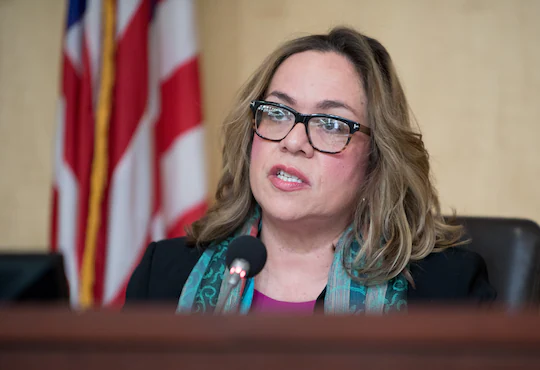
Jennifer Martin is president of the Montgomery County Education Association.
The best part of my job as president of the Montgomery County Education Association (MCEA) is stopping by schools to talk with colleagues about their experiences on the front lines in public education. While there, I also get to observe and chat with students. Every school visit reinforces the sense of pride I feel in the skill and dedication of my colleagues and reminds me what an honor it is to be entrusted with educating our county’s children.Sign up for a weekly roundup of thought-provoking ideas and debates
At a high school, I struggle to keep up with the lanky young man whose stride is easily four of mine as he guides me through the halls and offers his opinions about life. At a middle school, I weave through groups of kids as they verbally jostle to impress each other and scurry or saunter between classes. I am reminded then how a 13-year-old’s bravado covers a host of teenage insecurities. And at an elementary school, little ones peer up at me quizzically and offer shy waves as they line up outside their classrooms waiting to be escorted to the next activity. Their trust, openness and curiosity are beguiling.
But each visit also emphasizes the weighty burden that educators shoulder to make schools welcoming, safe and powerful places of learning for students. Educators are beleaguered and exhausted. Our county must do much more to support their work.
Teachers have been whipsawed over the past two years by those who praise them for their heroism and others who cast unfair blame for months of school building closures that forced us to become instant experts in running virtual classrooms. The return to the school buildings didn’t end the challenges and fears — in fact, the job is pushing many to the breaking point as they cope with staffing shortages while they strive to address the increased challenges our students and families experience.
To meet the needs of every child, we must do right by the educators who teach them. A recent Education Week article described the national problem of education staffing shortages caused by poor working conditions and overwhelming workloads. These same problems exist in our county, where this month hundreds of classroom positions still remain unfilled. Many staff members have expressed that this will be their last year in the system — and the profession.
Educators are tired of sacrificing countless unpaid hours beyond their workday to fulfill their duties. They are tired of neglecting their own families’ well-being because of work pressures. They are tired of struggling to pay down student debt and find housing they can afford. And they recognize that they possess skills that are highly prized and better paid in other sectors of the economy. As a result, many current teachers are eyeing the exits, and very few college students are now pursuing careers in education. We must increase our commitment to the people who seek to do this crucial work.
Throughout these two years of hardship, the 14,000 members of the Montgomery County Education Association have leveraged their collective power to move mountains to better serve students. They have fought for policies such as adequate student preparation and planning time, wage increases to incentivize and retain educators and substitute teachers, and increases in mental health staffing in schools.
Now is the moment to renew our county’s commitment to giving our students the schools they deserve. Emerging from two years of a health crisis and into a time of managing covid-19, students, families and educators recognize the need to invest in our schools and the people who do the work of educating students. The MCEA calls on our elected county leaders to commit to that investment.
One has already answered that call. Montgomery County Executive Marc Elrich (D) released a budget that seizes the opportunity to build back better. Supplying nearly 99 percent of what the Board of Education requested, Elrich’s budget is designed to give teachers and students the support they need.
The Montgomery County Council now has a duty to approve this budget so that educators have the time, resources and working conditions needed to nurture and develop the full potential of our students. Our children’s success and our county’s future prosperity depend on it.
Fading candles, a ‘sad’ horse: Students process pandemic with quilt
The quilt block depicted a dove flying through the sky, a coronavirus vaccine in its talons.
The dove, created using dyed merino wool, was dropping the vaccine over the world, Max Tolka, 10, explained to his classmates at Bannockburn Elementary School on Thursday. The artwork represented his hope that the pandemic would nearly be over.
“It took a while, but eventually it’s going to end,” Max said. “You’re almost there.”
The block is among 133 decorated by fourth- and fifth-graders at Bannockburn Elementary School in Bethesda as part of a months-long project to help the students document their feelings about the pandemic. Together, the blocks will form a 45-foot-long, three-foot-tall quilt.
“We gave kids time to actually reflect on the experience,” said Emily Thaler, Bannockburn’s art teacher.“During school, we’re mostly focusing on academics, whereas this time, they’re really able to express themselves in an artistic way and show how they really felt.”
A lot of the students’ artwork shared how alone they felt during the past two yearsand how much they missed their friends and the normal school experience. Some depicted how they felt like the pandemic was an experience that would never end. And then there were students like Max, who tried to capture the hope the vaccine would have on their futures.
Nathan Satlof, a fifth-grader, divided his block into six smaller panels that chronicled his experience at the beginning of the pandemic until February when the class started the project. The first panel showed a candle burning, the flame gradually dimming through each frame. He told his classmates he felt like he was the candle. He hadn’t contracted the coronavirus for a while, he said, but in January, he tested positive. The fading flame represented how eventually, he just “burnt out,” he said.
Emily Winningham, 9, told her peers she chose to illustrate a horse in a stable in herblock, since she loves the animal. But the horse was “sad, because he didn’t have any friends,” she said.
“If you’re in fourth or fifth grade, that’s a huge percentage of your short life that has been taken up by this experience,” said Katherine Dilworth, a visiting visual artist from Baltimore-based nonprofit Arts for Learning Maryland. “It was interesting to watch them talk about in their images, talk about how hard it’s been, but also, there were little inklings that maybe this is going to be the end.”
Dilworth collaborated with Bannockburn’s teachers on the topic, which would help the students also learn about metaphors and how to depict them through art.
The students wrote poetry in their homeroom teacher’s class that captured how they felt throughout the pandemic. They then brought the poems to Dilworth, and looked at New Yorker cartoons and other sources of inspiration to figure out what images they wanted to use. Once they were ready, they created a sketch.
Dilworth then taught the students needle felting, an art form that uses dyed fleece from an animal and special needles to create different images. The needles have a point and tiny barbs at the end of the shaft. When it’s stabbed into a background material — which in this case, was cloth — the barbs catch on the fibers and smooth it out. Unlike sewing, no thread is involved.
“It’s almost like you’re able to sculpt with your needle,” Dilworth said.
Felting is an obscure art form, so many of the students didn’t know how to do it, Dilworth said. But she said that made it easier in the classroom because everyone was able to start from the same place. Students who weren’t typically successful at other art forms took to this, she said.
Mason Qiu, 10, pointed to his quilt block, which showed a coronavirus cell taking over the Earth “because coronavirus felt like it was overpowering — there was nothing we could do,” he said. Smaller coronavirus cells were rotating around the planet in space. Mason said he probably would have made those smaller, but he had “needle problems,” he said, though he liked experimenting with how the wool functioned.
“The wool sometimes decides, ‘Hey, I’m not going to do what you want. I’m going to suddenly fluke this way,’ ” the fifth-grader said. “It’s pretty fun.”
The students used dyed merino wool to construct their quilt blocks, and each took roughly four days to make. Some of the students have been taking panels home to sew them together with other family members. Others have gone to Thaler’s classroom during their lunch periods to help, like they were doing on Thursday.
“Do you guys feel different about the pandemic than when we were making it?” Dilworth asked the class. “Because I feel like we made it in February, and a lot has changed.”
A lot of the children nodded their heads. When they started constructing the quilt, the omicron variant had been sweeping across the D.C. region. Many schools shifted to virtual instruction to curb the spread of the virus. But now that caseloads were down, they were back working together, only a few of them were wearing masks.
“We can, like, get closer and collaborate more than we used to,” one student said.
“Physically, the masks are being taken off,” another student added. “It’s a lot easier to breathe. But mentally, we’re still recovering.”
The quilt, once completed, will be displayed in the elementary school.